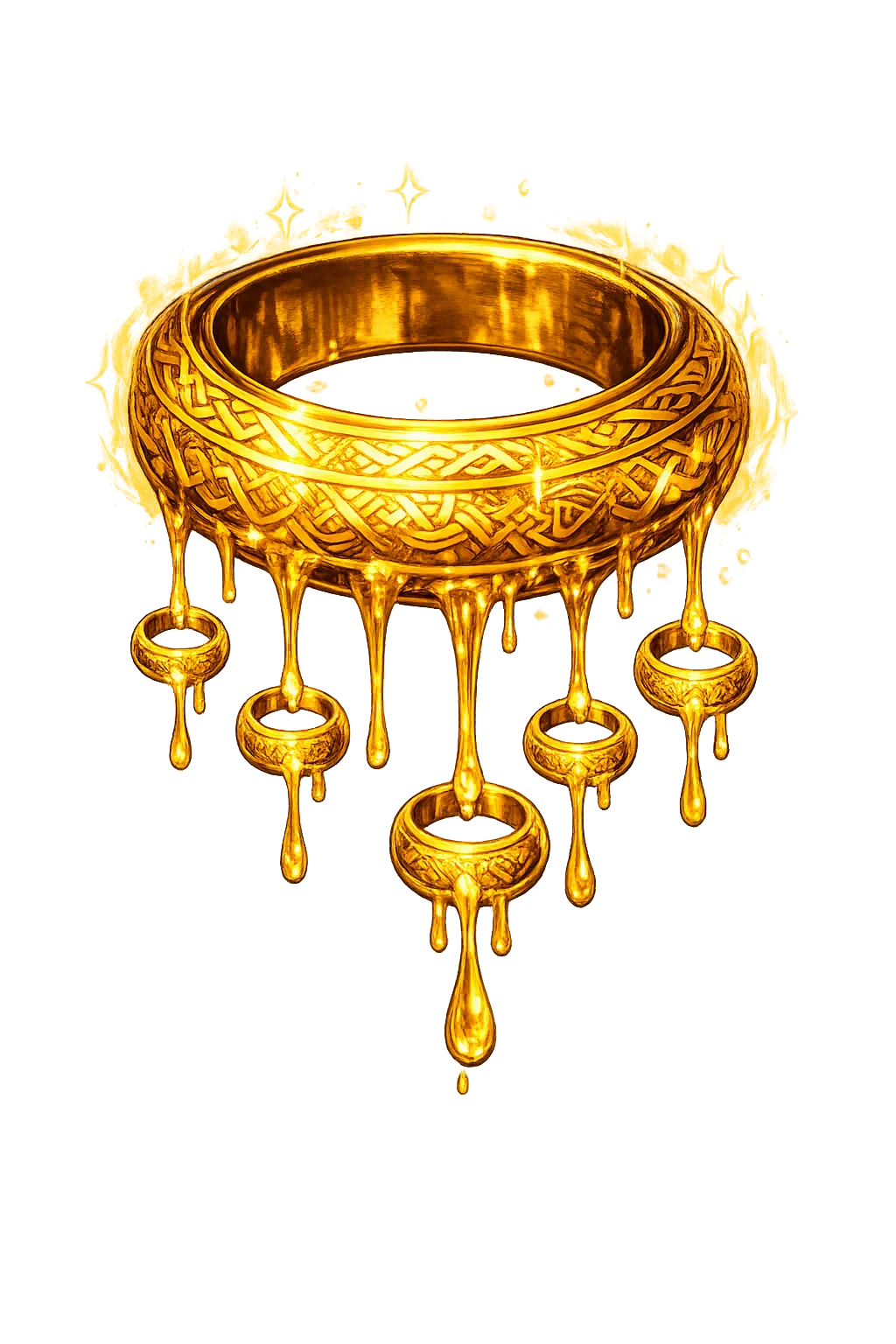
Stories of Draupnir
Draupnir's dossier divides cleanly in two: Skáldskaparmál tells its making, in the wager that also produced Gullinbursti and Mjǫllnir, and the Baldr cycle tells its journey — into the fire with the dead god and back out of Hel with the living one's token. Between those poles the Poetic Edda catches it twice: offered and refused in Skírnismál, and catalogued as a dwarf's own name in Völuspá.
It begins with a crime of Loki's: he cut off all the hair of Sif, Þórr's wife, for mischief. Þórr caught him and would have broken every bone in him, but Loki swore to have the dwarfs make amends — and the amends escalated into a bet: he wagered his own head with the dwarf Brokkr that Brokkr's brother Sindri could not make three treasures as good as the golden hair, the ship Skíðblaðnir, and the spear Gungnir that the sons of Ivaldi had already made for the gods.
Snorri frames the whole episode as an explanation of how the gods got their treasures — the myth exists in the Edda to account for the properties of the great objects, and Draupnir's property is the strangest of them: it does not merely exist; it multiplies.
Sindri laid a pig's skin in the forge and told Brokkr to blow, and never to stop until he himself drew the work out. When the smith had gone from the forge, a fly settled on Brokkr's hand and stung him — but he blew on. Out came the boar with bristles of gold, Gullinbursti. Next Sindri laid gold in the forge and gave the same command; the fly settled on Brokkr's neck and stung twice as hard — but he blew on. Out came the ring Draupnir. Last came iron, and the fly settled between Brokkr's eyes and stung the eyelid until blood ran down and blinded him; he swept the fly away with his hand, and for that one moment the bellows failed — and so the hammer Mjǫllnir came out with its handle too short. The fly was Loki, spending himself against the bellows.
The brothers carried the three treasures to Ásgarðr to be judged against Loki's three. Óðinn received the spear Gungnir and the ring Draupnir, and Snorri gives the ring's nature in a single sentence the whole tradition repeats: every ninth night, eight rings of equal weight drip from it. Freyr took the ship and the boar; Þórr took the hammer. The Æsir judged Mjǫllnir the best of all, because it was the surest defence against the rime-giants — but Loki kept his head on a point of law: Brokkr might have the head, but not one hair of the neck. So the dwarf sewed Loki's lips shut instead, and the wager closed with the gods six treasures richer.
The Poetic Edda catches the ring in motion, being offered as a bride-price. When Freyr's servant Skírnir rides to Jötunheimr to woo the giant's daughter Gerðr for his lovesick master, he carries gifts, and the second of them is the ring: 'the ring that was burned with Óðinn's young son; eight of equal weight drip from it every ninth night.' The poem does not name it — it does not need to; no other ring in the corpus matches the description, and the tradition from the prose commentators onward has read it as Draupnir.
Gerðr refuses it: she wants no gold, she says, for she lacks none in her father Gymir's halls, and will not share wealth with Freyr's messenger. The episode is a quiet marvel of the corpus: the self-breeding ring of the Allfather, the one gift that cannot be outbid, laid before a giantess who counts it worthless. Only Skírnir's curse, carved in runes and threats, moves her where Óðinn's treasure could not — the poem's own verdict that gold, even multiplying gold, buys nothing that matters.
When Baldr lay dead of the mistletoe and the Æsir built his pyre on Hringhorni, the greatest of ships, the funeral gathered the whole wealth of the gods' grief. Nanna died of sorrow at the sight of him and was laid beside her husband; Þórr hallowed the pyre with Mjǫllnir; and Óðinn did the thing this temple exists to record: he laid the ring Draupnir on the fire with his son. No word of his is preserved with the gift. The dripper, the fountain of the Allfather's gold, went into the smoke as a father's last giving to the child he could not keep.
The corpus keeps the gesture where it belongs — among the funeral's few named acts, beside the hallowing hammer and the burst heart. A ring that makes eight more of itself every ninth night is the least losable treasure in the world, and Óðinn loses it deliberately, which is exactly what makes it a gift.
The story does not let the ring rest in the fire. Hermóðr the Bold rode nine nights down the dark road, leapt Helgrindr on Sleipnir, and found Baldr seated in the high seat of Hel's hall. When Hel set her famous condition — that all things in the world must weep Baldr out — Baldr sent tokens home with the rider, and first among them was Draupnir, returned to Óðinn as a keepsake. The ransom failed at Þökk's one refusal, and Baldr stayed with the dead; but the ring came back across the boundary that nothing else crosses, carrying the dead god's love to the living father. It is the only object in the corpus to make that journey in both directions.
Völuspá preserves the name's older, stranger root: in the dvergatal, the great catalogue of dwarfs, a dwarf named Draupnir stands in the list beside Dólgþrasir and his kin. The treasure-name and the dwarf-name are the same word — 'the dripper' — and scholars have long noted how naturally the corpus names its wonders after its smiths. The ring that drips gold wears a name the dwarf-lists already owned, as if the Edda kept, fossilized in its oldest poem, the memory that such things come from under the earth.
The Dripper of the Ninth Night
Draupnir is the golden arm-ring of Óðinn, forged by the dwarf Sindri while his brother Brokkr worked the bellows — the one treasure in the northern corpus that increases by its own nature. Every ninth night eight new rings of equal weight drip from it, so that the Allfather's wealth is not a hoard but a fountain. Óðinn laid it on Baldr's pyre as his last gift to his son, and Baldr sent it back from Hel with Hermóðr: the ring that crosses the boundary of death in both directions.
The dwarf-smith's hearth where gold went in and the ring came out — Brokkr at the bellows, forbidden to stop, and a fly on his hand.
Every ninth night, eight rings of equal weight drip from the one — wealth that multiplies in the dark, without labour and without theft.
The ring Óðinn laid on Hringhorni's fire beside his dead son — the father's parting gift, sent into the smoke with the fairest of the Æsir.
The token Baldr sent back from Hel's hall with the nine-night rider — proof, in gold, that the errand reached the dead god's hand.
From the original script to the living URL
ᛏᚱᛅᚢᛒᚾᛁᚱ
The name in its original Norse form. Draupnir (ᛏᚱᛅᚢᛒᚾᛁᚱ) is attested in the source tradition — “The dripper”. Its original diacritics and script distinctions carry the full phonetic and orthographic weight of the source tradition.
draupnir
The plain draupnir form is identical to the Unicode restoration. Because this name is already written in Latin letters, no diacritics, stress, or script information were lost — only capitalization differs.
Draupnir
The Unicode restoration does not need to recover lost marks for Draupnir. Its value is canonical spelling and consistent cataloguing, not the reconstruction of erased orthography. The domain is readable as-is to both DNS and humanity.
Draupnir.com
This restoration is written entirely in ASCII letters — no Punycode encoding stands between Draupnir and the DNS. The domain reads identically to machines and to human eyes.
Owned, ideal, and ASCII forms of Draupnir
Draupnir
Restores ᛏᚱᛅᚢᛒᚾᛁᚱ. The full Unicode restoration. draupnir.com is not in the PuniCodex collection — it is watched for release; if it drops, this temple upgrades to an owned flagship.
How Draupnir was spoken
How Draupnir travels from ancient script to the modern URL
The lore you have read is the living myth. Extended Lore opens the scholarly vault beneath it: the cult and its material remains, a history of the image, the name after antiquity, a meditation on what the name still means, and the full scholarly apparatus — etymology, orthography, sources.
Enter Extended Lore