
Why Draupnir belongs in your address bar
Every address bar is a choice. When you type Draupnir, you are not typing a novelty; you are restoring a name that the early DNS, built for English typewriters, could not carry. The plain ASCII form draupnir is a leftover of that constraint, not the name itself. This post is the long version of the restoration: where the name comes from, how the Younger Futhark tradition wrote it, how it is pronounced, what the myths and the material record preserve, and why its Unicode form now lives as a working domain. The claim throughout is simple — the original spelling is not decoration. It is the name.
At a Glance
- Restored name: Draupnir
- ASCII form: draupnir
- Meaning: "The dripper"
- Domain of influence: Odin's Ring, Wealth
- Pantheon: Norse
- Classification: Tier 2
- Original script: ᛏᚱᛅᚢᛒᚾᛁᚱ (Younger Futhark)
Overview
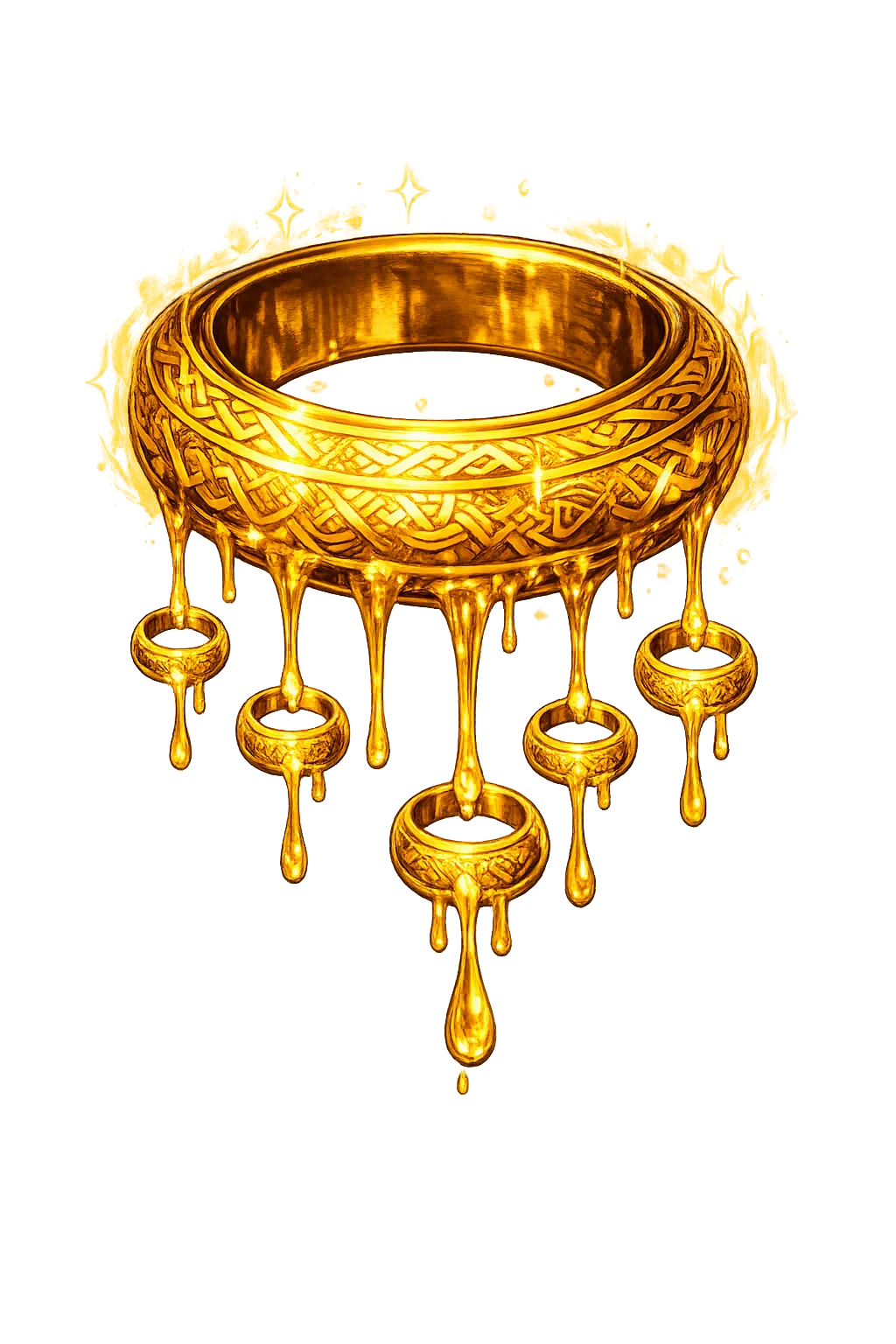
Draupnir (draupnir) — Odin's Ring, Wealth · The Dripper — is the golden arm-ring of Óðinn and the one treasure in the northern corpus whose nature is increase: every ninth night, eight rings of equal weight drip from it. Forged by the dwarf Sindri while his brother Brokkr worked the bellows, it came out of the same wager that produced the boar Gullinbursti and Þórr's hammer Mjǫllnir, and was judged beside them at Ásgarðr.
Its career in the corpus is short and perfectly shaped. Skáldskaparmál tells its making; Skírnismál catches it in motion, offered as bride-price to the giantess Gerðr and refused; and Gylfaginning 49 gives it the two gestures that define it — Óðinn laying it on Baldr's pyre, and Baldr sending it back from Hel with Hermóðr as a keepsake for his father. Völuspá's catalogue of dwarfs preserves the name's older root: a dwarf Draupnir stands in the dvergatal, the treasure wearing a name the smith-lists already owned.
PuniCodex restores the name as Draupnir — identical to the ASCII input, because the normalized Old Norse form is itself plain ASCII: no diacritic, no distinctive letter, nothing for the ASCII alphabet to lose. The name is therefore Tier 2 by the project's mechanical rule — a property of its orthography, not of the treasure's standing. The plain-ASCII domain draupnir.com is registered to a third party outside the collection and is watched for release; the project claims no domain for this temple.
The Name
The name is attested in Old Norse as Draupnir (masculine; genitive Draupnis). It is a transparent deverbal formation: the verb drjúpa 'to drip' plus the agent and instrument suffix -nir — the same ending that makes Mjǫllnir 'the grinder' from mala/mylja — yielding 'the dripper'. The name states the ring's single miraculous property as plainly as a label: it is called after what it does, which is to drip gold.
The Poetic Edda knows the same word as a dwarf-name: in Völuspá's dvergatal, Draupnir stands in the catalogue among the earth-smiths. The double life of the word — dwarf in the oldest poem, treasure in the prose tradition — is typical of the corpus's wonder-names, and scholars have long read the ring's name as a dwarf's name transferred to a dwarf's work.
The ASCII form is not a compromise here: normalized Old Norse Draupnir is already written in plain ASCII letters. There is no diacritic, no thorn or eth, no vowel-length mark for the early domain-name system to have stripped; the diphthong au is written with two ordinary letters. The name is classified Tier 2 by the project's mechanical rule — the restoration preserves nothing the ASCII form loses — which is a statement about orthography, never about the treasure. The final -r belongs to the nominative ending fused into the -nir suffix.
The letter-by-letter transformation runs:
- d → D — Same, capitalized
- r → r — Same
- a → a — Same
- u → u — Same
- p → p — Same
- n → n — Same
- i → i — Same
- r → r — Same
The project holds no domain for this name: draupnir.com is registered to a third party outside the PuniCodex collection and is watched for release. The temple lives at its canonical lexicon address.
The Original Script
The name is preserved in medieval Icelandic manuscripts in the Latin alphabet as Draupnir — Old Norse (North Germanic), attested 13th c. CE in the Codex Regius of the Prose Edda (Skáldskaparmál, Gylfaginning) and the Codex Regius of the Poetic Edda (Skírnismál, Völuspá), recording material centuries older. The manuscript form is itself plain ASCII: Old Norse writes no diacritic in this name, and the restoration changes nothing but the capital. In the Younger Futhark the name would have been carved ᛏᚱᛅᚢᛒᚾᛁᛦ (t-r-au-b-n-i-R); the runic row underspecifies what the manuscripts fix, with ᛏ writing both t and d, ᛒ writing both b and p, and ᛦ the final nominative -r.
The scholarly rendering proceeds step by step:
- The word is a deverbal masculine: drjúpa 'to drip' + the agent suffix -nir, hence 'the dripper'.
- The diphthong au is written with two plain letters; Old Norse orthography requires no accent anywhere in the word.
- The name also occurs as a dwarf-name in Völuspá's dvergatal; the treasure and the smith share one word.
- The Unicode restoration Draupnir is therefore identical to the ASCII form — a Tier 2 name by the mechanical rule, whose dignity comes from the treasure, not from rescued diacritics.
PuniCodex holds no domain for this name: the plain-ASCII draupnir.com is registered to a third party outside the collection and is watched for release.
Pronunciation
The reconstructed pronunciation of the name is /ˈdrɑup.nir/ — Old Norse Reconstruction.
Phoneme by phoneme:
- Dr- — Fully voiced dental stop [d] releasing directly into a trilled [r]; the cluster is voiced throughout, with no aspiration after the d
- -au- — The falling diphthong [ɑu], open back vowel gliding to [u]; the sound Old Norse wrote au, cousin to the 'ow' of English 'cow'
- -pnir — Voiceless bilabial [p], alveolar nasal [n], short close [i], and the final trilled [r] of the agent suffix -nir
For the modern speaker, the closest approximation is: 'DROYP-nir' — two syllables, stress on the first; 'droyp' rhyming with 'cowp', the r's lightly trilled.
Kindred and historical forms of the name:
- Old Norse — Draupnir, Óðinn's ring; from drjúpa 'to drip' + -nir; also a dwarf-name in Völuspá
- Younger Futhark — ᛏᚱᛅᚢᛒᚾᛁᛦ, the Viking-Age runic rendering (t-r-au-b-n-i-R)
- Modern Icelandic — Draupnir, the unbroken living form
Draupnir is Tier 2 because the Old Norse form is already plain ASCII: nothing distinctive is lost in transit. The diphthong au and the suffix -nir are written with the plainest letters the language owns.
Mythology
Draupnir's mythology divides into its making and its journey, with the Poetic Edda catching it twice between.
The Wager of Loki's Head (Skáldskaparmál)
It begins with Loki's crime against Sif, whose hair he cuts off for mischief, and his oath to replace it with gold. From the sons of Ivaldi he gets the golden hair, the ship Skíðblaðnir, and the spear Gungnir — and then, boasting, he wagers his own head with the dwarf Brokkr that Brokkr's brother Sindri cannot make three treasures as good. The bet frames the whole episode: everything that follows is forge-work under a death-wager.
Three Treasures from the Bellows (Skáldskaparmál)
Sindri lays pigskin, then gold, then iron in the forge, and Brokkr blows without ceasing while a fly — Loki — stings his hand, his neck, and at last his eyelid until blood blinds him and the bellows falter for one stroke. Out come the golden boar Gullinbursti, the ring Draupnir, and the short-handled hammer Mjǫllnir. Judged at Ásgarðr against Loki's three, the treasures are dealt out: Gungnir and Draupnir to Óðinn — and Snorri fixes the ring's nature in the sentence the whole tradition repeats: every ninth night, eight rings of equal weight drip from it. Mjǫllnir is judged the best for the defence of the gods; Loki keeps his head on the point of law that Brokkr may not take the neck, and has his lips sewn shut instead.
The Ring Refused (Skírnismál 21–22)
When Freyr's servant Skírnir woos the giantess Gerðr for his master, his second gift is 'the ring that was burned with Óðinn's young son; eight of equal weight drip from it every ninth night' — unnamed, unmistakably Draupnir. Gerðr refuses: she lacks no gold in Gymir's halls. The self-breeding treasure of the Allfather, the one offer that cannot be outbid, is weighed by a giantess and found worthless — the poem's verdict that gold, even multiplying gold, buys nothing that matters. Only Skírnir's rune-carved curse moves her.
The Pyre and the Return (Gylfaginning 49)
At Baldr's funeral on Hringhorni, Óðinn lays Draupnir on the pyre with his dead son — the fountain of his gold given away in the one gesture that makes a treasure a gift. Then Hermóðr rides the nine nights to Hel, wins the famous condition, and brings the tokens back: first among them Draupnir, sent by Baldr to Óðinn as a keepsake. The ransom fails at Þökk's refusal and Baldr remains with the dead; but the ring completes the journey no other object makes, out of the fire, into Hel, and home again.
The Dwarf's Name (Völuspá)
In Völuspá's dvergatal, the great catalogue of the earth-smiths, a dwarf named Draupnir stands in the list. The treasure-name and the smith-name are one word — 'the dripper' — and the corpus seems to keep, fossilized in its oldest poem, the truth that such wonders come from under the earth.
Symbols & Iconography
Draupnir is itself the symbol — a treasure whose whole meaning is its working — but the tradition has fixed a small constellation of attributes around it:
- The eight rings — The dripping yield of every ninth night: increase as a calendar, wealth arriving on a schedule rather than by conquest
- Sindri's forge and Brokkr's bellows — The making under pressure: the unbroken blast that produced the ring while Loki, in a fly's shape, spent his malice on the bellows-hand
- The fly — The sting that cost Mjǫllnir its handle but never touched the ring: the proof that not all sabotage succeeds
- The pyre — Óðinn's last gift laid in the fire with Baldr: the one inexhaustible treasure deliberately given away
- The return token — The ring in Hermóðr's hand on the road back from Hel: the only object in the corpus to cross the boundary of death in both directions
Archaeology & Evidence
Draupnir is a literary object: no inscription names it and no find can be identified with it. But the ring it describes belongs to one of the best-attested object-classes in the northern record. Gold and silver arm-rings are the standard currency of Viking-Age hoards — the great Gotlandic deposits, crowned by the Spillings hoard of 1999, the largest Viking silver hoard yet found, are full of ring-money cut and weighed as bullion, the archaeological reality behind the poetry's ring-giver.
The ring's social weight is documented from both sides of the conversion. Eyrbyggja saga (ch. 4) describes a ring of twenty ounces lying on the altar of the hof at Þórsnes, on which all oaths were sworn; and the Forsa ring of Hälsingland — an iron ring bearing a runic law inscription, the oldest legal text in Scandinavia — survives as that practice's one famous material witness. Earlier still, the ring-swords of the Vendel-period elite, with a ring mounted on the pommel as the sign of the oath between lord and man — attested at Valsgärde and famously at Sutton Hoo — carry the ring's meaning back into the Migration Age. The manuscript witnesses are the usual two codices: Skáldskaparmál and Gylfaginning in the Codex Regius of the Prose Edda (GKS 2367 4to), Skírnismál and Völuspá in the Codex Regius of the Poetic Edda (GKS 2365 4to).
Realm & Domain
Draupnir is catalogued under Odin's Ring, Wealth — and the sources earn both halves of the phrase.
Odin's Ring
The ring is Óðinn's own, one of his two great treasures from the forging wager, beside the spear Gungnir. It moves only at his giving: onto Baldr's pyre, and — in Skírnismál — into the wooing-gifts carried for Freyr's suit.
Wealth
Its single property is increase: eight rings of equal weight every ninth night. Snorri states it in one sentence and the whole tradition repeats it — the ring is wealth's self-portrait, gold that breeds gold without labour or taking.
The Gift
Every appearance of the ring in the corpus is a gift: judged and given at Ásgarðr, offered as bride-price, laid on the pyre as a father's last giving, returned from Hel as a keepsake. It is never bought, sold, won, or stolen.
The Number Nine
The multiplication runs on the corpus's sacred interval — nine nights, the same rhythm as Óðinn's hanging on the world-tree and Hermóðr's ride to Hel.
Across Cultures
Draupnir's true company is objects, not gods, and the corpus itself supplies the sharpest contrast: Andvari's ring Andvaranaut, extorted at the waterfall and answered with a curse, kills every hand that holds it, while Draupnir — made freely, on a wager's terms, for the gods — breeds gold for its keeper. The taken ring destroys; the given ring multiplies. The wider Germanic frame is the ring-giving culture the heroic poetry everywhere assumes: the lord of Beowulf is the beaga brytta, the 'ring-giver', and arm-rings are the very currency of the loyalty between lord and man — a self-breeding ring is that economy's dream made metal.
Folklorists file Draupnir among the self-multiplying magic treasures of the international motif-index, beside inexhaustible purses, tables that set themselves, and horns of plenty; its nearest mythic kin are things, not deities. Within the corpus, its kin are its fellow-wonders of the wager — Gullinbursti and Mjǫllnir — and its makers Brokkr and Sindri, the dwarf-brothers whose names the corpus binds to the finest smith-work in the world.
Cultural Legacy
Draupnir's afterlife is the afterlife of an idea: the treasure that makes treasure. The nineteenth-century Norse revival fixed the forging-wager as a set-piece — the Kearys' The Heroes of Asgard (1857) carried Brokkr and Sindri at the bellows to generations of English-speaking children, and every handbook since has repeated the ninth-night dripping.
In contemporary popular culture the name has become a byword for self-replicating wonders. God of War Ragnarök (2022) gives Brok and Sindri a Draupnir of its own — a spear forged through the ring's multiplying magic, reproducing itself in the wielder's hand — the most widely seen adaptation of the dwarf-brothers and their craft in any medium. Fantasy games and fiction reach for the name whenever gear must breed gear. In Iceland the word never needed reviving: Draupnir remains a living name for ships, firms, and horses, the dripper doing ordinary work in the language that wrote the Eddas. And wherever a modern storyteller needs wealth that grows honestly — by time, by patience, by nature rather than by taking — the shape they reach for is Óðinn's ring, whether they name it or not.
The Scholarly Record
The account of Draupnir given in this edition rests on the witnesses and reference works listed below. Skáldskaparmál supplies the making; Gylfaginning 49 the pyre and the return; Skírnismál and Völuspá the poetic attestations; the lexica secure the name's etymology.
- Snorri Sturluson, Edda, Skáldskaparmál (the wager of Loki's head; the forging of Gullinbursti, Draupnir, and Mjǫllnir; the judgment of the treasures), ed. and trans. Anthony Faulkes (London: Everyman, 1987).
- Snorri Sturluson, Edda, Gylfaginning 49 (Baldr's funeral; Óðinn lays Draupnir on the pyre; Hermóðr's ride and the keepsake), trans. Faulkes (1987).
- The Poetic Edda, trans. Carolyne Larrington, 2nd ed. (Oxford: Oxford University Press, 2014): Skírnismál 21–22 (the ring offered to Gerðr); Völuspá, dvergatal (Draupnir among the dwarf-names).
- Cleasby, Richard, and Guðbrandur Vigfússon, An Icelandic-English Dictionary, 2nd ed. (Oxford: Clarendon Press, 1957), s.v. draupnir, drjúpa.
- Zoëga, Geir T., A Concise Dictionary of Old Icelandic (Oxford: Clarendon Press, 1910), s.v. draupnir, drjúpa.
- Simek, Rudolf, Dictionary of Northern Mythology, trans. Angela Hall (Cambridge: D. S. Brewer, 1993), s.v. Draupnir, Brokk, Sindri, ring.
- Orchard, Andy, Dictionary of Norse Myth and Legend (London: Cassell, 1997), s.v. Draupnir.
- Lindow, John, Norse Mythology: A Guide to the Gods, Heroes, Rituals, and Beliefs (Oxford: Oxford University Press, 2001), s.v. Draupnir, Andvaranaut, rings.
- Gordon, E. V., An Introduction to Old Norse, 2nd ed. rev. A. R. Taylor (Oxford: Clarendon Press, 1957).
- Eyrbyggja saga, ch. 4 (the altar ring at Þórsnes); the Forsa ring of Hälsingland.
A Meditation
The North was not sentimental about gold. Its greatest hoard is cursed at birth, its dragons die on beds of metal, and its poets ken gold as the fire of the flood where the Niflungar sank it. Against all of that stands one exception, and it is the highest treasure of the highest god: a ring whose only property is that it increases.
Draupnir does not shine, speak, strike, or protect. It drips — on a schedule, in the dark, eight for one every ninth night, wealth arriving the way wealth actually arrives for those who keep it lawfully: slowly, cyclically, by nature rather than by conquest. The myth then does the two most instructive things a myth can do with such an object. It gives it away: Óðinn lays the one inexhaustible treasure in the world on his son's pyre, because no fountain of gold outweighs one act of love. And it sends it back: the dead return the gift to the living, because some bonds outlast the boundary. Gold that is kept breeds gold. Gold that is given breeds everything else.
The Unicode Restoration
Draupnir is classified as Tier 2: the restoration needs no distinctive letters or diacritics its ASCII form would lose. The ASCII fallback draupnir still resolves everywhere, but it is the restored form that carries the name's full information. That is the whole thesis of this temple: the marks are the message.
Why This Restoration Matters
Restoring Draupnir is part of a larger effort to make the web multilingual by default. The PuniCodex project does not ask users to learn a new alphabet; it asks the infrastructure to respect the alphabets that already exist. Every section of this post — the script, the sound, the myths, the evidence — converges on the same point: the marks in Draupnir are information, and information deserves an address of its own. A single Unicode domain is a small proof, but it is a proof that scales: every name restored makes the next one easier, and every visit to the temple is a vote for the restored form.
Explore Further
This post is one doorway into the temple. The home page carries the full character breakdown and the ambient canvas; the lore page tells the myths in long form; the Scholarly Edition preserves the sources, pronunciation data, and revision history; and the patron wall supports the restoration directly. For the wider map, browse the Lexicon, explore the Pantheon, or return to the PuniCodex blog.
Related Names
Sources
The full scholarly apparatus — every citation, revision, and review — lives in the Scholarly Edition. Key references for this post:
- Snorri Sturluson, Edda, Skáldskaparmál (the forging of Draupnir and the judgment of the treasures), ed. and trans. Anthony Faulkes (London: Everyman, 1987).
- Skírnismál 21–22 (Poetic Edda), trans. Carolyne Larrington, The Poetic Edda, 2nd ed. (Oxford: Oxford University Press, 2014).
- Snorri Sturluson, Edda, Gylfaginning 49 (Baldr's funeral; Hermóðr's ride), trans. Faulkes (1987).
- Völuspá, dvergatal (Poetic Edda), trans. Larrington (2014).
- Lexicon authorities for this entry: Poetic Edda, Cleasby-Vigfusson.