PuniCodex

Extended Lore

ᛏᚱᛅᚢᛒᚾᛁᚱ Draupnir

Etymology · Phonology · Orthography · Cultural Legacy · Primary Sources

Tier 2 Draupnir
Draupnir — Odin's Ring, Wealth
01

Quick Facts

Essential information about Draupnir, Odin's Ring, Wealth

Original Scriptᛏᚱᛅᚢᛒᚾᛁᚱ
Unicode RestorationDraupnir
Reconstructed Pronunciation/ˈdrɑup.nir/
PantheonNorse
DomainOdin's Ring, Wealth
MeaningThe dripper
ClassificationTier 2
Primary DomainDraupnir
Sacred SymbolsThe gold ring itself, The ninth night, Brokkr's bellows, The fly (Loki), The pyre-token
02

Etymology & Word Family

From original script to Unicode restoration

Original Script ᛏᚱᛅᚢᛒᚾᛁᚱ Draupnir — "The dripper"
Unicode Restoration Draupnir Restored stress, length, and script
Modern ASCII draupnir Plain-ASCII fallback

Draupnir is Tier 2 by the mechanical rule: the normalized Old Norse form is already plain ASCII — no diacritic, no distinctive letter — so the ASCII alphabet loses nothing in copying it. The richest treasure in Ásgarðr wears one of its plainest names; only the capital distinguishes the restored form from the input.

03

Unicode Character Breakdown

Character-by-character philological analysis

CharacterUnicodeNameBlockPhonetic Role
DU+0044Latin Capital Letter DBasic LatinSame, capitalized
rU+0072Latin Small Letter RBasic LatinSame
aU+0061Latin Small Letter ABasic LatinSame
uU+0075Latin Small Letter UBasic LatinSame
pU+0070Latin Small Letter PBasic LatinSame
nU+006ELatin Small Letter NBasic LatinSame
iU+0069Latin Small Letter IBasic LatinSame
rU+0072Latin Small Letter RBasic LatinSame

The Tier 2 classification reflects how much of the original phonology this restoration preserves — stress and vowel length for Greek names, distinctive letters and diacritics for every other tradition.

04

Cultural Significance

From ancient cult to modern Unicode

Ancient Domain

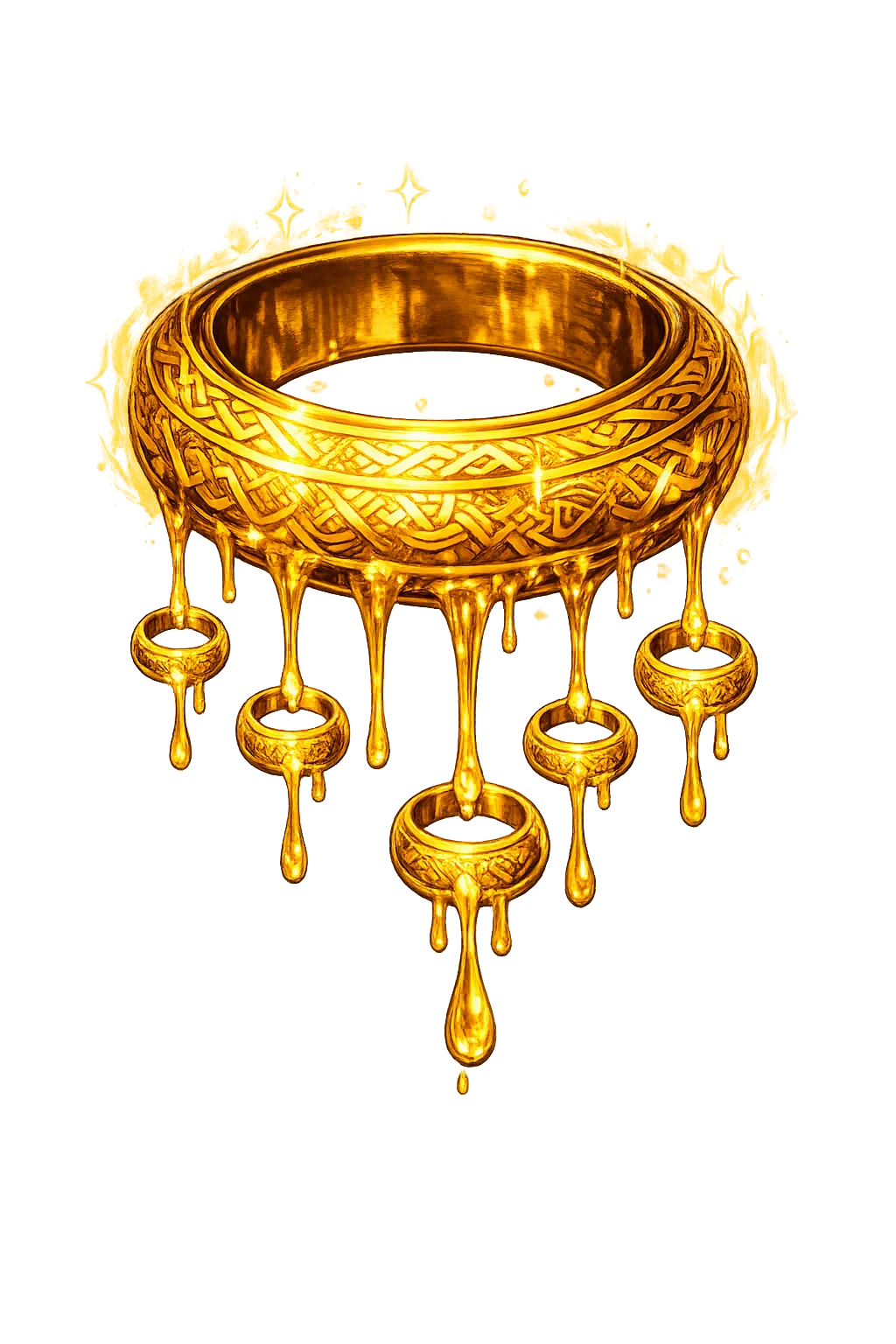
Draupnir is the golden arm-ring of Óðinn, forged by the dwarf Sindri while his brother Brokkr worked the bellows — the one treasure in the northern corpus that increases by its own nature. Every ninth night eight new rings of equal weight drip from it, so that the Allfather's wealth is not a hoard but a fountain. Óðinn laid it on Baldr's pyre as his last gift to his son, and Baldr sent it back from Hel with Hermóðr: the ring that crosses the boundary of death in both directions.

Draupnir in Later Traditions

Draupnir needs no borrowed god to explain it — it is an object, and its company is other objects. The corpus itself sets the sharpest contrast: [[andvari|Andvari]]'s ring Andvaranaut, extorted at the waterfall and cursed, kills every hand that holds it, while Draupnir, freely made for the gods on a wager's terms, breeds gold for its keeper — the taken ring destroys, the given ring multiplies. The wider Germanic context is the ring-giving culture the poetry everywhere assumes: Beowulf's lord is the *beaga brytta*, the 'ring-giver', and arm-rings were the very currency of loyalty between lord and man; a self-breeding ring is that economy's dream made metal. Folklorists file Draupnir among the self-multiplying magic treasures of the international motif-index, beside inexhaustible purses and cornucopias; its nearest mythic cousins are things, not gods. Within the corpus its makers [[brokkr|Brokkr]] and [[sindri|Sindri]] and its fellow-wonders — Gullinbursti, and [[thor|Þórr]]'s hammer [[mjolnir|Mjǫllnir]] from the same forging — are its true kin.

Modern Legacy

Draupnir's afterlife is the afterlife of an idea: the treasure that makes treasure. Nineteenth-century retellings fixed the forging-wager as a set-piece of the Norse revival — the Kearys' The Heroes of Asgard (1857) carries Brokkr and Sindri at the bellows, and every handbook since repeats the ninth-night dripping. In modern popular culture the name has become a byword for self-replicating wonders: God of War Ragnarök (2022) gives Brok and Sindri a Draupnir of its own — a spear, forged from the ring's multiplying magic, that reproduces itself in the wielder's hand — the most widely seen adaptation of the dwarf-brothers and their craft in any medium. Fantasy games and fiction reach for the name whenever gear must breed gear. In Iceland the word never needed reviving: Draupnir remains a living name there for ships, firms, and horses, the dripper doing ordinary work in the language that wrote the Eddas. And every time a modern storyteller needs wealth that grows honestly — by time, by patience, by nature rather than by taking — the shape they reach for is Óðinn's ring, whether they name it or not.

Unicode Restoration as Cultural Act

Restoring Draupnir in a domain name is more than orthographic accuracy. It is a statement that the internet should recognize the full range of human writing — not only the ASCII keyboard.

05

Frequently Asked Questions

Common questions about Draupnir, Odin's Ring, Wealth, and Unicode restoration

01How do you pronounce Draupnir?

In reconstructed pronunciation, Draupnir is /ˈdrɑup.nir/ — approximately 'DROYP-nir' — two syllables, stress on the first; 'droyp' rhyming with 'cowp', the au a single gliding vowel, the r's trilled..

02What does Draupnir mean?

Draupnir means The dripper in the norse tradition.

03What are the symbols of Draupnir?

Draupnir is associated with The gold ring itself (Wealth that breeds wealth — the one treasure in the corpus whose nature is increase, not keeping), The ninth night (The interval of multiplication — eight rings of equal weight for every nine nights the ring is kept), Brokkr's bellows (The unbroken breath of the forge — the wager turned on a blast no fly could interrupt twice), The fly (Loki) (The sting that cost the hammer its handle but could not touch the ring — malice spent against patience), The pyre-token (The gift that goes down with the dead and returns with the messenger — love's keepsake across Hel's gate).

04Why restore Draupnir in Unicode?

Plain ASCII draupnir strips the stress, length, and script that make the name specific. Unicode restoration returns the name to its original written dignity.

05What is the most important myth about Draupnir?

It begins with a crime of Loki's: he cut off all the hair of Sif, Þórr's wife, for mischief. Þórr caught him and would have broken every bone in him, but Loki swore to get the black-elves to make Sif hair of gold that would grow like other hair. He went to the dwarfs called the sons of Ivaldi, and they made the golden hair, and Skíðblaðnir, the best of ships, for Freyr, and the spear Gungnir for Óðinn. Then Loki boasted, and his boasting made the bet: he wagered his own head with the dwarf Brokkr that Brokkr's brother Sindri could not make three treasures as good as these.Snorri frames the whole episode as an explanation of how the gods got their treasures — the myth exists in the Edda to account for the properties of the great objects, and Draupnir's property is the strangest of them: it does not merely exist; it multiplies.

06

Scholarly Sources

The philological foundations of this restoration

Every claim on this page is grounded in established scholarship. The orthographic restorations follow disciplinary convention. The etymological chain follows the best available reference works. This is not invention — it is resurrection through scholarship.

Lexicography & Philology

  • Poetic Edda
  • Cleasby-Vigfusson

Primary Texts

  • Snorri Sturluson, Prose Edda: Skáldskaparmál (the wager of Loki's head; the forging of Gullinbursti, Draupnir, and Mjǫllnir; the judgment of the treasures — 'every ninth night eight rings of equal weight drip from it')
  • Snorri Sturluson, Prose Edda: Gylfaginning 49 (Óðinn lays Draupnir on Baldr's pyre; Baldr sends it back from Hel with Hermóðr as a keepsake)
  • Poetic Edda: Skírnismál 21–22 (Skírnir offers Gerðr 'the ring that was burned with Óðinn's young son; eight of equal weight drip from it every ninth night' — read as Draupnir) and Völuspá, dvergatal (Draupnir among the dwarf-names)

Archaeology & Art History

  • Material evidence — iconography, inscriptions, and temple archaeology — for Draupnir and related cults.
  • Draupnir is a literary object: no inscription names it, and no find can be identified with it — but the ring it describes belonged to one of the best-attested object-classes in the northern record. Gold and silver arm-rings are the standard currency of Viking-Age hoards: the great Gotlandic deposits, crowned by the Spillings hoard of 1999 (the largest Viking silver hoard yet found), are full of ring-money cut and weighed as bullion, the archaeological reality behind the poetry's ring-giver. The ring's social weight is documented from both sides of the conversion: Eyrbyggja saga (ch. 4) describes a twenty-ounce ring lying on the altar of the hof at Þórsnes, on which all oaths were sworn, and the Forsa ring of Hälsingland — an iron oath-ring bearing a runic law inscription, the oldest legal text in Scandinavia — survives as the practice's one famous material witness. Earlier still, the ring-swords of the Vendel-period elite, with a ring mounted on the pommel as the sign of the oath between lord and man (attested at Valsgärde and famously at Sutton Hoo), show the ring as the badge of the gift-bond itself. The manuscript witnesses are the usual two codices: Skáldskaparmál and Gylfaginning in the Codex Regius of the Prose Edda (GKS 2367 4to, c. 1300–1350), Skírnismál and Völuspá in the Codex Regius of the Poetic Edda (GKS 2365 4to, c. 1270).

Religious Studies

  • Cleasby–Vigfusson, An Icelandic-English Dictionary, s.v. draupnir ('Odin's ring'), drjúpa ('to drip')
  • Zoëga, A Concise Dictionary of Old Icelandic, s.v. draupnir, drjúpa
  • Simek, Dictionary of Northern Mythology; Orchard, Dictionary of Norse Myth and Legend; Lindow, Norse Mythology: A Guide — s.v. Draupnir, Brokkr, Sindri, sons of Ivaldi
Return

The Surface Awaits

You have traced the name from its earliest attestation to its Unicode restoration. Now return to the myth. The story is where the name lives.

Back to Lore
Draupnir mascot