PuniCodex

Extended Lore

Draupnir — The Deeper Record

Etymology · Orthography · Cult · Iconography · Reception · Sources

ASCII-equivalent form Draupnir
Draupnir — Odin's Ring, Wealth
01

At a Glance

Draupnir — every fact links to its home

PantheonNorse
DomainOdin's Ring, Wealth
Primary Sources4 cited →
02

Etymology & Word Family

From original script to canonical restoration — the full etymology page →

Original Script ᛏᚱᛅᚢᛒᚾᛁᛦ Draupnir — "The dripper"
Canonical Restoration Draupnir Canonical scholarly spelling — ASCII-identical
Modern ASCII draupnir Plain-ASCII fallback

The name Draupnir reaches the modern world through scholarly transliteration of the norse tradition. Because the conventional spelling uses only Latin letters, its canonical and ASCII forms coincide — the tradition it carries is in the name itself, not in diacritics.

03

Character breakdown

Character-by-character philological analysis

CharacterUnicodeNameBlockPhonetic Role
DU+0044Latin Capital Letter DBasic LatinSame, capitalized
rU+0072Latin Small Letter RBasic LatinSame
aU+0061Latin Small Letter ABasic LatinSame
uU+0075Latin Small Letter UBasic LatinSame
pU+0070Latin Small Letter PBasic LatinSame
nU+006ELatin Small Letter NBasic LatinSame
iU+0069Latin Small Letter IBasic LatinSame
rU+0072Latin Small Letter RBasic LatinSame

This restoration reflects fidelity to the attested tradition, not recovered diacritics: every character of Draupnir already survives in ASCII. What the restoration preserves is the canonical spelling itself — the form scholarship standardised.

04

Cult & Worship

How the sacred was kept — rites, sanctuaries, remains

The Cult

Draupnir had no temple, but the cult it belonged to was real: the ring was the holiest object of the northern oath. Icelandic sources describe rings of gold or silver kept on the altar of the heathen hof, where men swore their weightiest vows — Eyrbyggja saga's twenty-ounce ring lay on the altar at Þórsnes with all oaths sworn upon it — and the practice left one astonishing survival in the Forsa ring of Hälsingland, an iron oath-ring incised with a law of fines, a unique wedding of cult object and legal text. Ring-giving itself was religious: the lord who gave gold made loyalty, and the arm-ring paid at the temple bound the giver to god as well as man. Against that background the dripping ring reads as the cult object perfected — wealth that renews itself for the altar, the oath, and the gift.

In the Earth

Draupnir is a literary object: no inscription names it, and no find can be identified with it — but the ring it describes belonged to one of the best-attested object-classes in the northern record. Gold and silver arm-rings are the standard currency of Viking-Age hoards: the great Gotlandic deposits, crowned by the Spillings hoard of 1999 (the largest Viking silver hoard yet found), are full of ring-money cut and weighed as bullion, the archaeological reality behind the poetry's ring-giver. The ring's social weight is documented from both sides of the conversion: Eyrbyggja saga (ch. 4) describes a twenty-ounce ring lying on the altar of the hof at Þórsnes, on which all oaths were sworn, and the Forsa ring of Hälsingland — an iron oath-ring bearing a runic law inscription, the oldest legal text in Scandinavia — survives as the practice's one famous material witness. Earlier still, the ring-swords of the Vendel-period elite, with a ring mounted on the pommel as the sign of the oath between lord and man (attested at Valsgärde and famously at Sutton Hoo), show the ring as the badge of the gift-bond itself. The manuscript witnesses are the usual two codices: Skáldskaparmál and Gylfaginning in the Codex Regius of the Prose Edda (GKS 2367 4to, c. 1300–1350), Skírnismál and Völuspá in the Codex Regius of the Poetic Edda (GKS 2365 4to, c. 1270).

05

Iconography

How Draupnir was imaged across the ages

The Image

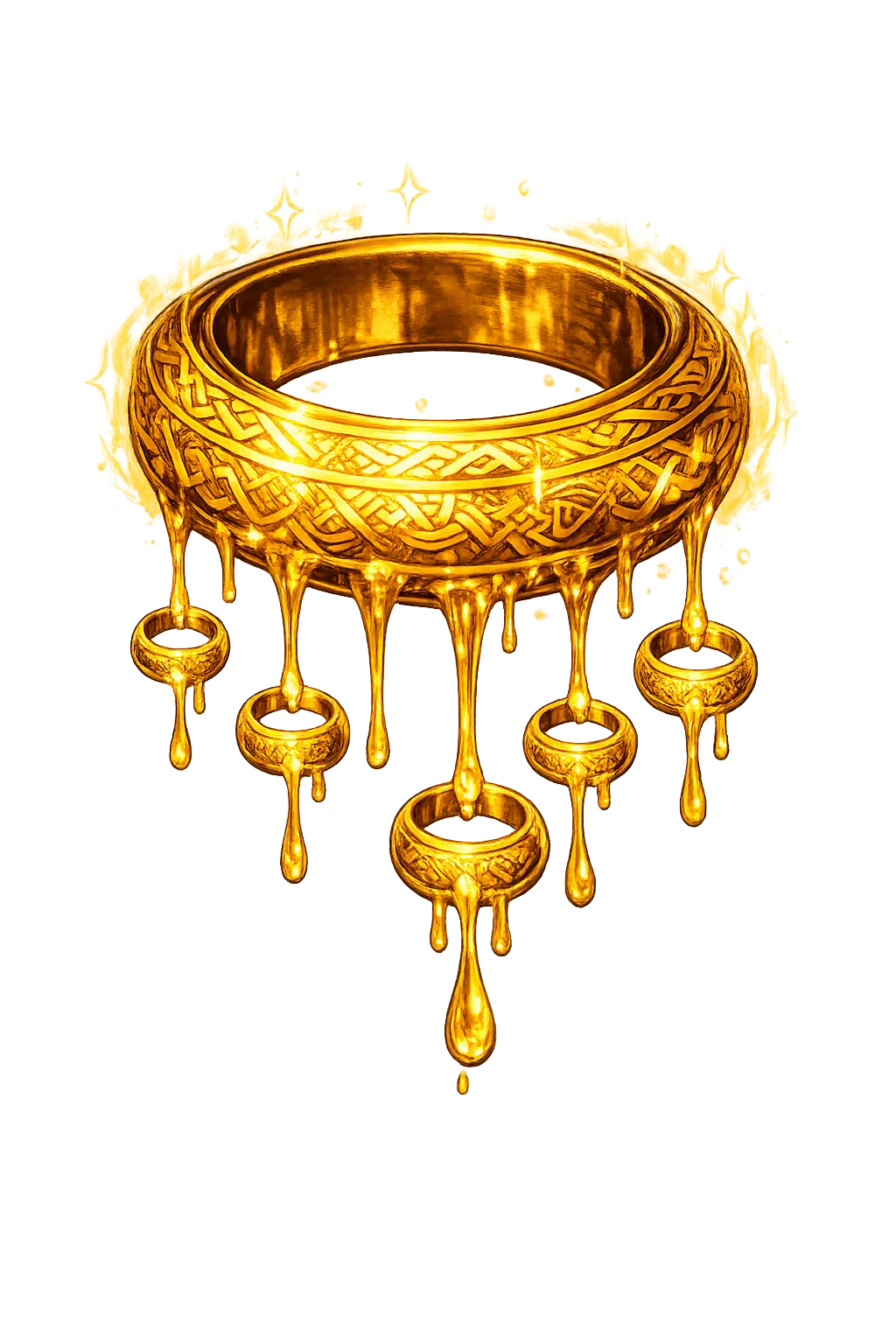
No Viking-Age artist signed Draupnir by name — the ring appears in no carving, no weaving, no pendant — but its type is everywhere, and that is the point. The arm-ring rides the same visual world as the gold-foil figures of the Vendel and Viking periods, the tiny stamped couples of Sorte Muld and Uppåkra pressing rings into each other's hands: the gift made visible. Where the Edda codices are illustrated — the Prose Edda's Codex Regius of c. 1300 gives Óðinn, Þórr, and Heimdallr their panels — the dwarf-forged treasures are passed over, and the ring's portrait must wait for the antiquarian draftsmen of early modern Iceland, whose illustrated paper manuscripts drew the Edda's wonders for seventeenth- and eighteenth-century collectors. Thereafter the image freezes into the badge it still is: one plain ring, smaller rings falling from it — the most legible icon in the Norse treasury.

06

Reception & Transformation

The name after its own age — transmission, translation, survival

Afterlives

Draupnir's transmission is short and rich: two medieval codices carried the whole dossier. Skáldskaparmál and Gylfaginning ride in the Codex Regius of the Prose Edda (c. 1300–50), Skírnismál and Völuspá in the Codex Regius of the Poetic Edda (c. 1270), and everything the modern world knows of the ring passes through those two books and the Icelandic paper copies that guarded them. The seventeenth and eighteenth centuries opened the door: royal collections in Stockholm and Copenhagen catalogued the codices, antiquarian translations rendered the forging-wager into Latin and the vernaculars, and by the nineteenth century the dripping ring was a fixed exhibit of the Norse revival and a standing case in the study of Germanic gift-ethics, cited wherever ring-giving in Beowulf is read. Folklorists filed the self-multiplying treasure among the wonder-objects of the international tale-stock, and the motif has never left the handbooks. From altar-ring to motif-index — the shortest journey in the treasury, and completely documented.

Identifications Across Traditions

Draupnir needs no borrowed god to explain it — it is an object, and its company is other objects. The corpus itself sets the sharpest contrast: Andvari's ring Andvaranaut, extorted at the waterfall and cursed, kills every hand that holds it, while Draupnir, freely made for the gods on a wager's terms, breeds gold for its keeper — the taken ring destroys, the given ring multiplies. The wider Germanic context is the ring-giving culture the poetry everywhere assumes: Beowulf's lord is the *beaga brytta*, the 'ring-giver', and arm-rings were the very currency of loyalty between lord and man; a self-breeding ring is that economy's dream made metal. Folklorists file Draupnir among the self-multiplying magic treasures of the international motif-index, beside inexhaustible purses and cornucopias; its nearest mythic cousins are things, not gods. Within the corpus its makers Brokkr and Sindri and its fellow-wonders — Gullinbursti, and Þórr's hammer Mjǫllnir from the same forging — are its true kin.

Modern Legacy

Draupnir's afterlife is the afterlife of an idea: the treasure that makes treasure. Nineteenth-century retellings fixed the forging-wager as a set-piece of the Norse revival — the Kearys' The Heroes of Asgard (1857) carries Brokkr and Sindri at the bellows, and every handbook since repeats the ninth-night dripping. In modern popular culture the name has become a byword for self-replicating wonders: God of War Ragnarök (2022) gives Brok and Sindri a Draupnir of its own — a spear, forged from the ring's multiplying magic, that reproduces itself in the wielder's hand — the most widely seen adaptation of the dwarf-brothers and their craft in any medium. Fantasy games and fiction reach for the name whenever gear must breed gear. In Iceland the word never needed reviving: Draupnir remains a living name there for ships, firms, and horses, the dripper doing ordinary work in the language that wrote the Eddas. And every time a modern storyteller needs wealth that grows honestly — by time, by patience, by nature rather than by taking — the shape they reach for is Óðinn's ring, whether they name it or not.

08

The Original Script Note

What the written record preserves — and what it does not

Original Script

The normalized Old Norse form is Draupnir — already plain ASCII, with no diacritic or distinctive letter for the restoration to recover; in the Younger Futhark the name would have been carved ᛏᚱᛅᚢᛒᚾᛁᛦ (t-r-au-b-n-i-R, the ᛏ-rune writing d, ᛒ writing p, and ᛦ the final nominative -r). Because the name is pure ASCII, its domain was registered in the ordinary way: draupnir.com is held by a third party outside the PuniCodex collection and is watched for release — no form of the name is currently owned, and this temple claims none.

09

The Meditation

What Draupnir means — beyond the dictionary

The North was not sentimental about gold. Its greatest hoard is cursed at birth, its dragons die on their beds of metal, and its poets ken gold as the fire of the flood where the Niflungar sank it. Against all of that stands one exception, and it is the highest treasure of the highest god: a ring whose only property is that it increases. Draupnir does not shine, speak, strike, or protect. It drips — on a schedule, in the dark, eight for one every ninth night, wealth arriving the way wealth actually arrives for those who keep it lawfully: slowly, cyclically, and by nature rather than by conquest. The myth then does the two most instructive things a myth can do with such an object. It gives it away: Óðinn lays the one inexhaustible treasure in the world on his son's pyre, because no fountain of gold outweighs one act of love. And it sends it back: the dead return the gift to the living, because some bonds outlast the boundary. Between those two gestures the ring becomes something stranger than a treasure — a measure of what treasure is for. The cursed ring of the dwarf Andvari passes from hand to hand and each owner dies; the dripper passes from father to son and back to father, and the only thing that multiplies is the meaning. Gold that is kept breeds gold. Gold that is given breeds everything else.

10

Frequently Asked Questions

Deep-dives into the cult, attestation, reception, and sources of Draupnir

01How do we know how Draupnir was worshipped?

Draupnir is a literary object: no inscription names it, and no find can be identified with it — but the ring it describes belonged to one of the best-attested object-classes in the northern record. The full cult record →

02Where do the earliest attestations of Draupnir come from?

The record rests on Snorri Sturluson, Prose Edda: Skáldskaparmál (the wager of Loki's head; the forging of Gullinbursti, Draupnir, and Mjǫllnir; the judgment of the treasures — 'every ninth night eight rings of equal weight drip from it'), Snorri Sturluson, Prose Edda: Gylfaginning 49 (Óðinn lays Draupnir on Baldr's pyre; Baldr sends it back from Hel with Hermóðr as a keepsake), Poetic Edda: Skírnismál 21–22 (Skírnir offers Gerðr 'the ring that was burned with Óðinn's young son; eight of equal weight drip from it every ninth night' — read as Draupnir) and Völuspá, dvergatal (Draupnir among the dwarf-names), among 6 cited works. The full source apparatus →

03How did later traditions reinterpret Draupnir?

Draupnir's transmission is short and rich: two medieval codices carried the whole dossier. Reception & transformation →

04What do the surviving images of Draupnir actually show?

No Viking-Age artist signed Draupnir by name — the ring appears in no carving, no weaving, no pendant — but its type is everywhere, and that is the point. The iconography →

05What does the written record of Draupnir actually preserve?

The normalized Old Norse form is Draupnir — already plain ASCII, with no diacritic or distinctive letter for the restoration to recover; in the Younger Futhark the name would have been carved ᛏᚱᛅᚢᛒᚾᛁᛦ (t-r-au-b-n-i-R, the ᛏ-rune writing d, ᛒ writing p, and ᛦ the final nominative -r). The Original Script note →

11

Scholarly Sources

The philological foundations of the record

Every claim on this page is grounded in established scholarship. The orthographic restorations follow disciplinary convention. The etymological chain follows the best available reference works. This is not invention — it is resurrection through scholarship.

◈

Lexicography & Philology

  • Cleasby-Vigfusson
◎

Primary Texts

  • Poetic Edda
  • Snorri Sturluson, Prose Edda: Skáldskaparmál (the wager of Loki's head; the forging of Gullinbursti, Draupnir, and Mjǫllnir; the judgment of the treasures — 'every ninth night eight rings of equal weight drip from it')
  • Snorri Sturluson, Prose Edda: Gylfaginning 49 (Óðinn lays Draupnir on Baldr's pyre; Baldr sends it back from Hel with Hermóðr as a keepsake)
  • Poetic Edda: Skírnismál 21–22 (Skírnir offers Gerðr 'the ring that was burned with Óðinn's young son; eight of equal weight drip from it every ninth night' — read as Draupnir) and Völuspá, dvergatal (Draupnir among the dwarf-names)
◉

Archaeology & Art History

  • Foote, P., & Wilson, D. M. The Viking Achievement; Graham-Campbell, J. Viking Art.
✦

Religious Studies

  • Cleasby–Vigfusson, An Icelandic-English Dictionary, s.v. draupnir ('Odin's ring'), drjúpa ('to drip')
  • Zoëga, A Concise Dictionary of Old Icelandic, s.v. draupnir, drjúpa
  • Simek, Dictionary of Northern Mythology; Orchard, Dictionary of Norse Myth and Legend; Lindow, Norse Mythology: A Guide — s.v. Draupnir, Brokkr, Sindri, sons of Ivaldi
Return

The Surface Awaits

You have traced the name from its earliest attestation to its canonical restoration. Now return to the myth. The story is where the name lives.

Back to Lore
Draupnir mascot