
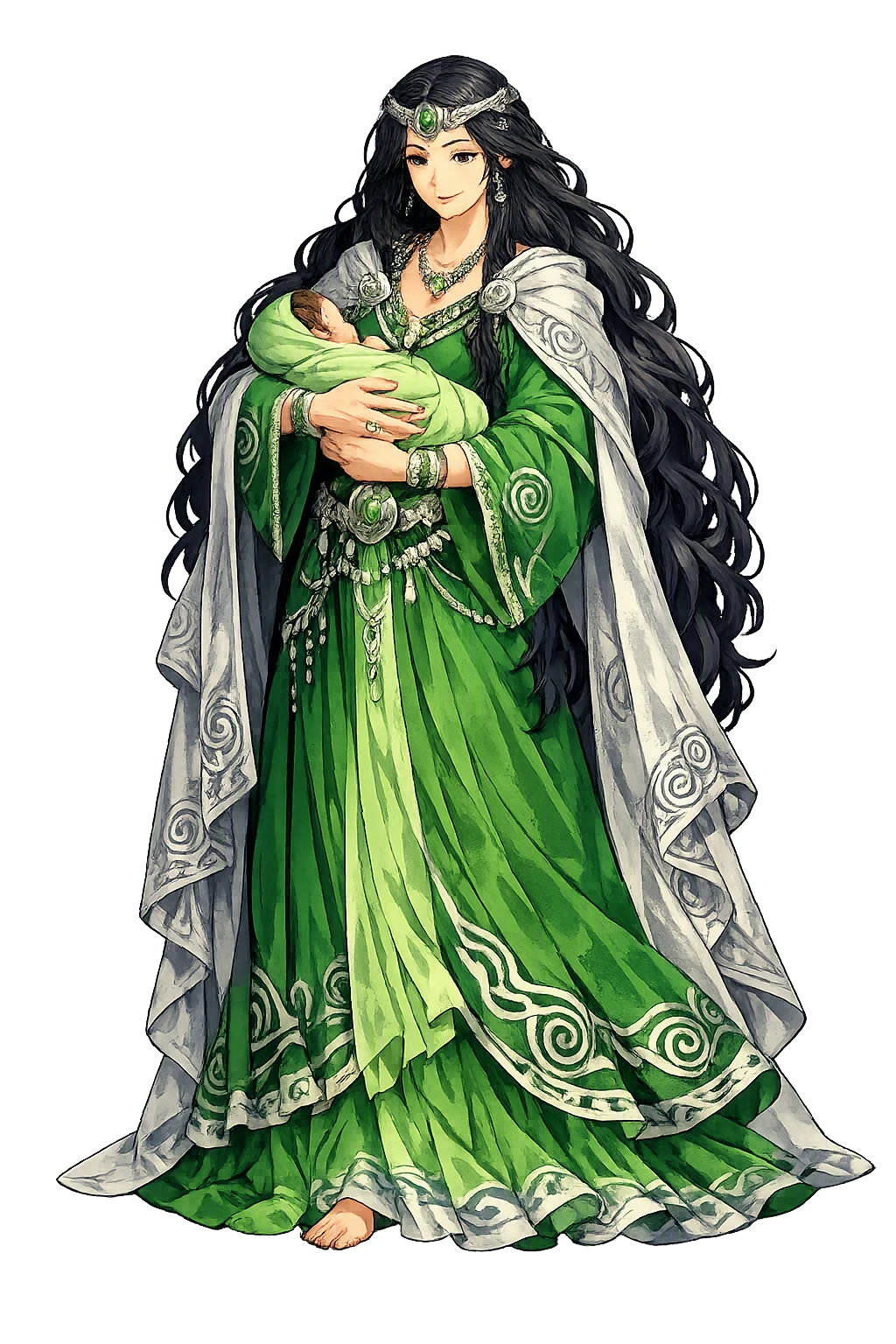
How Don was rebuilt, mark by mark
The workshop file for Don. Every rejected form is recorded here too — that is the point of keeping notes.
What We Found
The attestation is the tradition's own record, preserved in romanized scholarly form — no older script securely attests the name. Meaning: "Goddess".
The figure behind the name: Dôn has no myth of her own — no tale, no speech, no deed the sources record.
What the Name Carried In
The Sister-Sons at Math's Court. The Fourth Branch opens at the court of Math fab Mathonwy, lord of Gwynedd — who cannot live unless his feet rest in a virgin's lap, except when war is in the land — and it introduces the great men of that court by their mother's name: Gwydion and Gilfaethwy, sons of Dôn, Math's own sister-sons, his nephews and his company. Gwydion is 'the best teller of tales in the world'.
Arianrhod ferch Dôn and the Wand. When Math needs a new footholder after Goewin, Gwydion proposes his own sister: 'Seek for you a maiden... here is Arianrhod daughter of Dôn.
A spelling that has to carry stories like these is not a label. It is equipment.
Where It Stood Before Us
Dôn is a textual figure: no temple, votive deposit, or inscription names her, and the epigraphic record of early Wales — the Latin and ogham memorial stones catalogued by Nash-Williams — records personal names in funerary formulae, not theonyms. Her evidence is manuscript evidence. The Fourth Branch survives complete in the White Book of Rhydderch (Aberystwyth, NLW Peniarth MSS 4–5, c. 1350) and the Red Book of Hergest (Oxford, Jesus College MS 111, c. 1375–1420), with earlier fragments in Peniarth 6; Culhwch ac Olwen is preserved in the same two codices; the Book of Taliesin (NLW Peniarth MS 2, early fourteenth century) holds Kat Godeu. The tales' date of composition is debated, most often placed in the later eleventh or twelfth century. The geography of her house is real — Gwynedd and Arfon in the north-west of Wales, where Math's court and Arianrhod's castle stand in the tale — but no sanctuary of hers is known. The closest thing to a material trace of the name is a river: Dyfrdwy, the Welsh name of the Dee, continues Common Celtic *Dēwā, 'the goddess', and keeps the matriarch's name-element flowing through the landscape to this day. The bench inherits all of it — the web temple is the newest site, not the first.
What We Rejected
Invented diacritics. The canonical form Don is already complete; adding a mark for visual sophistication would be less accurate, not more.
What We Set Down
Don — The displayed form is ASCII-equivalent.
For the voice: 'DOHN' — one syllable, one long pure 'oh' held steady, like English 'dawn' with the vowel kept clean and simple.
The temple stands at /don/ — the notes above are public in its Scholarly Edition, sources and all.
At a Glance
- Canonical name: Don
- ASCII form: don
- Meaning: "Goddess"
- Domain of influence: Mother of Gods
- Pantheon: Celtic
- Restoration: ASCII-equivalent form
- Scholarly Transliteration: no original script securely attested — the romanized form is the primary record
- Series: The Restoration Files, No. 140 of 597
The File Continues
The temple's founding dispatch tells the name's story; its Resonance File reads the myths into the industries; the blog index holds the whole archive.
Continue the series — previous file: Diti (read it here) · next file: Drákōn (read it here).
The Restoration Files are written from the same canonical record as the temples themselves: the lexicon, the lore catalog, the pattern atlas, and the cited scholarly sources. If a file ever disagrees with its temple, the temple is right — tell us, and the file will be corrected.