PuniCodex

Extended Lore

Don

Etymology · Phonology · Orthography · Cultural Legacy · Primary Sources

Tier 2 Don
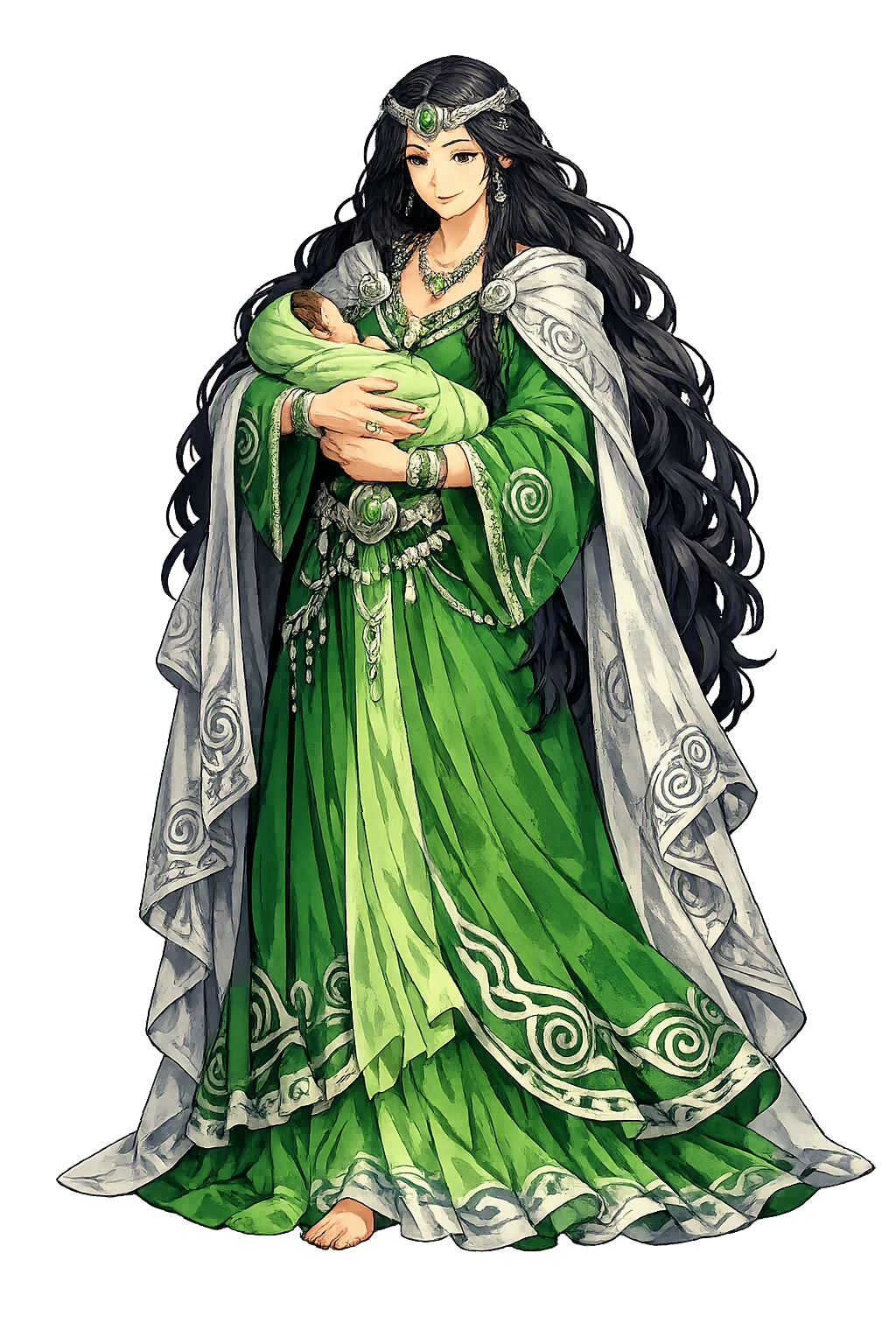
Don — Mother of Gods
01

Quick Facts

Essential information about Don, Mother of Gods

Scholarly TransliterationDon
Unicode RestorationDon
Reconstructed Pronunciation/doːn/
PantheonCeltic
DomainMother of Gods
MeaningGoddess
ClassificationTier 2
Primary DomainDon
Sacred SymbolsThe matronymic (uab Dôn), Math's wand, Plough and anvil, The Dee (Dyfrdwy), The star-castles
02

Etymology & Word Family

From original script to Unicode restoration

Scholarly Transliteration Don Don — "Goddess"
Unicode Restoration Don Restored stress, length, and script
Modern ASCII don Plain-ASCII fallback

Don is Tier 2 by the mechanical rule: the temple follows the Middle Welsh manuscript spelling Don — three plain ASCII letters, with no diacritic and no distinctive letter for the restoration to recover. Modern Welsh scholarship writes Dôn with a circumflex, but that mark is a modern length-sign, not a letter the manuscripts carry; the normalized temple form preserves it only in the pronunciation record, not the spelling. The etymology is honestly uncertain: derivation from Common Celtic *dēwā 'goddess' — the root the Welsh still hear in Dyfrdwy, the Dee — is the traditional reading, while a river-name origin is also argued; the handbooks mark the question open.

03

Unicode Character Breakdown

Character-by-character philological analysis

CharacterUnicodeNameBlockPhonetic Role
DU+0044Latin Capital Letter DBasic LatinSame, capitalized
oU+006FLatin Small Letter OBasic LatinSame
nU+006ELatin Small Letter NBasic LatinSame

The Tier 2 classification reflects how much of the original phonology this restoration preserves — stress and vowel length for Greek names, distinctive letters and diacritics for every other tradition.

04

Cultural Significance

From ancient cult to modern Unicode

Ancient Domain

Dôn is the matriarch of the Mabinogi's magical house: sister of Math fab Mathonwy, lord of Gwynedd, and mother of the great kindred the Welsh tradition called Plant Dôn, the Children of Dôn — Gwydion the enchanter, Gilfaethwy his brother, Arianrhod of the star-castle, Gofannon the smith, and Amaethon the ploughman. She is the only major figure of the Four Branches who never speaks, acts, or appears: the whole of the Fourth Branch happens among her children and her brother, and she is present only in the names they carry — uab Dôn, son of Dôn; uerch Dôn, daughter of Dôn.

Don in Later Traditions

Dôn's great comparison is Irish, and it is as old as modern Celtic studies: [[danu|Danu]] (or Dana), the equally shadowy mother after whom the Túatha Dé Danann — the peoples of the goddess Danu — are named. A Welsh divine kindred called the Children of Dôn and an Irish one called the peoples of Danu look like two faces of one inheritance, and MacKillop and Koch both register the comparison as standard. But it is a comparison, not an equation: no Welsh text identifies the two names, and the philology is genuinely disputed. The traditional reading derives Dôn from Common Celtic *dēwā, 'goddess' — the very word the Welsh language keeps in Dyfrdwy, its name for the River Dee — while a river-name origin, matching the continental Dānuvius (Danube) and the English Don, is also argued; the handbooks leave the question open rather than resolve it. Inside the Welsh corpus her closest kin are the tradition's other mothers and queens: [[rhiannon|Rhiannon]], the Great Queen of Dyfed, and, in later genealogical speculation, her pairing with [[beli|Beli Mawr]] as father of her children — a marriage the genealogies assert and the Mabinogi never mentions. Her husbandless, speechless sovereignty has no exact parallel anywhere in Celtic literature: she is the matriarch reduced to pure name.

Modern Legacy

Dôn rode into English on the same wagon as the rest of the Mabinogi: Lady Charlotte Guest's translation (1838–49) first carried the Fourth Branch into print, and the antiquarian mythography that followed made Plant Dôn the standard label for the northern divine kindred — the house of Gwydion, set beside the house of Llŷr, in every Victorian account of the Welsh gods. Twentieth-century scholarship fixed her place with precision: Ifor Williams's Pedeir Keinc y Mabinogi (1930) established the text, Mac Cana's The Mabinogi read the Fourth Branch as the masterpiece of Welsh prose, and the great encyclopedias — Koch's Celtic Culture and MacKillop's Dictionary — gave the matriarch her standing head-words, Danu comparison and all. Her widest modern audience came through a children's classic: Lloyd Alexander's Chronicles of Prydain (1964–68) made 'the Sons of Don' the ruling house of Prydain, with Math son of Mathonwy and Prince Gwydion at Caer Dathyl — her name on the throne of the best-loved Welsh-derived fantasy ever written. Modern Druid and pagan practice honours her as the Welsh mother-goddess and mother of the magical line, and the Welsh sky keeps her children's names: Caer Gwydion, the Milky Way, and Caer Arianrhod among the stars.

Unicode Restoration as Cultural Act

Restoring Don in a domain name is more than orthographic accuracy. It is a statement that the internet should recognize the full range of human writing — not only the ASCII keyboard.

05

Frequently Asked Questions

Common questions about Don, Mother of Gods, and Unicode restoration

01How do you pronounce Don?

In reconstructed pronunciation, Don is /doːn/ — approximately 'DOHN' — one syllable, one long pure 'oh' held steady, like English 'dawn' with the vowel kept clean and simple..

02What does Don mean?

Don means Goddess in the celtic tradition.

03What are the symbols of Don?

Don is associated with The matronymic (uab Dôn) ('Son of Dôn' — the mother-name standing at the head of every child's name, her whole presence in the text), Math's wand (Her brother's instrument of testing and transformation, laid across her children's fates — the power of the uncle's house over the mother's), Plough and anvil (Amaethon's plough and Gofannon's smithy — the crafts of cultivation and making that her sons carry into the oldest tale), The Dee (Dyfrdwy) (The river the Welsh still call 'the goddess' — *Dēwā, the name's closest living relative, flowing through the real landscape), The star-castles (Caer Arianrhod and Caer Gwydion — her daughter's and her son's halls written into the Welsh night sky by later tradition).

04Why restore Don in Unicode?

Plain ASCII don strips the stress, length, and script that make the name specific. Unicode restoration returns the name to its original written dignity.

05What is the most important myth about Don?

The Fourth Branch opens at the court of Math fab Mathonwy, lord of Gwynedd — who cannot live unless his feet rest in a virgin's lap, except when war is in the land — and it introduces the great men of that court by their mother's name: Gwydion and Gilfaethwy, sons of Dôn, Math's own sister-sons, his nephews and his company. Gwydion is 'the best teller of tales in the world'. It is these two who set the branch's whole tragedy in motion: Gilfaethwy desires Goewin, the maiden of the foothold, and Gwydion engineers the remedy — a war against Pryderi of Dyfed, bought with conjured stallions, hounds, and shields that vanish after a day, so that the king marches south and the rape can happen.Through all of it — the war, the crime, the three years of animal-shape punishment — the mother never appears. Dôn is present in the text exactly as a name inside other names: uab Dôn, son of Dôn, the matronymic the tale attaches to her children every time it introduces them. The most consequential family in Welsh prose walks the stage under her name, and she never once walks it herself.

06

Scholarly Sources

The philological foundations of this restoration

Every claim on this page is grounded in established scholarship. The orthographic restorations follow disciplinary convention. The etymological chain follows the best available reference works. This is not invention — it is resurrection through scholarship.

Lexicography & Philology

  • Mabinogion
  • MacKillop

Primary Texts

  • The Immram Brain (Voyage of Bran); Tochmarc Étaíne; Cóir Anmann; medieval Irish saga literature.

Archaeology & Art History

  • Material evidence — iconography, inscriptions, and temple archaeology — for Don and related cults.
  • Dôn is a textual figure: no temple, votive deposit, or inscription names her, and the epigraphic record of early Wales — the Latin and ogham memorial stones catalogued by Nash-Williams — records personal names in funerary formulae, not theonyms. Her evidence is manuscript evidence. The Fourth Branch survives complete in the White Book of Rhydderch (Aberystwyth, NLW Peniarth MSS 4–5, c. 1350) and the Red Book of Hergest (Oxford, Jesus College MS 111, c. 1375–1420), with earlier fragments in Peniarth 6; Culhwch ac Olwen is preserved in the same two codices; the Book of Taliesin (NLW Peniarth MS 2, early fourteenth century) holds Kat Godeu. The tales' date of composition is debated, most often placed in the later eleventh or twelfth century. The geography of her house is real — Gwynedd and Arfon in the north-west of Wales, where Math's court and Arianrhod's castle stand in the tale — but no sanctuary of hers is known. The closest thing to a material trace of the name is a river: Dyfrdwy, the Welsh name of the Dee, continues Common Celtic *Dēwā, 'the goddess', and keeps the matriarch's name-element flowing through the landscape to this day.

Religious Studies

  • The Mabinogi, Fourth Branch (Math fab Mathonwy) — trans. Sioned Davies (Oxford, 2007); Welsh text ed. Ifor Williams, Pedeir Keinc y Mabinogi (1930)
  • Culhwch ac Olwen, ed. Rachel Bromwich and D. Simon Evans (Cardiff, 1992) — Amaethon and Gofannon among the anoethau
  • Trioedd Ynys Prydein (The Welsh Triads), ed. and trans. Rachel Bromwich, 3rd ed. (2006) — the Three Futile Battles; Cad Goddeu and Amathaon fab Dôn
  • Book of Taliesin (Kat Godeu), ed. and trans. Marged Haycock, Legendary Poems from the Book of Taliesin (2007)
  • The Mabinogion, trans. Lady Charlotte Guest (1838–49)
  • MacKillop, James, Dictionary of Celtic Mythology (Oxford, 1998), s.vv. Dôn, Danu, Amaethon, Gofannon, Beli Mawr
  • Koch, John T., ed., Celtic Culture: A Historical Encyclopedia (ABC-CLIO, 2006), s.vv. Dôn, Plant Dôn, Dee
  • Mac Cana, Proinsias, The Mabinogi, 2nd ed. (University of Wales Press, 1992)
  • Jackson, Kenneth H., Language and History in Early Britain (Edinburgh University Press, 1953) — *Dēwā and the river-name evidence
  • Geiriadur Prifysgol Cymru / A Dictionary of the Welsh Language (GPC), s.v. Dôn
Return

The Surface Awaits

You have traced the name from its earliest attestation to its Unicode restoration. Now return to the myth. The story is where the name lives.

Back to Lore
Don mascot