
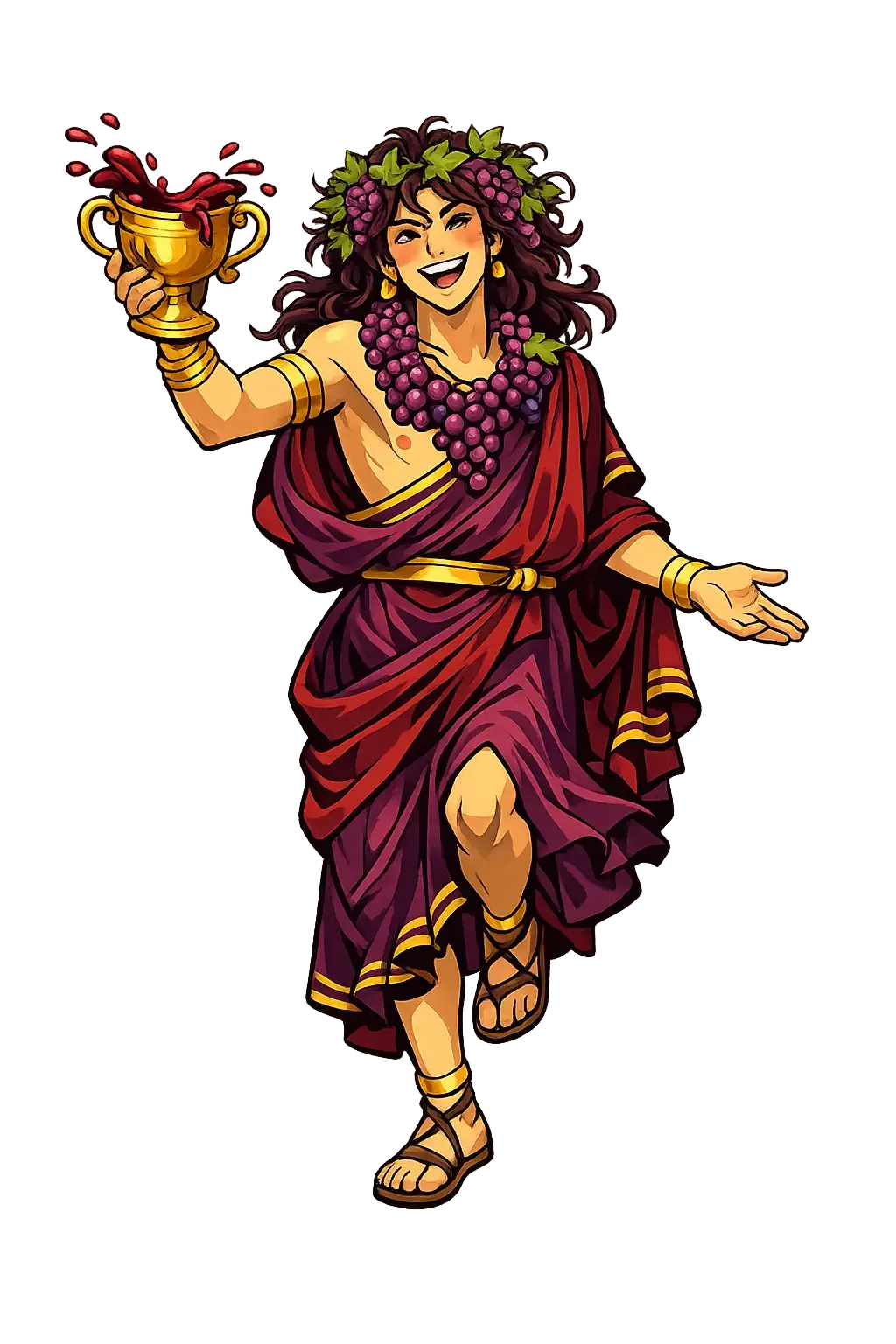
Diónysos: the stories first, then the spelling
Before the spelling, the story. Diónysos earns its restoration the old way — through what was actually told.
The Stories That Carry the Name
Fire and the Thigh of Zeus. Semele, daughter of Cadmus of Thebes, was loved by Zeus — and destroyed by the love. Hera, disguised as her nurse, planted the fatal wish: make him swear by the Styx to grant one request, then ask to see him as he appears to Hera. The oath bound; the unveiled glory of the thunderer burned Semele to ash (Apollodorus 3.
Pentheus and Thebes. The god came home to Thebes, and the king refused him. Pentheus, grandson of Cadmus, denied the new deity, jailed his own citizens for maenad frenzy, and mocked the stranger in women's dress. Euripides' Bacchae (c.
Diónysos and the Return. Diónysos dies, and that is his deepest secret. In the Orphic telling preserved by Olympiodorus and the fragments of the Rhapsodies, the child Zagreus — son of Zeus and Persephonē, marked as heir — is lured with toys and a mirror by the Titans, who tear him to pieces and devour him; Athena rescues the heart, Zeus swallows it, and the god is reborn as Diónysos (Orphic frs. 34–39, 207–215 Bernabé).
And Here Is What the Spelling Preserves
Against those stories, the attestation: Διόνυσος, as LSJ and Beekes record. The name means "God of Nysa (mountain of ecstasy)".
The restoration keeps one feature the ASCII form dionysos cannot show:
- o → ó — Acute on omicron: where the voice peaks.
A storyteller pronouncing the name would restore every one of them by instinct. The file only writes down what the voice already knows.
At a Glance
- Restored name: Diónysos
- ASCII form: dionysos
- Meaning: "God of Nysa (mountain of ecstasy)"
- Domain of influence: Wine, Ecstasy, Theatre
- Pantheon: Greek
- Classification: Tier 2
- Original script: Διόνυσος
- Series: The Restoration Files, No. 128 of 546
The Name Travels
The Romans knew Diónysos as Bacchus or the old Italic Liber, a god of fertility, wine, and the dissolution of social constraints. Egyptian priests identified him with Osiris as a dying-and-rising vegetation deity, though Osiris lacked the ecstatic, theatrical dimension.
The Address It Earned
The temple of Diónysos stands at /dionysos/ — lore, scholars, patterns — because a name carrying this much story deserves more than a parking page. One decisive feature survives — a single, honest mark — which places the restoration in Tier-2: exact, and exactly labeled.
The Sources Are Open
The myths above are retold from the temple's record; the primary voices are in the Sacred Texts: Theogony, Homeric Hymns, and Works and Days. Nothing in this file outranks them.
The File Continues
Read the founding dispatch for the name's full story, the Resonance File for the archetype at work — or the whole archive in one sitting.
Continue the series — previous file: Diāna (read it here) · next file: Don (read it here).
The Restoration Files are written from the same canonical record as the temples themselves: the lexicon, the lore catalog, the pattern atlas, and the cited scholarly sources. If a file ever disagrees with its temple, the temple is right — tell us, and the file will be corrected.