The Living Myth
Law, Duty, Righteousness · That Which Holds, Law and Righteousness · That which holds or sustains — law, duty, and righteousness
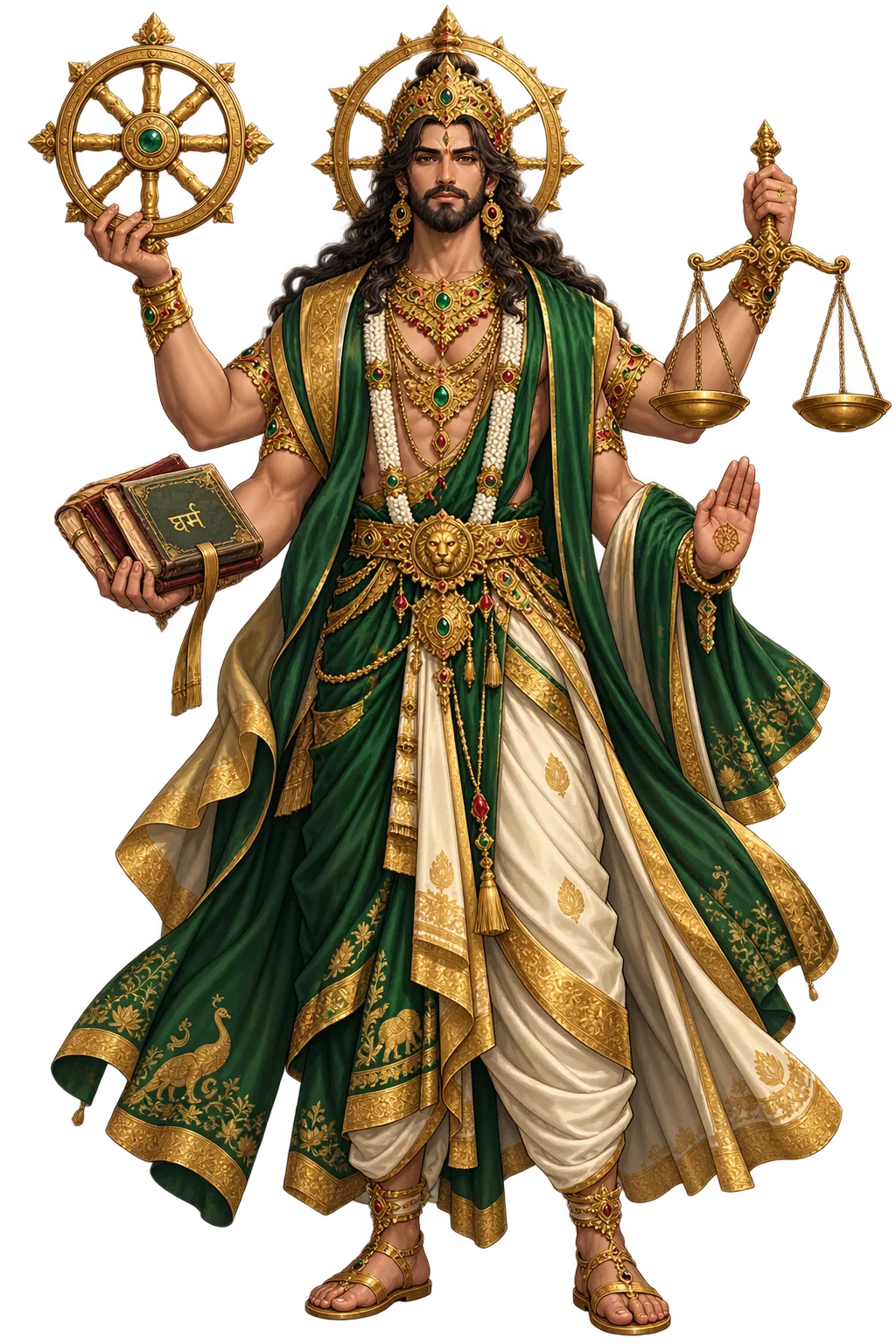
Stories of Dharma
Dharma’s mythology is the epics’ moral machinery: the god of righteousness fathers the eldest Pāṇḍava, tests his devotees in disguise, and — in the Nala story — teaches dice to a king as the instrument of ruin. He has no cult-image because he is what every cult-image stands for; yet the tradition gave him a family and a biography.
When Pāṇḍu was cursed to die on his wedding night, his queens invoked the gods: Dharmarāja himself, the god of righteousness, fathered Yudhiṣṭhira on Kuntī. The eldest Pāṇḍava is thus dharma’s son — which is why the epic keeps asking whether righteousness itself can survive the dice-game and the war it forces.
The epic’s forest-books stage Dharma’s examinations: as a stork demanding why Yudhiṣṭhira would not abandon a fallen brother; as a Yakṣa whose riddles the king answers with the epic’s most quoted verses; as a dog who follows the Pāṇḍavas to heaven’s gate and is refused entry — until Yudhiṣṭhira refuses heaven without it. The dog was Dharma; the gate opens.
In the Nala episode, Kali — the demon of the Kali Yuga — begs Dharma for a means to enter the righteous king Nala; Dharma, inexplicably, teaches him dice. The story’s commentators wrestled for centuries with the god of righteousness arming the demon of strife: the standard resolution — even dharma’s permission is a test that righteousness must survive.
The Purāṇas give Dharma genealogy: born of Brahmā’s breast as one of the mind-born sons, husband of Dhṛti and father of the personified virtues — Kāma (desire), Lobha (greed), Darpa (pride) and the rest. The abstraction’s family-tree is the Indian psyche’s map of its own forces.
The Moral Order Personified
Dharma is the load-bearing word of Indian civilization: the law that holds the cosmos, the duty that holds the person, the order that holds society. From √dhṛ, ‘to sustain’, it names everything that keeps the world from sliding into chaos — and in the epics it walks as a person: the god of righteousness, father of Yudhiṣṭhira, who came down to test his own devotees.
The cosmos rests on dharma; the four feet of the bull of dharma mark the four ages of time.
Svadharma — one’s own duty by birth and life-stage: the Bhagavadgītā’s central teaching.
The four yugas are the four feet of the bull: four in the Kṛta age, one stumbling foot in ours.
In the epics Dharma appears in disguise — a beggar, a dog, a crane — to test righteousness where it counts.
From the original script to the living URL
धर्म
The name in its original Sanskrit form. Dharma (धर्म) is attested in the source tradition — “That which holds or sustains — law, duty, and righteousness; the moral and religious order that upholds the world (from √dhṛ, 'to hold, sustain').”. Its original diacritics and script distinctions carry the full phonetic and orthographic weight of the source tradition.
dharma
The plain dharma form is identical to the Unicode restoration. Because this name is already written in Latin letters, no diacritics, stress, or script information were lost — only capitalization differs.
Dharma
The Unicode restoration does not need to recover lost marks for Dharma. Its value is canonical spelling and consistent cataloguing, not the reconstruction of erased orthography. The domain is readable as-is to both DNS and humanity.
Dharma.com
This restoration is written entirely in ASCII letters — no Punycode encoding stands between Dharma and the DNS. The domain reads identically to machines and to human eyes.
The attested spelling family of Dharma
Dharma
Restores धर्म. The full Unicode restoration. dharma.com is not in the PuniCodex collection — it is watched for release; if it drops, this temple upgrades to an owned flagship. Attested by MW, Manusmriti.
How Dharma was spoken
How Dharma travels from ancient script to the modern URL
The lore you have read is the living myth. Extended Lore opens the scholarly vault beneath it: the cult and its material remains, a history of the image, the name after antiquity, a meditation on what the name still means, and the full scholarly apparatus — etymology, orthography, sources.
Enter Extended Lore