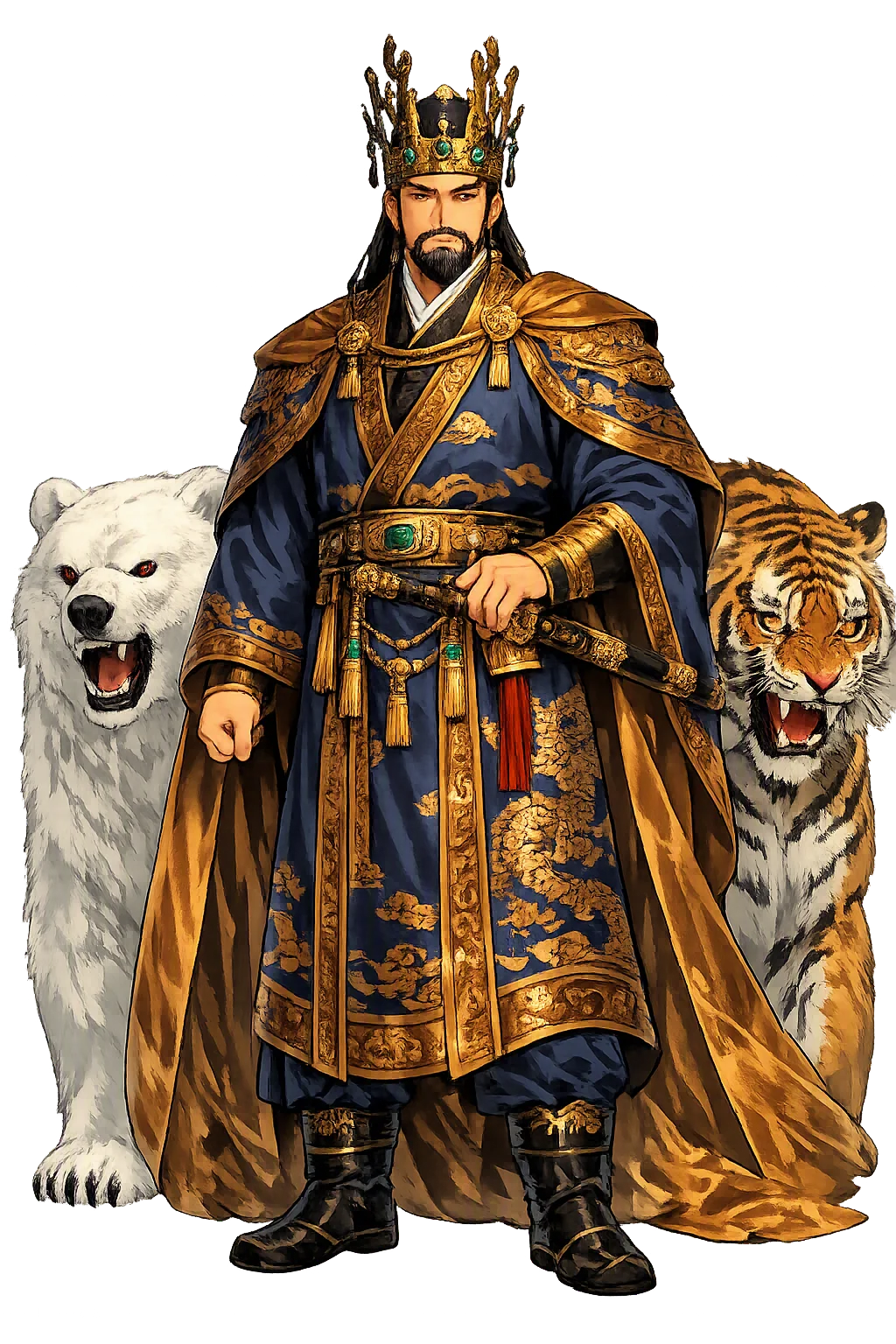
Stories of Dangun
The Dangun cycle is Korea’s charter myth: a heavenly prince descends beneath a sandalwood tree, an animal bride endures a hundred days of darkness, and the first king binds law, grain, and ritual into a single realm. Its fullest early telling is Iryeon’s Samguk Yusa (1281), with a briefer notice in Kim Pusik’s Samguk Sagi (1145); shamanic and popular retellings vary the details without changing the spine.
The Samguk Yusa opens the tale in heaven: the supreme lord Hwanin ruled the sky, and his son Hwanung, gazing down upon the world, begged leave to govern it and bring order to humankind. Hwanin looked and saw that the land was worth the blessing; granting his son the three heavenly seals and three thousand followers, he sent him down to the foot of the sandalwood tree, where Hwanung established the holy city of Sin-si, the ‘city of god’. There the heavenly prince taught the hundred arts: he bound the people by law, showed them how to sow the five grains, how to cure sickness with herbs, how to take husbands and wives by rite and to send the dead away by rule. The sandalwood — 檀 (dan), the tree that gives the dynasty its first syllable — stands at the center of the settlement as an axis where heaven’s bureaucracy touches the soil of earth. The myth reads like a charter: Korean civilization begins not with conquest or migration but with a delegation of heavenly order, administered patiently from a single sacred tree.
When a bear and a tiger living together prayed to Hwanung that they might become human, the heavenly prince set them an ordeal: eat only garlic and mugwort, and shut yourselves away from sunlight for one hundred days. The tiger grew restless and broke the fast before the days were out, but the bear endured to the end and was transformed into a woman — Ungnyeo, the ‘bear-woman’. She prayed beneath the sandalwood for a child, and Hwanung, moved by her devotion, took her as his wife; from their union was born Dangun, the sandalwood prince. The Samguk Yusa tells the episode with the economy of a parable: the stronger animal fails, the meeker succeeds, and a nation descends from patience rather than power. Later Korean tradition never tired of the moral — that the people’s character was shaped in a dark cave, by an animal’s willingness to endure what flesh finds unbearable, and to come out of it changed.
Dangun grew and in his day founded the state of Gojoseon, ‘Joseon of old’, establishing its capital at Asadal — a name later tradition ties to the sandalwood tree of his father’s descent and to a peak in the Taebaek range. The Samguk Yusa credits him with a reign of one thousand five hundred years, a fabulous span that marks his kingship as belonging to mythic time rather than history; the Samguk Sagi, more sober, enters the founding under 2333 BCE in the Dangi calendar that Korean tradition still counts from. The two accounts agree on the essence: Dangun gave his people law, agriculture, and ritual order, the three instruments by which a settlement becomes a state. When the sage Jizi (Gija) led five thousand followers east from the Zhou collapse, tradition says Dangun did not resist but yielded, withdrew to Jangdanggyeong, and let the new line rule — the mythic model of a succession accomplished by withdrawal rather than war, legitimacy transferred by grace.
The end of Dangun’s story is a retirement, not a death — at least in the older telling. Withdrawing from affairs of state after yielding to Gija, he is said to have gone into the mountains and become a sansin, a mountain spirit, one of the most beloved figures of Korean folk religion: the white-robed lord of the peak, paired with his tiger, invoked in the sansin-gut shamanic rite for the protection of villages, travelers, and the harvest. The Samguk Sagi closes its notice differently, recording that Dangun at last died and that the people mourned him for three days, giving him the honorific Wanggeom. The two endings are not rivals but layers: the chronicler preserves the king, the people preserve the god, and the mountain keeps both. In Korean sacred geography the founder never really leaves — he moves his court uphill, where every range becomes a memory of the first settlement beneath the sandalwood tree.
founder of Gojoseon and first ancestor of the Korean people
Dangun is the legendary founder of Gojoseon and the first ancestor of the Korean people: son of the heavenly prince Hwanung and the bear-woman Ungnyeo, king of Asadal for fifteen hundred mythic years, and at last a mountain spirit watching over the land from every peak.
Dangun is the mythic first king whose reign marks the beginning of Korean statehood.
His birth unites heavenly descent with the transformed earth-animal, modelling cosmic and terrestrial harmony.
The sacred capital where Dangun established law, agriculture, and the ordering of the people.
After his long reign Dangun became a mountain spirit, still invoked for protection and prosperity.
From the original script to the living URL
단군 (檀君)
The name in its original Korean form. Dangun (단군 (檀君)) is attested in the source tradition — “Lord of the sandalwood”. Its original diacritics and script distinctions carry the full phonetic and orthographic weight of the source tradition.
dangun
The plain dangun form is identical to the Unicode restoration. Because this name is already written in Latin letters, no diacritics, stress, or script information were lost — only capitalization differs.
Dangun
The Unicode restoration does not need to recover lost marks for Dangun. Its value is canonical spelling and consistent cataloguing, not the reconstruction of erased orthography. The domain is readable as-is to both DNS and humanity.
Dangun.com
This restoration is written entirely in ASCII letters — no Punycode encoding stands between Dangun and the DNS. The domain reads identically to machines and to human eyes.
Owned, ideal, and ASCII forms of Dangun
Dangun
Restores 단군 (檀君). The full Unicode restoration. dangun.com is not in the PuniCodex collection — it is watched for release; if it drops, this temple upgrades to an owned flagship.
How Dangun was spoken
How Dangun travels from ancient script to the modern URL
The lore you have read is the living myth. Extended Lore opens the scholarly vault beneath it: the cult and its material remains, a history of the image, the name after antiquity, a meditation on what the name still means, and the full scholarly apparatus — etymology, orthography, sources.
Enter Extended Lore