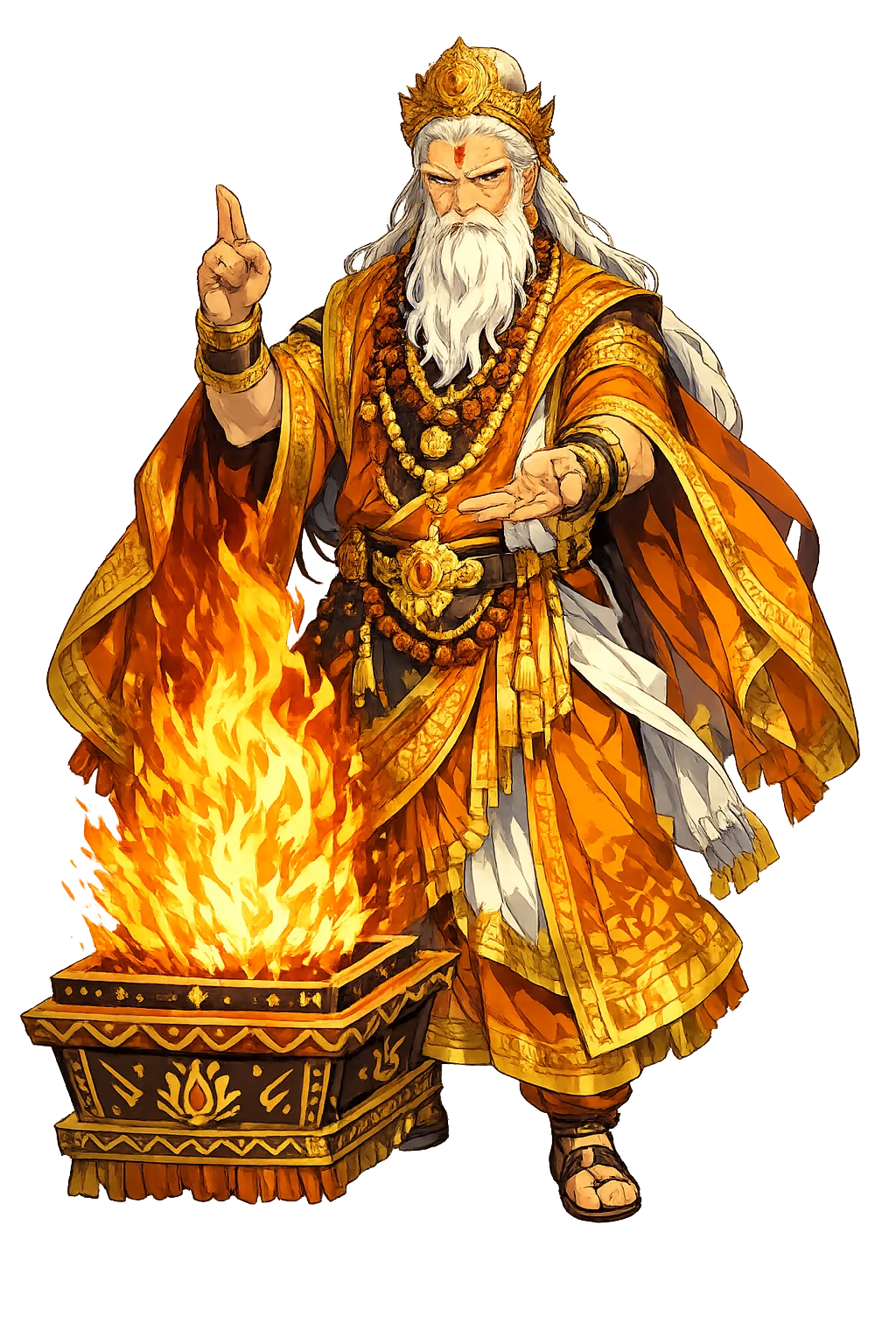
Stories of Dakṣa
Dakṣa's cycle is the Indian study of procedure versus devotion: the man who performs the rite perfectly and loses everything because of who was left off the list — and the moon he cursed, still waning monthly in witness against favoritism.
His daughter Satī loved Śiva — the ash-smeared, skull-garlanded wanderer whom Dakṣa regarded as no fit match for a Prajāpati's house. The Purāṇas make the marriage the scandal of the age: Dakṣa's open scorn, Satī's immovable devotion, Śiva serenely indifferent to court opinion (Śiva Purāṇa, Rudrasaṃhitā, Satīkhaṇḍa). She married him anyway, against her father's will, and went to live on Kailāsa, in the realm of the gods of the uncivilized places. When Dakṣa later held the great sacrifice at Kankhal — the rite of the age, to which every god, every seer, and every daughter was summoned — two names were missing from the guest list: Śiva and Satī. The omission was deliberate, public, and meant. In the theology of the story the list is the sacrifice's whole substance: what is deliberately left out is what brings it all down.
Satī came uninvited to her father's rite and endured his contempt until she could endure no more: declaring that she would no longer wear a body born of one who insulted her lord, she entered the sacrificial fire and burned (Śiva Purāṇa, Satīkhaṇḍa; the Devībhāgavata gives the Goddess's own version). Her body, scattered in Śiva's grief-stricken dance across the land, seeded the fifty-one Śakti Pīṭhas — the holiest map of Śakta India, from Kamakhya in Assam to Hinglaj beyond the Indus. The tradition is exact about the meaning: the daughter's death is not defeat but sovereignty, the first self-offering by which the Goddess teaches that the body insulted is the body withdrawn. Every pīṭha is a place where the story says a piece of her fell — and where her power, not her father's, is worshipped.
Śiva did not come himself. He tore a lock from his hair and cast it down, and from it rose Vīrabhadra — dark as a burned jungle, commissioned with the wreckage (Śiva Purāṇa, Rudrasaṃhitā, Dakṣakhaṇḍa; the Kālikā Purāṇa shifts the agency to the Goddess herself, who sends her own emanation). The host fell on the rite: Bhaga's eyes were knocked from his face, Pūṣan's teeth smashed in his mouth, the gods fled the oblations, the sacrificial animals were slaughtered where they stood — and Dakṣa was beheaded among the ruins of his own flawless order. When the surviving gods begged, Śiva relented and restored him, setting a goat's head upon his shoulders; the humbled Prajāpati rose a devotee. The sequel is the point of the whole cycle: procedure is restored, but transfigured — skill survives, wearing a humbler head, at an altar where ritual and devotion at last share the fire.
Dakṣa gave his twenty-seven daughters — the Nakṣatras, the lunar mansions — to the Moon, on condition he visit each equally. The Moon favoured Rohiṇī alone, and Dakṣa's curse made him waste away of consumption: hence the moon's monthly dying (the tale is told across the Purāṇas, in the Śiva Purāṇa's account of the marriage and in the Devī and Mārkaṇḍeya cycles). The gods pleaded, and the curse was commuted, not revoked — the waxing that follows is the negotiated sentence, death softened into rhythm. Even a Prajāpati's curse, the story says, cannot be simply unsaid; it can only be mitigated by appeal — a principle the Purāṇic narrators clearly relish, for it makes even divine wrath answerable to negotiation. The night sky still keeps the record: twenty-seven stations, one favorite, and a penalty written in phases, renewed every month without fail.
The Purāṇas insist the story does not end at the beheading: when the gods intercede, Śiva forgives, and Dakṣa rises with a goat's head — and becomes, the texts say, Śiva's devotee, praising the very lord he once excluded. Iconography keeps him so: goat-headed, shown in the act of worship, the humbled adept of Purāṇic panels across the Deccan and the South. At Kankhal, where the sacrifice is said to have burned, the Daksheśvara temple stands on the traditional ground — continuously rebuilt, renovated in 1810 and again in 1962 — commemorating not the ruin but the reconciliation. The cycle's final image is the two of them at one altar: the skilled father and the wild god, procedure and devotion finally sharing the fire. It is among the most quietly hopeful endings in the Purāṇas — perfection was not restored; something better was.
Progeny, Sacrifice, and the Goat's Head
Dakṣa is the Prajāpati of competence: the 'skilled one' whose sixty daughters married the Moon, Dharma, and the sage Kaśyapa to people the world — and whose flawless sacrifice, performed without Śiva, became the great cautionary tale of Indian religion.
Father of the Nakṣatras — the 27 lunar mansions are his girls, wed to the Moon.
The yajña to which Śiva was not invited — the snub that shattered heaven and earth.
His punishment and restoration: beheaded in the ruined rite, revived with the head of a goat.
'Lord of progeny' — the office of populating the cosmos, held by a committee of the skilled.
From the original script to the living URL
दक्ष
The name in its original Sanskrit form. Dakṣa (दक्ष) is attested in the source tradition — “'The skilled, the able' (from dakṣa), a Prajāpati”. Its emphatic consonants and palatal/retroflex sibilants carry the full phonetic and orthographic weight of the source tradition.
daksa
Reduced to plain daksa, the name loses everything that made it specific: emphatic consonants and palatal/retroflex sibilants. What remains is an ASCII string that machines can parse but that no longer speaks with its original voice.
Dakṣa
The Unicode restoration recovers what ASCII flattened. Dakṣa restores emphatic consonants and palatal/retroflex sibilants, returning the name to its original written dignity. The domain encodes to Punycode, but the browser displays the truth.
Dakṣa.com → xn--daka-di5a.com
The non-ASCII characters in Dakṣa are encoded while the ASCII remains visible. To the DNS, it is Punycode. To humanity, it is Dakṣa.
Owned, ideal, and ASCII forms of Dakṣa
Dakṣa
Restores दक्ष. The live temple domain — dakṣa.com.
daksa
Flattens दक्ष. The plain ASCII fallback — what DNS and legacy systems see.
How Dakṣa was spoken
How Dakṣa travels from ancient script to the modern URL
The lore you have read is the living myth. Extended Lore opens the scholarly vault beneath it: the cult and its material remains, a history of the image, the name after antiquity, a meditation on what the name still means, and the full scholarly apparatus — etymology, orthography, sources.
Enter Extended Lore