PuniCodex

Extended Lore

दक्ष Dakṣa

Etymology · Orthography · Cult · Iconography · Reception · Sources

Tier 1 Dakṣa.com
Dakṣa — Skill, Creation, Order
01

Quick Facts

Essential information about Dakṣa, Skill, Creation, Order

Original Scriptदक्ष
Unicode RestorationDakṣa
Reconstructed Pronunciation/ˈd̪ɐk.ʂɐ/
PantheonSanskrit
DomainSkill, Creation, Order
Meaning'The skilled, the able' (from dakṣa), a Prajāpati
ClassificationTier 1
Primary DomainDakṣa.com
Sacred SymbolsThe sacrificial post, The goat, The rosary
02

Etymology & Word Family

From original script to Unicode restoration

Original Script दक्ष Dakṣa — "'The skilled, the able' (from dakṣa), a Prajāpati"
Unicode Restoration Dakṣa Restored stress, length, and script
Modern ASCII daksa Plain-ASCII fallback

The name Dakṣa carries the orthographic signature of the sanskrit tradition: दक्ष. Unicode restoration recovers what ASCII flattens.

03

Unicode Character Breakdown

Character-by-character philological analysis

CharacterUnicodeNameBlockPhonetic Role
DU+0044Latin Capital Letter DBasic LatinSame letter
aU+0061Latin Small Letter ABasic LatinSame letter
kU+006BLatin Small Letter KBasic LatinSame letter
ṣU+1E63Latin Small Letter S with Dot BelowUnknownScript-specific diacritic
aU+0061Latin Small Letter ABasic LatinSame letter

The Tier 1 classification reflects how much of the original phonology this restoration preserves — stress and vowel length for Greek names, distinctive letters and diacritics for every other tradition.

04

Cult & Worship

How the sacred was kept — rites, sanctuaries, remains

The Cult

Dakṣa never had a cult of his own — the texts that remember him best are the ones that record his ruin. As one of the Ādityas he received his share of the midday oblations in the Vedic fire rite, one name in a litany rather than the lord of a shrine. The only geography his story owns is Kankhal, on the Ganga at Haridwar, where the Daksheśvara temple stands on the traditional ground of the great sacrifice — continuously rebuilt, renovated in 1810 and 1962, but dedicated chiefly to Śiva, the very god Dakṣa excluded. His daughters' geography is far larger: the fifty-one Śakti Pīṭhas, from Kamakhya in Assam to Hinglaj beyond the Indus, mark where Satī's body fell, and their pilgrims walk his story without ever stopping at an altar of his. What votive evidence exists is performance — the yajña cycle retold in temple festival drama — rather than image or relic. The honest summary: a Prajāpati worshipped everywhere by inference, and almost nowhere by name.

In the Earth

The Kankhal complex at Haridwar — the Daksha Mahadev temple and the Śrī Daksheśvara site on the Ganga — marks the traditional ground of the great sacrifice, continuously rebuilt from early times and renovated in 1810 and 1962. Satī's pīṭhas, from Kamakhya to Hinglaj, give the myth the largest sacred geography of any Indian story. Iconography shows him goat-headed in the act of worship — the humbled adept — in Purāṇic panels across the Deccan and the South.

05

Iconography

How Dakṣa was imaged across the ages

The Image

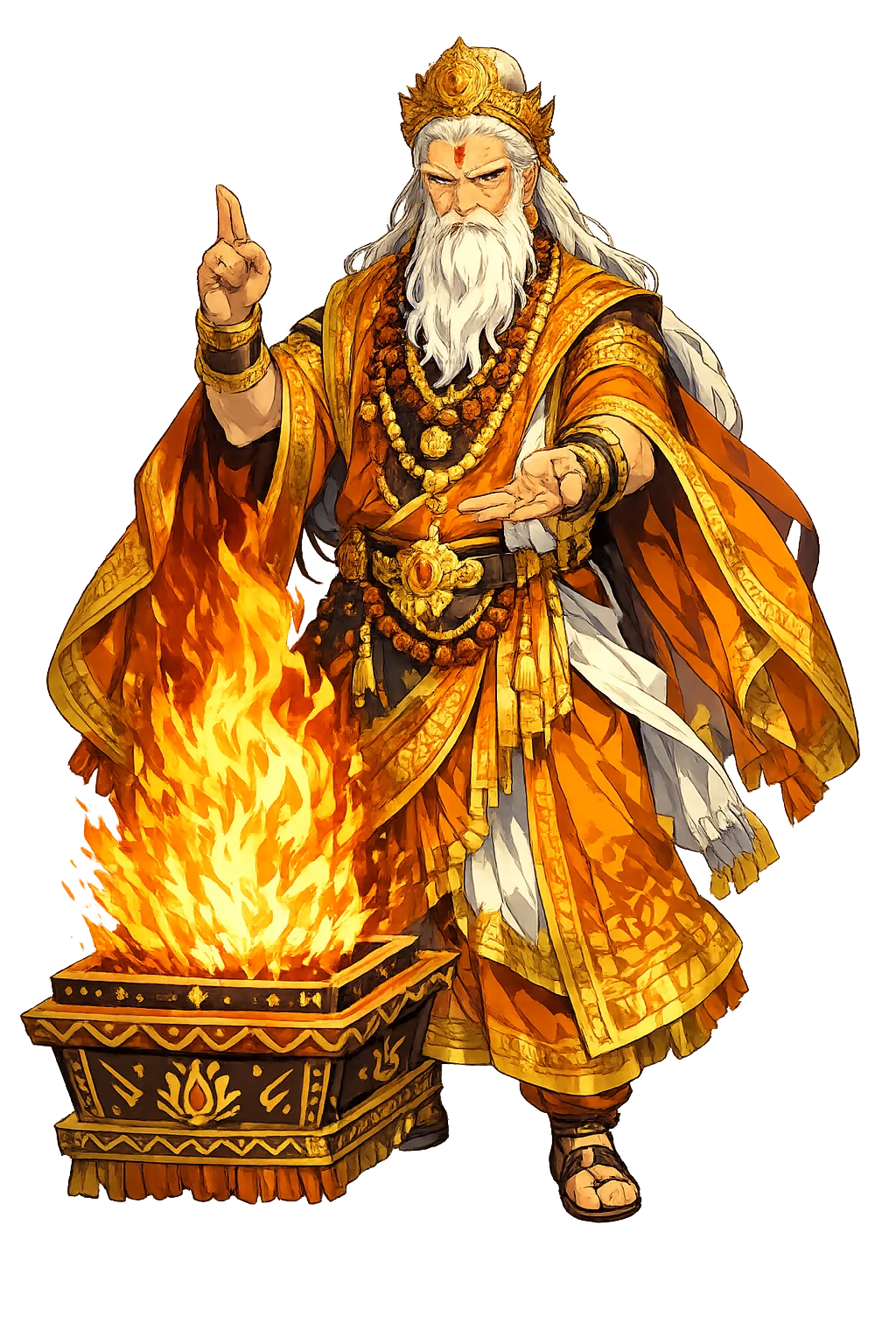
You know Dakṣa by his second head. Iconography keeps the Purāṇas' ending rather than their beginning: not the proud Prajāpati but the goat-headed penitent, shown kneeling in worship before the very god he excluded, the sacrificial cord still over his shoulder and the rosary in his hand. The type belongs to medieval Śiva-narrative art — panels of the ruined yajña across the Deccan and the Tamil South, where he is a supporting actor in his own disaster, dwarfed by Vīrabhadra's rage. No early sculptural portrait of him is known; the Ṛgveda's Āditya left no image, and the first 'portraits' are literary — the Purāṇas' stubborn insistence on the new head. In painting the scene lived longest: illustrated Purāṇa manuscripts and later popular prints show the beheading and the reconciliation. His remaining attributes follow his office — the sacrificial post, the ladle, the tallying rosary of a progenitor counting his daughters. The image that froze is the one the theology wanted kept: skill wearing humility like a graft.

06

Reception & Transformation

The name after its own age — transmission, translation, survival

Afterlives

Dakṣa travelled by daughter. The Vedic Āditya passed into the epic-Purāṇic cycle, the Mahābhārata gave his story its narrative spine, and the Purāṇas made it doctrine — while the Śakti Pīṭhas turned it into a map that still organizes pilgrimage. Medieval Śaiva art carried the goat-headed penitent onto temple walls; the classical stages of the South fixed the yajña cycle as performance literature, where it remains in the Kathakali repertoire. The manuscript age gave him wide circulation — the Purāṇas are among the most copied Sanskrit texts — and the nineteenth-century print revolution multiplied him: lithographed Purāṇas, and in the twentieth century the Gita Press Śiva Purāṇa, carried the cycle into hundreds of millions of households. European scholarship arrived meanwhile: Vedic philologists catalogued him in Macdonell's Vedic Mythology, and the dakṣa–dexter cognate made him a permanent exhibit of Indo-European linguistics. Modern India files him under governance — the flawed guest list is cited in management literature — and the moon he cursed still rehearses his story monthly. His reception is double: a god who became a parable, whose oldest layer survives in a dictionary entry and a waxing sky.

Identifications Across Traditions

As Prajāpati he absorbed and was absorbed by Brahmā: the Mahābhārata and Purāṇas shift 'lord of progeny' between them until the offices blur. His daughter-lineages map the whole Purāṇic cosmos — through Kaśyapa's wives descend gods, demons, birds, and serpents; through Dharma's, the virtues. The Śakta tradition reframed his sacrifice entirely: not a tale of Śiva's wrath but of the Goddess's sovereignty, with Satī as the first self-offering. And because his name is simply the common word for 'the able one', the god of skill survives anonymously in every modern Indian compliment — the daksh professional — and in the dakṣiṇā, the ritual fee of the skilled hand, paid at every Hindu rite today.

Modern Legacy

The Dakṣa-yajña cycle is among the most retold stories in India — sculpture, dance-drama, and television epics return to it constantly — and the Śakti Pīṭha pilgrimage map it generates still organizes Śakta devotion. His name lives in the language: dakṣa/daksh remains the word for the capable professional, and the dakṣiṇā, the ritual fee 'of the skilled hand,' is paid at every Hindu rite today.

07

The Meditation

What Dakṣa means — beyond the dictionary

Dakṣa is the god of the flawless plan that fails. Everything at his sacrifice was correct — the altar, the mantras, the portions — except the heart that made the guest list. He asks of every institution that confuses procedure with worth: who have you left out, and what will their absence burn?

His cycle is retold wherever competence grows proud: the flawless system, the perfect rite, the immaculate procedure — and the one excluded name that brings it all down. India keeps the story as a standing audit of institutions: correctness is not completeness, and the guest list is a moral document. The goat's head he wears is the gentlest icon in the Purāṇas: the skilled man, restored — thinking, at last, with a humbler head.

Every tradition keeps a version of his story — the elder who confuses the map with the territory, the priest with the presence — because every generation needs it. The sacrifice at Kankhal burned not because the rite was wrong but because the rite was all there was. India's answer, sung in a hundred retellings, is the goat-headed worshipper: the same hands, the same skill, the same altar — and a head that has learned what the altar is for.

The moon he cursed still keeps the story: it wanes for favoring one wife over twenty-six, and waxes because the gods commuted the sentence — the night sky's monthly reminder that allotment, once made, rules even the gods. Dakṣa's family is the cosmos's org chart; his sacrifice, its cautionary appendix.

08

Frequently Asked Questions

Common questions about Dakṣa, Skill, Creation, Order, and Unicode restoration

01How do you pronounce Dakṣa?

In reconstructed pronunciation, Dakṣa is /ˈd̪ɐk.ʂɐ/ — approximately DUCK-shah; the ṣ is the retroflex sh.

02What does Dakṣa mean?

Dakṣa means 'The skilled, the able' (from dakṣa), a Prajāpati in the sanskrit tradition.

03What are the symbols of Dakṣa?

Dakṣa is associated with The sacrificial post (The yūpa of his cosmic rite — order raised, then ruined by pride), The goat (His second head — humility grafted onto skill), The rosary (The Prajāpati's counting of creatures and years).

04Why restore Dakṣa in Unicode?

Plain ASCII daksa strips the stress, length, and script that make the name specific. Unicode restoration returns the name to its original written dignity.

05What is the most important myth about Dakṣa?

“Satī and the Ascetic” — the The Marriage story that anchors the mythology of Dakṣa, told in full on the lore page.

09

Scholarly Sources

The philological foundations of this restoration

Every claim on this page is grounded in established scholarship. The orthographic restorations follow disciplinary convention. The etymological chain follows the best available reference works. This is not invention — it is resurrection through scholarship.

◈

Lexicography & Philology

  • Mahabharata
  • Monier-Williams
◎

Primary Texts

  • Rigveda
  • Ṛgveda 10.72 (Dakṣa among the Ādityas)
  • Śiva Purāṇa, Rudrasaṃhitā (Satīkhaṇḍa; Dakṣakhaṇḍa)
  • Kālikā Purāṇa (the Goddess's version)
◉

Archaeology & Art History

  • Material evidence — iconography, inscriptions, and temple archaeology — for Dakṣa and related cults.
✦

Religious Studies

  • Mahābhārata, Ādi parvan (the sacrifice retold)
  • Vāyu Purāṇa 30 (the daughters of Dakṣa)
  • Monier-Williams, A Sanskrit-English Dictionary (1899), s.v. dakṣa
Return

The Surface Awaits

You have traced the name from its earliest attestation to its Unicode restoration. Now return to the myth. The story is where the name lives.

Back to Lore
Dakṣa mascot