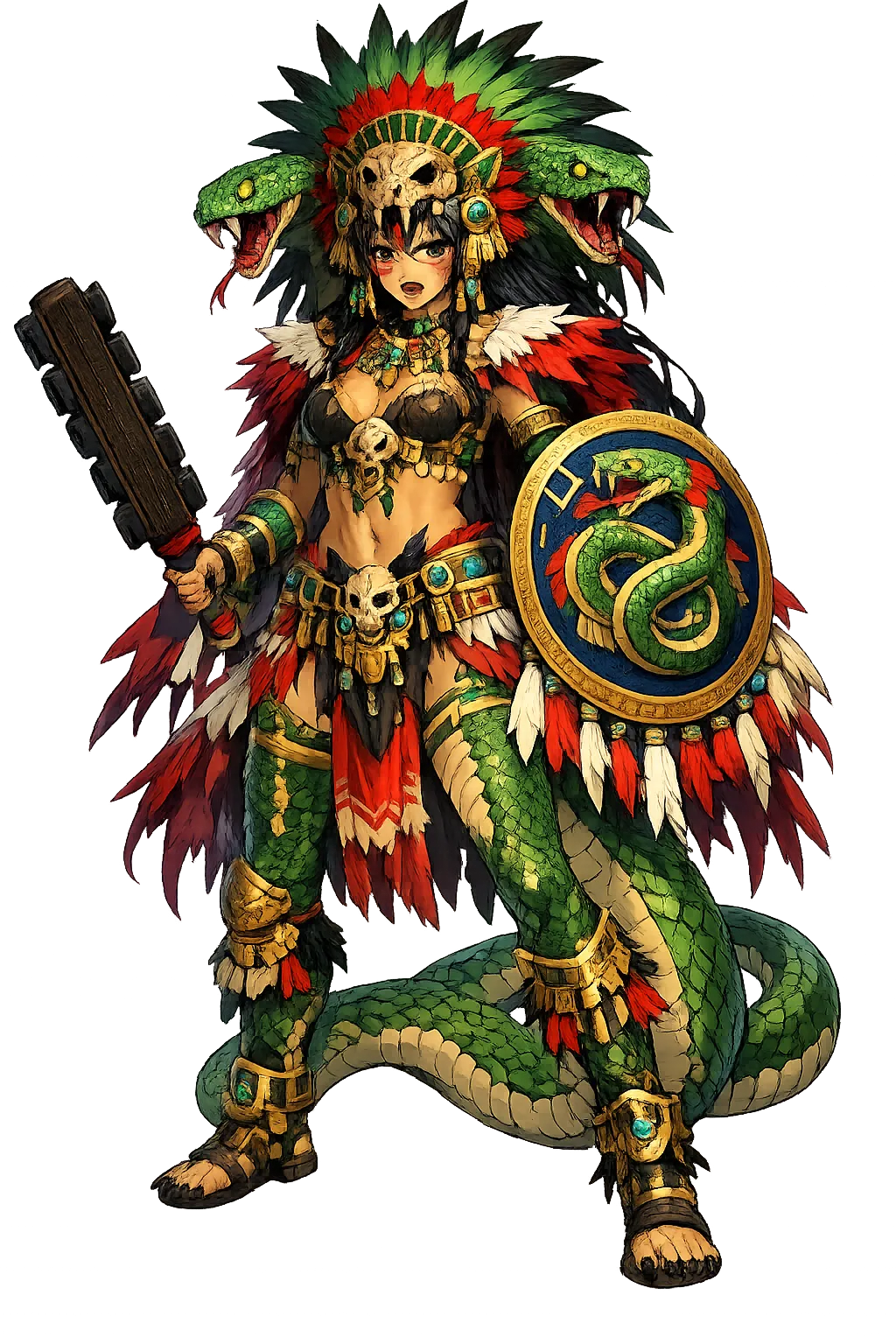
Stories of Cihuacōātl
Cihuacōātl's mythology is preserved in the birth rituals recorded by Sahagún and in the widespread Mexican legend of the weeping woman. She is both a beneficent guardian and a terrifying ghost, a duality that reflects the high mortality of childbirth in the pre-modern world.
Sahagún’s informants describe how the midwife received the newborn as a captive taken in sacred battle: the child, they said, had been chosen in the land of the dead by the gods and delivered into the midwife’s hands. She addressed the infant as a warrior arriving from the sky, invoked the divine protectresses of the birthing chamber — among them Cihuacōātl — cut the umbilicus over an open vessel, and buried the afterbirth in the corner of the house as an offering. The child was bathed, named, and ritually presented to the gods; the cord of a girl child was buried by the hearth, that of a boy by the fields, fixing each life to its future work. Cihuacōātl’s presence ensured the dangerous passage from womb to world ended in life rather than death (Florentine Codex, Book VI). The ritual means birth was classified as war: the mother a battlefield, the midwife a commander, and the goddess the power holding the door.
Women who died in childbirth — above all in a first labor — were believed to become cihuāpīpiltin, “noble women,” spirits of enormous and ambivalent power. They wandered at night dressed in white, faces chalked, hair loose, weeping at crossroads and waterways for the children they had lost; they could seize or strike men who mocked them, appear as omens of war, and visit fathers in dreams. Yet the same powers defended their communities: the spirits of women dead in childbirth were counted among the fierce dead who carried the sun from noon to setting, soldiers in the sky’s war. Over centuries this figure merged with Spanish colonial ghost-lore to produce La Llorona, the weeping woman of Mexican folklore. The transformation means a goddess of childbirth survived conquest by becoming a ghost — the cult suppressed, the grief irrepressible.
The name was also the second-highest office of the Mexica state: Cihuacōātl, “Woman-Snake,” counselor and executor of the ruler’s will. Diego Durán and the Florentine Codex describe the office as “speaker of the city,” sometimes rendered vice-ruler, charged with internal order — the courts, the marketplace, the tribute rolls — while the tlātoāni managed war and diplomacy. Tlācaelel, the great architect of the Aztec state under Itzcōātl and Motēuczōma, held the title for decades and is credited with rebuilding the whole imperial ideology. That the state’s chief magistrate bore a goddess’s name — and a goddess of childbirth at that — suggests the office carried sacred as well as administrative authority: the state, like the birthing chamber, governed a threshold where death stood close by.
When the strangers from the east were coming, omens walked the land — and among them, the ancient ones. The Florentine Codex (Book 12) records that in the tenth year before the strangers’ arrival a woman’s voice was heard crying in the night: “My children, my children, we are lost! Where shall I take you? We are lost, we are doomed!” — the cry of a cihuāteōtl, one of the divine women who had died in childbirth, mourning the world that was ending. The same book lists the comet, the burning temple of Huitzilopochtli, and the mirror that showed the armies marching. Read against her older cult, the wailing woman of the omens is Cihuacōātl herself turned prophetess of catastrophe. The myth means the goddess of birth had become the goddess of ending: the same threshold, walked the other way.
Childbirth, Midwifery, and the Fate of Mothers
Cihuacōātl is the divine midwife and the spectral woman who haunts the crossroads. In one aspect she protects women in labor; in another she wanders at night weeping for children who died unbaptized into life. She embodies the dangerous threshold between pregnancy and birth, life and death, the domestic hearth and the wild road.
She aids women in labor and receives the afterbirth; midwives call upon her and make offerings.
The tēntitl 'midwife' served as her human representative; birthing rituals invoked her power.
La Llorona, the wailing specter of crossroads and waterways, descends partly from Cihuacōātl lore.
She governs the dangerous moment when a new life crosses from the spirit world into the body.
From the original script to the living URL
Cihuacōātl
The name survives only in scholarly transliteration. Cihuacōātl is the standard Nahuatl romanisation, documented in academic sources — “Snake Woman”. Its macron-length vowels preserve distinctions lost in plain ASCII.
No indigenous writing system is securely attested for individual nahuatl names. The form shown is a modern scholarly transliteration.
cihuacoatl
Reduced to plain cihuacoatl, the name loses everything that made it specific: macron-length vowels. What remains is an ASCII string that machines can parse but that no longer speaks with its original voice.
Cihuacōātl
The Unicode restoration recovers what ASCII flattened. Cihuacōātl restores macron-length vowels, returning the name to its original written dignity. The domain encodes to Punycode, but the browser displays the truth.
Cihuacōātl.com → xn--cihuactl-m7a37e.com
The non-ASCII characters in Cihuacōātl are encoded while the ASCII remains visible. To the DNS, it is Punycode. To humanity, it is Cihuacōātl.
Owned, ideal, and ASCII forms of Cihuacōātl
Cihuacōātl
The live temple domain — cihuacōātl.com.
cihuacoatl
The plain ASCII fallback — what DNS and legacy systems see.
How Cihuacōātl was spoken
How Cihuacōātl is preserved in writing
No indigenous writing system is securely attested for individual nahuatl names. The form shown is a modern scholarly transliteration.
Contribute scholarly provenance →The lore you have read is the living myth. Extended Lore opens the scholarly vault beneath it: the cult and its material remains, a history of the image, the name after antiquity, a meditation on what the name still means, and the full scholarly apparatus — etymology, orthography, sources.
Enter Extended Lore