PuniCodex

Extended Lore

Cihuacōātl

Etymology · Orthography · Cult · Iconography · Reception · Sources

Tier 1 Cihuacōātl.com
Cihuacōātl — Childbirth, Motherhood, Earth
01

Quick Facts

Essential information about Cihuacōātl, Childbirth, Motherhood, Earth

Scholarly TransliterationCihuacōātl
Unicode RestorationCihuacōātl
Reconstructed Pronunciation/si.waːˈkoː.aːtɬ/
PantheonNahuatl
DomainChildbirth, Motherhood, Earth
MeaningSnake Woman
ClassificationTier 1
Primary DomainCihuacōātl.com
Sacred SymbolsSerpent, Child swaddling-clothes, Crossroads at night, Cihuapipiltin spirits
02

Etymology & Word Family

From original script to Unicode restoration

Scholarly Transliteration Cihuacōātl Cihuacōātl — "Snake Woman"
Unicode Restoration Cihuacōātl Restored stress, length, and script
Modern ASCII cihuacoatl Plain-ASCII fallback

The name Cihuacōātl carries the orthographic signature of the nahuatl tradition. Unicode restoration recovers what ASCII flattens.

03

Unicode Character Breakdown

Character-by-character philological analysis

CharacterUnicodeNameBlockPhonetic Role
CU+0043Latin Capital Letter CBasic LatinSame, capitalized
iU+0069Latin Small Letter IBasic LatinSame
hU+0068Latin Small Letter HBasic LatinSame
uU+0075Latin Small Letter UBasic LatinSame
aU+0061Latin Small Letter ABasic LatinSame
cU+0063Latin Small Letter CBasic LatinSame
ōU+014DLatin Small Letter O with MacronLatin Extended-AMacron on o
āU+0101Latin Small Letter A with MacronLatin Extended-AMacron on a
tU+0074Latin Small Letter TBasic LatinSame
lU+006CLatin Small Letter LBasic LatinSame

The Tier 1 classification reflects how much of the original phonology this restoration preserves — stress and vowel length for Greek names, distinctive letters and diacritics for every other tradition.

04

Cult & Worship

How the sacred was kept — rites, sanctuaries, remains

The Cult

Her cult lived in the birthing chamber, not the temple precinct. The Florentine Codex (Book VI) preserves the full rite: the midwife received the newborn as a captive taken in sacred war, cut the cord over an open vessel, and buried the afterbirth — a girl's by the hearth, a boy's by the fields — while the divine protectresses of childbirth, Cihuacōātl among them, were invoked by name. Midwives were her effective priesthood, and the ceramic figurines of women in childbirth known from Mesoamerica stand as votive evidence of the whole complex. No excavated sanctuary can be securely assigned to her, though her name was borne by the second-highest office of the Mexica state, the Cihuacōātl, 'Woman-Snake,' who kept the courts and markets. Women who died in labor joined the cihuapipil spirits, feared and honored at crossroads. What survived the conquest was not an institution but a figure: the weeping woman of roads and waterways, still known across Mexico as La Llorona.

In the Earth

Cihuacōātl is not represented by a single monumental sculpture comparable to Cōātlīcue, but her presence is documented in the birth rituals recorded by Sahagún, in ceramic figurines of women in childbirth, and in the large corpus of Nahuatl ritual speech preserved in colonial manuscripts. Cross-cultural parallels with Maya childbirth deities and with colonial-period ex-votos suggest a long history of female-divine assistance at birth in Mesoamerica.

05

Iconography

How Cihuacōātl was imaged across the ages

The Image

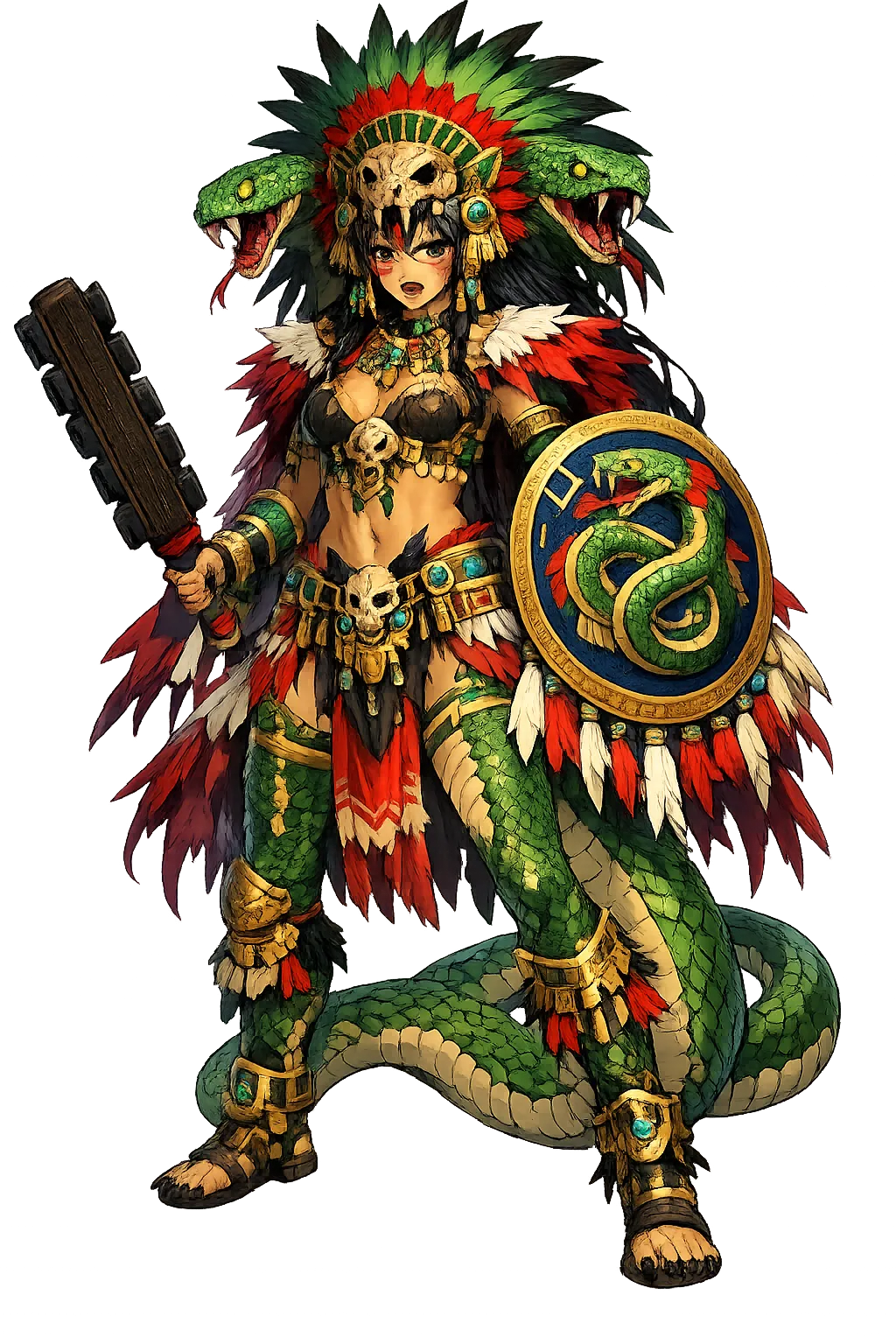
No great cult statue of Cihuacōātl survives to rival Cōātlīcue's, and none is described in the sources; her image was carried instead by the spirits of her company. The cihuāteōtl, the woman dead in childbirth, was drawn in the post-Conquest codices as a white-faced, loose-haired, claw-handed specter — the formula rendered in the Telleriano-Remensis and in Borgia-group manuscripts — and later tradition transferred that chalked face and those flint claws to La Llorona. The goddess's own attributes are textual rather than pictorial: the serpent of her name, the midwife's swaddling gear, the crossroads at night. West Mexican shaft-tomb ceramics preserve the human posture her cult watched over. Read together, the corpus yields a recognizable figure — the chalk-faced woman at the crossing — whose iconography stayed remarkably stable from sixteenth-century manuscript painting to the ghost of modern folklore.

06

Reception & Transformation

The name after its own age — transmission, translation, survival

Afterlives

Her afterlife runs through the conquest itself. In the Florentine Codex (Book XII) a woman's voice cries in the night — 'My children, we are lost' — among the omens that announced the strangers: the goddess of birth become prophetess of ending, recorded between 1540 and 1585 by Sahagún's Nahua informants and scribes. Diego Durán and the Dominican chroniclers preserved her for European readers, and the colonial centuries fused her with the Spanish weeping-woman legend into La Llorona, a fixture of Mexican folklore by the nineteenth century. The scholarly recovery belongs to the twentieth: Francisco del Paso y Troncoso's edition of the Florentine Codex (1905–1907) returned the birth rites to view, Arthur J. O. Anderson and Charles Dibble's English translation (1950–1982) carried them into world scholarship, and Alfredo López Austin's anatomical studies of Nahua religion placed her cosmology on a rigorous footing. Through every metamorphosis — codex page, ghost legend, ethnographic text — the chalked face at the crossroads kept its hold.

Identifications Across Traditions

Cihuacōātl merges in popular memory with La Llorona, the weeping woman of crossroads and rivers, and with the Virgin Mary in her sorrowful or protective aspects. The cihuapipiltin spirits share traits with the Celtic-Spanish banshee and with other worldwide figures of the woman who died in childbirth. In Nahuatl religion she is closely related to Cōātlīcue and Tlāltēcuhtli, forming a cluster of serpent-and-earth maternal powers.

Modern Legacy

Cihuacōātl survives most visibly in La Llorona, a figure known throughout Mexico and the U.S.-Mexico borderlands. The weeping woman at the water's edge, mourning children lost to drowning, violence, or history, carries the ancient goddess into contemporary song, film, and political allegory. Feminist and Chicana writers have reclaimed both Cihuacōātl and La Llorona as symbols of maternal grief, female autonomy, and the suppressed voices of indigenous women.

07

The Meditation

What Cihuacōātl means — beyond the dictionary

Cihuacōātl lives at the threshold. She is the goddess you call when the door between life and death is swinging open and a child is trying to pass through. For most of human history, that door was wider than it is now; many women and infants did not survive the crossing. Cihuacōātl is the divine witness to that grief.

Her later form as La Llorona shows how ancient goddesses become ghosts, and how ghosts become moral lessons. But beneath the cautionary tale is something older and more tender: the recognition that birth is a battle, that mothers are warriors, and that some losses echo forever along the roads and rivers. To speak her name with the long vowels restored is to remember that this was once a goddess, not merely a bogey.

08

Frequently Asked Questions

Common questions about Cihuacōātl, Childbirth, Motherhood, Earth, and Unicode restoration

01How do you pronounce Cihuacōātl?

In reconstructed pronunciation, Cihuacōātl is /si.waːˈkoː.aːtɬ/ — approximately 'see-wah-KOH-ahtl' — the first vowel is short, the 'c' is a hard 'k,' and the final -tl is one crisp tongue-stop.

02What does Cihuacōātl mean?

Cihuacōātl means Snake Woman in the nahuatl tradition.

03What are the symbols of Cihuacōātl?

Cihuacōātl is associated with Serpent (The snake element shared with Cōātlīcue, linking her to earth powers and regeneration), Child swaddling-clothes (Midwives' equipment associated with her protection of births), Crossroads at night (The liminal space where she appears as a weeping woman carrying a dead child), Cihuapipiltin spirits (The 'noble women' who died in childbirth and became fierce omens and warriors of the sun).

04Why restore Cihuacōātl in Unicode?

Plain ASCII cihuacoatl strips the stress, length, and script that make the name specific. Unicode restoration returns the name to its original written dignity.

05What is the most important myth about Cihuacōātl?

“The Midwives’ Prayer” — the Ritual myth story that anchors the mythology of Cihuacōātl, told in full on the lore page.

09

Scholarly Sources

The philological foundations of this restoration

Every claim on this page is grounded in established scholarship. The orthographic restorations follow disciplinary convention. The etymological chain follows the best available reference works. This is not invention — it is resurrection through scholarship.

◈

Lexicography & Philology

  • Sahagún
◎

Primary Texts

  • The Florentine Codex (Sahagún); the Anales de Cuauhtitlan; colonial Nahuatl testimonies and pictorial manuscripts.
◉

Archaeology & Art History

  • Material evidence — iconography, inscriptions, and temple archaeology — for Cihuacōātl and related cults.
✦

Religious Studies

  • Sahagún, Florentine Codex
  • Durán, Book of the Gods and Rites
  • Karttunen, An Analytical Dictionary of Nahuatl
  • Andrews, Introduction to Classical Nahuatl
  • López Austin, The Human Body and Ideology
  • Nuttini and Roberts, Bloodsucking Witchcraft
  • Pérez, 'La Llorona: A Mexican Medea'
Return

The Surface Awaits

You have traced the name from its earliest attestation to its Unicode restoration. Now return to the myth. The story is where the name lives.

Back to Lore
Cihuacōātl mascot