
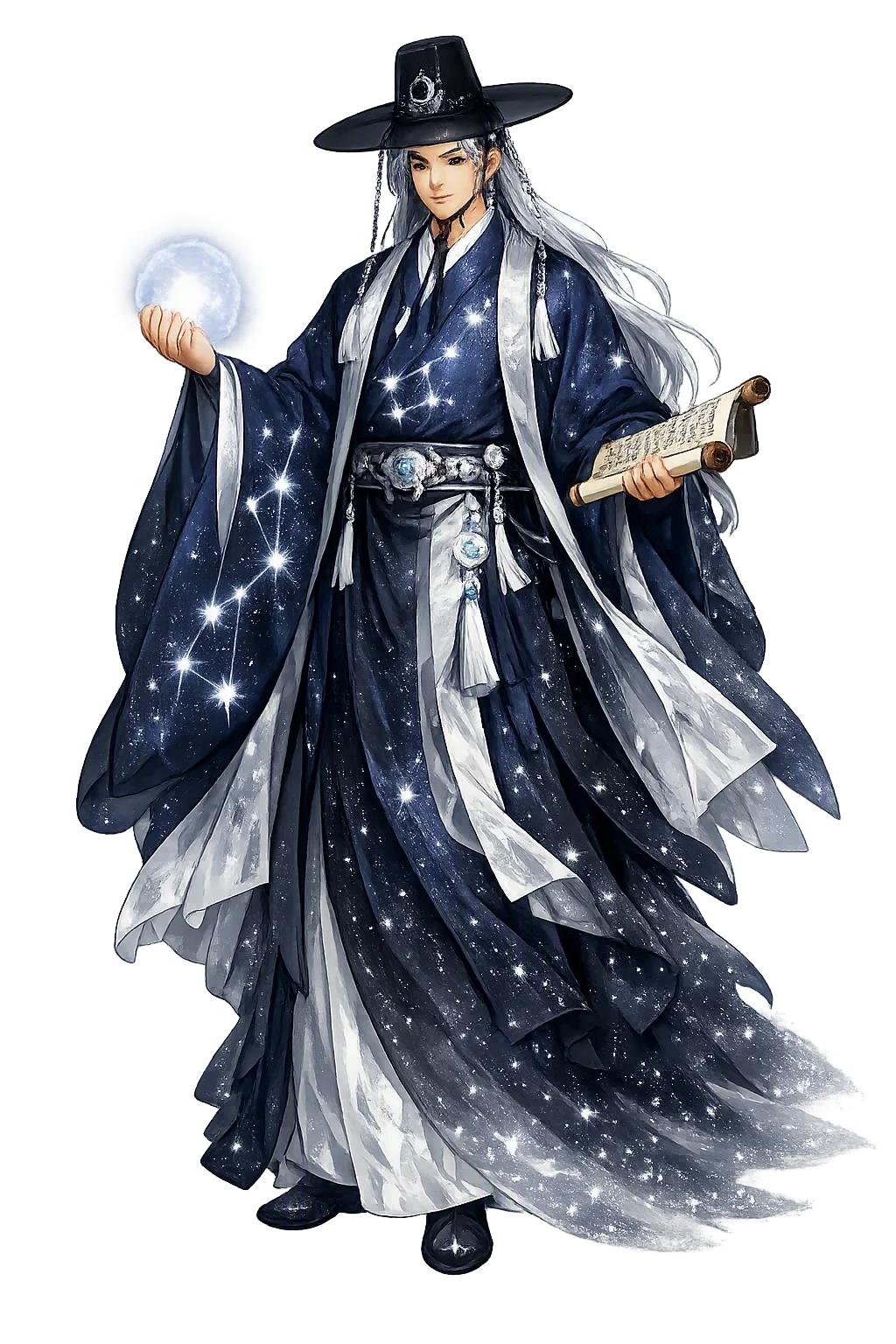
How Chilsong was rebuilt, mark by mark
The workshop file for Chilsong. Every rejected form is recorded here too — that is the point of keeping notes.
What We Found
The attestation runs through the tradition's own sources: 칠성 (七星). Meaning: "Seven stars".
The figure behind the name: No epic tells Chilsong's story; the sources are court protocol, monastic liturgy, and village custom, and on one point they agree — the seven lights of the northern sky keep each person's days.
What the Name Carried In
The Seven Lights Who Keep the Days. In Korean folk religion, as recorded in the collections of the National Folk Museum of Korea, the seven stars of the Big Dipper are not lights but officials: Chilseongsin, the star spirits, who keep the register of every life beneath the northern sky. When a child is born, the days are written in the Dipper's book; when a life nears its term, the household may appeal.
The Ch'ilseongnan, Averting the Stars' Calamity. When crisis struck the Joseon dynasty — invasion, epidemic, a comet over the palace — the court did not appeal to heaven in the abstract; it addressed the seven stars by name. The uigwe, the royal protocols of the Joseon court, prescribe the Ch'ilseongnan (七星難), the rite for averting the calamity of the seven stars, performed by the king and his ministers in the palace precinct to turn aside the disasters the Dipper was believed capable of sending upon the state.
A spelling that has to carry stories like these is not a label. It is equipment.
Where It Stood Before Us
The material record of Chilsong worship is recent but rich. The seven stars stand at the northern crown of the Cheonsang Yeolcha Bunyajido, the great Korean star chart first engraved on stone in 1395 and recut in 1687 — the surviving copy is National Treasure of Korea no. 228, its three thousand stars centered on the circumpolar region the Dipper governs. The Joseon court's own liturgies survive on paper: the uigwe protocols for the Ch'ilseongnan rite, including the Oegyujanggak set returned from France in 2011 and now held by the National Palace Museum of Korea. And the shamanic layer has its own artifacts: paintings of Chilseongsin in official robes, holding the tablets of life and death, are preserved in the collections of the National Folk Museum of Korea and the Gahoe Museum, Seoul. The bench inherits all of it — the web temple is the newest site, not the first.
What We Rejected
The plain ASCII chilsong — admissible as a fallback, never as the primary. A wrong accent would have been worse: the rulebook is explicit that a misplaced mark is worse than none.
What We Set Down
Chilsong — The restoration keeps one feature the ASCII form drops. One is enough to matter, and the label says so plainly: Tier-2.
For the voice: 'CHEEL-song' — The first consonant is aspirated; the second syllable ends in a velar nasal. The name refers to the seven stars of the Northern Dipper.
The temple stands at /chilsong/ — the notes above are public in its Scholarly Edition, sources and all.
At a Glance
- Restored name: Chilsong
- ASCII form: chilsong
- Meaning: "Seven stars"
- Domain of influence: Seven Stars, Ursa Major
- Pantheon: Korean
- Classification: Tier 2
- Original script: 칠성 (七星)
- Series: The Restoration Files, No. 106 of 548
The File Continues
The temple's founding dispatch tells the name's story; its Resonance File reads the myths into the industries; the blog index holds the whole archive.
Continue the series — previous file: Cháos (read it here) · next file: Chímaira (read it here).
The Restoration Files are written from the same canonical record as the temples themselves: the lexicon, the lore catalog, the pattern atlas, and the cited scholarly sources. If a file ever disagrees with its temple, the temple is right — tell us, and the file will be corrected.