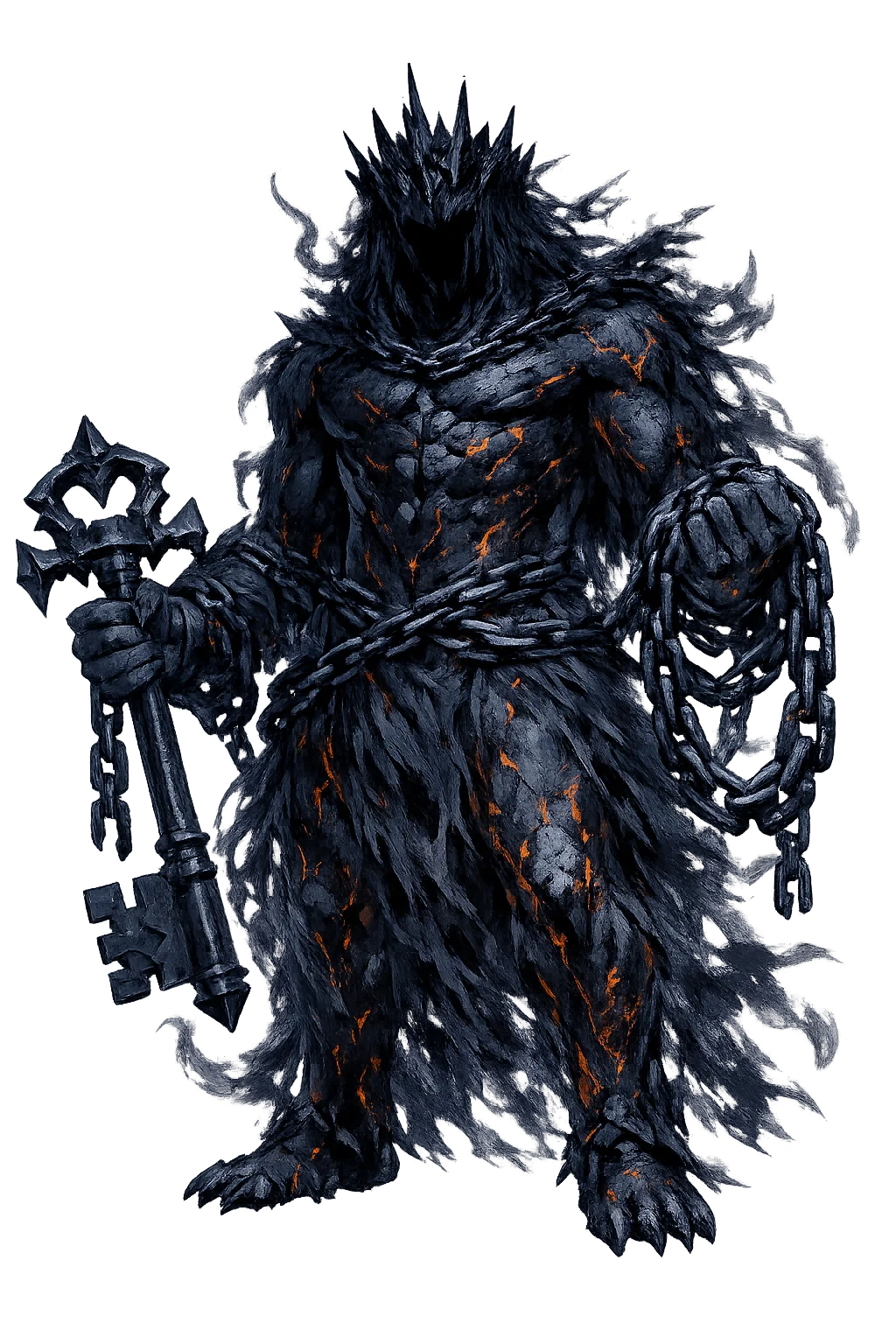
Stories of Cháos
Cháos has no myths in the usual sense — no loves, no wars, no disguises. It is the stage before the drama. Yet its single appearance in the Theogony is the most important stage direction in Greek literature, and later ages fought over what it meant.
Hesiod opens the Theogony (116) with the famous line: ‘Verily at the first Cháos came to be, but next wide-bosomed Gaia.’ The verb matters: Cháos did not exist from everlasting; it came to be (genet’) — the first event, the first thing to arise from whatever preceded things. Only then does Gaia appear, firm seat of all; then dim Tartaros sunk in the earth; then Éros, fairest among the deathless gods. Aristotle, centuries later, read the passage as a philosopher's guess that place (topos) exists — Cháos as the space a world needs before it can have parts (Physics 208b27–33). The interpretive point is easy to miss and essential: Hesiod's Cháos is not a god, not a force, not a substance, but an opening — the grammatical fact that something came first, and that what came first was room. The myth means that before there can be anything, there must be somewhere for it to be.
From Cháos come Erebos (deep Darkness) and Nyx (Night) — Theogony 123 — and they are not made by any act of will; they simply differentiate out of the gap, the first distinctions inside the opening. Nyx then bears a whole brood of her own without a mate: Doom (Moros), black Ker, Thanatos, Hypnos, the tribe of Oneiroi, Blame, Woe, and finally Éris, Strife, mother of toils and forgetfulness and famine and pains (Theogony 211–232). The luminous counterweight arrives by union: Nyx and Erebos together produce Aithḗr and Hēmerē, bright air and Day (Theogony 124–125), and Hesiod imagines the two pairs passing each other at a bronze threshold at the edges of the earth, one entering as the other leaves (Theogony 748–757). The sequence is the first law of Greek cosmogony: from one gap, an entire population of opposites — darkness, night, light, day, and every calamity that walks between them.
Ovid reopens creation in Latin and quietly changes everything. In Metamorphoses 1.5–31 the world's first state is a rudis indigestaque moles, a ‘rough, undigested mass’, a heap of warring seeds — hot against cold, moist against dry, soft against hard — with no sun, no land, no air, only ‘a shapeless, unwrought thing, nothing but weight and the discordant seeds of things packed in one place’. A god — ‘better nature’ — then separates the elements and binds the estranged parts in peace. This is Stoic-inspired cosmology, not Hesiod: the gap has become raw material awaiting a craftsman. But Ovid's version won. Through his enormous authority, Cháos drifted from ‘yawning opening’ to ‘turbulent disorder’, and modern English ‘chaos’ — mess, confusion, noise — descends from this Latin reversal, not from the Greek original. The myth is a warning about reception: the most-read version of a story can become the wrong version, and stay wrong for two millennia.
In the Birds (693–703), produced in 414 BCE, Aristophanes parodies the Hesiodic opening for laughs — and in doing so proves it was public knowledge. His chorus of birds sings: in the beginning were Cháos, and Nyx, and black Erebos, and vast Tartaros; there was no Earth, no Air, no Heaven; and in the boundless bosom of Erebos, black-winged Nyx first laid a wind-egg, from which, in the fullness of a year, sprang Éros, the desirable, with his golden wings — and Éros, mating in Tartaros with windy Cháos, hatched the race of birds and brought them to light. The parody is precise: Aristophanes keeps Hesiod's primordials in order, then substitutes his own beloved birds for the Titans. Comedy is the oldest witness that by the classical period the ‘Cháos first’ sequence was so canonical it could be assumed in a theater full of Athenians. The myth means that cosmogony had become civic property — the opening of the world was something every citizen could sing, mock, and rearrange.
The Yawning Gap, First of All — the opening in which the world appears
Cháos is not disorder. It is not noise, mess, or confusion. In Hesiod's Greek, Cháos is the yawning gap — the first thing to exist, the empty interval in which everything else could appear. Before Earth, before Sky, before the gods themselves, there was the opening.
The original meaning: a gape, a chasm, the interval before form — χαίνω, 'to yawn', hardened into the first noun of the world.
Not empty, but unformed — the reservoir from which Erebos, Nyx, and every later distinction arise.
The first stratum of being, preceding Gaia, Tartaros, and Eros — the floor beneath all genealogy.
The boundary between non-being and being; Aristotle read Cháos as space itself, the precondition of place.
From the original script to the living URL
Χάος
The name in its original Greek form. Cháos (Χάος) is attested in the source tradition — “Gap, yawning void (from χάος)”. Its acute accents carry the full phonetic and orthographic weight of the source tradition.
chaos
Reduced to plain chaos, the name loses everything that made it specific: acute accents. What remains is an ASCII string that machines can parse but that no longer speaks with its original voice.
Cháos
The Unicode restoration recovers what ASCII flattened. Cháos restores acute accents, returning the name to its original written dignity. The domain encodes to Punycode, but the browser displays the truth.
Cháos.com → xn--chos-6na.com
The non-ASCII characters in Cháos are encoded while the ASCII remains visible. To the DNS, it is Punycode. To humanity, it is Cháos.
Owned, ideal, and ASCII forms of Cháos
Cháos
Restores Χάος. The live temple domain — cháos.com.
chaos
Flattens Χάος. The plain ASCII fallback — what DNS and legacy systems see.
How Cháos was spoken
How Cháos travels from ancient script to the modern URL
Greek Χάος; from χαίνω “to yawn, gape"; the primordial gap or yawning void.
The First Void
The Unicode restoration Cháos preserves Greek stress and length; the ASCII form chaos loses these features.
The lore you have read is the living myth. Extended Lore opens the scholarly vault beneath it: the cult and its material remains, a history of the image, the name after antiquity, a meditation on what the name still means, and the full scholarly apparatus — etymology, orthography, sources.
Enter Extended Lore