The Living Myth
Moon, Immortality, Mid-Autumn · The Moon goddess who drank the elixir of immortality
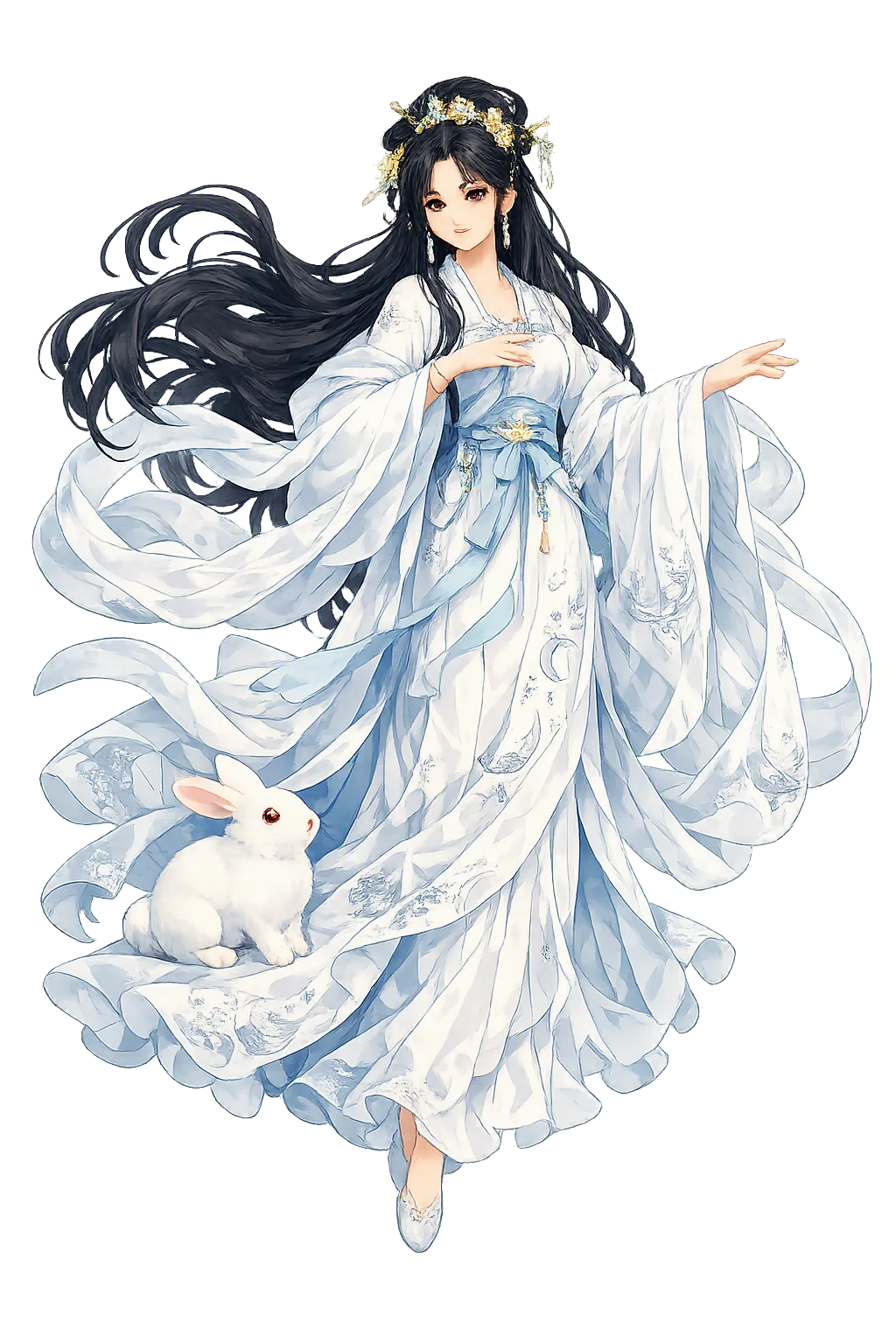
Stories of Chángé
Chángé's story is short and inexhaustible: one ascent, endlessly retold. The early sources preserve a bare skeleton — an elixir, a flight, a moon — and two thousand years of poets, painters, and festival-goers have hung their longing on it.
The core myth, fixed in the Lǎnmíng xùn 覽冥訓 chapter of the Huáinánzǐ (c. 139 BCE), begins with the archer Hòuyì, who had shot down nine of the ten suns and so received from Xīwángmǔ, Queen Mother of the West, the elixir of immortality. Chángé took it and floated up to the moon, where she became its goddess. The sources divide on her motive: in some versions she drinks to keep the elixir from Féngméng, Hòuyì's treacherous disciple; in others she drinks out of her own longing for deathlessness. Scholarship preserves both strands rather than adjudicating between them — the myth holds theft and sacrifice in suspension, and it is precisely the undecidability that has kept two thousand years of readers arguing on her behalf or against it — the earliest Chinese debate about a woman's motives that is still open.
The goddess was originally 姮娥 Héng'é. Under the Han, her name was altered to avoid the naming taboo on the personal name of Emperor Wen, Liú Héng 劉恆: the graph 姮 was replaced by the synonymous 常, and Héng'é became Chángé. It is a rare case where imperial censorship is legible inside a divine name itself — a goddess renamed so that a mortal emperor's name could remain unspoken. The change also shows how the myth lived inside institutions rather than outside them: not a fossil preserved in a book, but a name people actually said, and therefore a name the court could edit. Every modern recitation of 'Chángé' quietly repeats a two-millennium-old act of deference — the goddess has been carrying an emperor's taboo on her own identity ever since.
Her court on the moon is small and eternal. The Jade Rabbit (玉兔) stands at her side, pounding the elixir of immortality with mortar and pestle — the same work, night without end. Beside the palace grows a cassia tree that heals every wound the moment it is struck; the woodcutter Wú Gāng was condemned to fell it, and so he chops forever at a trunk that will not fall. Companionship, labor, and futility share one silver landscape. The two figures are the goddess's household gods of persistence: one works usefully forever, the other pointlessly forever, and the moon keeps both. Folk religion rarely states its theodicy outright, but here it is drawn plainly — the wheel of toil turns under every sky, even the coldest one, and the only comfort is that someone is there while it turns.
At the full moon of the eighth lunar month, China keeps the Mid-Autumn Festival (中秋節). Families gather, mooncakes are cut into wedges like the phases returning to round, and eyes turn upward to the brightest moon of the year — to her. Sū Shì's famous lyric of 1076 closes with the wish that, though a thousand miles apart, we may share chánjuān 嬋娟 — the lovely one, the moon, her. The festival reads her exile backward: the goddess who can never come home becomes the patroness of everyone who can. It is the myth's final inversion — the coldest palace in heaven underwriting the warmest night on earth, and loss itself converted, once a year, into an instrument of reunion: the goddess of distance presiding over the one night no one is meant to spend apart.
Immortality, Exile, Reunion
Chángé is the woman who swallowed forever and paid for it with the earth. Wife of the archer Hòuyì, she came into possession of the elixir of immortality from the Queen Mother of the West — and drank it. Whether to keep it from a treacherous disciple or out of her own longing, the sources divide; what they agree on is the result: she rose through the night until the moon received her, and there she remains, in the Guǎnghán Palace — the Palace of Vast Cold.
Her dwelling and her domain; the full moon of Mid-Autumn is read as her face, brightest and roundest when mortal eyes seek reunion.
Her husband, who shot down nine of the ten suns and received the elixir of immortality from Xīwángmǔ — the gift that divided them forever.
The Guǎnghán Palace (廣寒宮), her luminous and solitary court on the moon, shared with the Jade Rabbit and the woodcutter Wú Gāng.
The Mid-Autumn Festival (中秋節): mooncakes, moon-gazing, and the gathering of families — the night her separation sanctifies mortal togetherness.
From the original script to the living URL
嫦娥
The name in its original Chinese form. Chángé (嫦娥) is attested in the source tradition — “The Moon goddess who drank the elixir of immortality”. Its acute stress marks carry the full phonetic and orthographic weight of the source tradition.
change
Reduced to plain change, the name loses everything that made it specific: acute stress marks. What remains is an ASCII string that machines can parse but that no longer speaks with its original voice.
Chángé
The Unicode restoration recovers what ASCII flattened. Chángé restores acute stress marks, returning the name to its original written dignity. The domain encodes to Punycode, but the browser displays the truth.
Chángé.com → xn--chng-6na4c.com
The non-ASCII characters in Chángé are encoded while the ASCII remains visible. To the DNS, it is Punycode. To humanity, it is Chángé.
Owned, ideal, and ASCII forms of Chángé
Chángé
Restores 嫦娥. The live temple domain — chángé.com.
change
Flattens 嫦娥. The plain ASCII fallback — what DNS and legacy systems see.
How Chángé was spoken
How Chángé is preserved in writing
A bespoke provenance study for Chángé is being prepared by the PUNICODEX scholarly team.
Contribute scholarly provenance →The lore you have read is the living myth. Extended Lore opens the scholarly vault beneath it: the cult and its material remains, a history of the image, the name after antiquity, a meditation on what the name still means, and the full scholarly apparatus — etymology, orthography, sources.
Enter Extended Lore