PuniCodex

Extended Lore

Chángé — The Deeper Record

Etymology · Orthography · Cult · Iconography · Reception · Sources

Preserves stress Chángé.com
Chángé — Moon, Immortality, Mid-Autumn
01

At a Glance

Chángé — every fact links to its home

PantheonChinese
DomainMoon, Immortality, Mid-Autumn
Attestedc. 139 BCE
Original Script嫦娥 →
Cited Works9 cited →
02

Etymology & Word Family

From original script to Unicode restoration — the full etymology page →

Original Script 嫦娥 Chángé — "The Moon goddess who drank the elixir of immortality"
Unicode Restoration Chángé Restored stress, length, and script
Modern ASCII change Plain-ASCII fallback

The name Chángé carries the orthographic signature of the chinese tradition: 嫦娥. Unicode restoration recovers what ASCII flattens.

03

Unicode Character Breakdown

Character-by-character philological analysis

CharacterUnicodeNameBlockPhonetic Role
CU+0043Latin Capital Letter CBasic LatinSame, capitalized
hU+0068Latin Small Letter HBasic LatinSame
áU+00E1Latin Small Letter A with AcuteLatin-1 SupplementStress on a
nU+006ELatin Small Letter NBasic LatinSame
gU+0067Latin Small Letter GBasic LatinSame
éU+00E9Latin Small Letter E with AcuteLatin-1 SupplementStress on e

The restoration of Chángé preserves what it can of the original phonology — stress and vowel length for Greek names, distinctive letters and diacritics for every other tradition.

04

Cult & Worship

How the sacred was kept — rites, sanctuaries, remains

The Cult

No priesthood and no temple network was ever Chángé's; her cult is calendrical and domestic, and it is old. The Lǐjì's "Monthly Ordinances" already prescribe that the ruler greet the sun in spring and pay court to the moon in autumn — a royal moon sacrifice at the full moon of the eighth month that is the calendrical root of Mid-Autumn. By Song times the rite had migrated into the courtyard: an altar table set with mooncakes, pomelo, tea, and incense, the household bowing toward the full moon, exactly the observance local gazetteers still record. Taoism gave her a bureaucratic seat as Tàiyīn Xīngjūn, Sovereign of the Lunar Luminary, whom Daoist temples honor on the same night. Her true liturgy is the sharing of the round cake and the long look upward — every family its own sanctuary, the full moon itself the only icon required.

In the Earth

The flight to the moon is attested remarkably early. An early version of the story circulated in the Guǐcáng (歸藏), a divination text known from medieval quotations and from Qin-dynasty bamboo slips excavated at Wangjiatai in Hubei (tomb closed c. 3rd century BCE), in which Héng'é takes the elixir and ascends. The Huáinánzǐ (c. 139 BCE) gives the first full surviving account. Pictorial evidence is nearly as old: the painted silk funeral banner from Mawangdui Tomb 1 (sealed 168 BCE) depicts the moon disk with its toad and rabbit, and Han pictorial stones — notably from the Nanyang region — show Chángé in flight toward the moon, her robes streaming. Later dynasties rendered her on mirrors, ceramics, and festival prints, and moon-gazing scenes became a staple of Ming and Qing painting.

05

Iconography

How Chángé was imaged across the ages

The Image

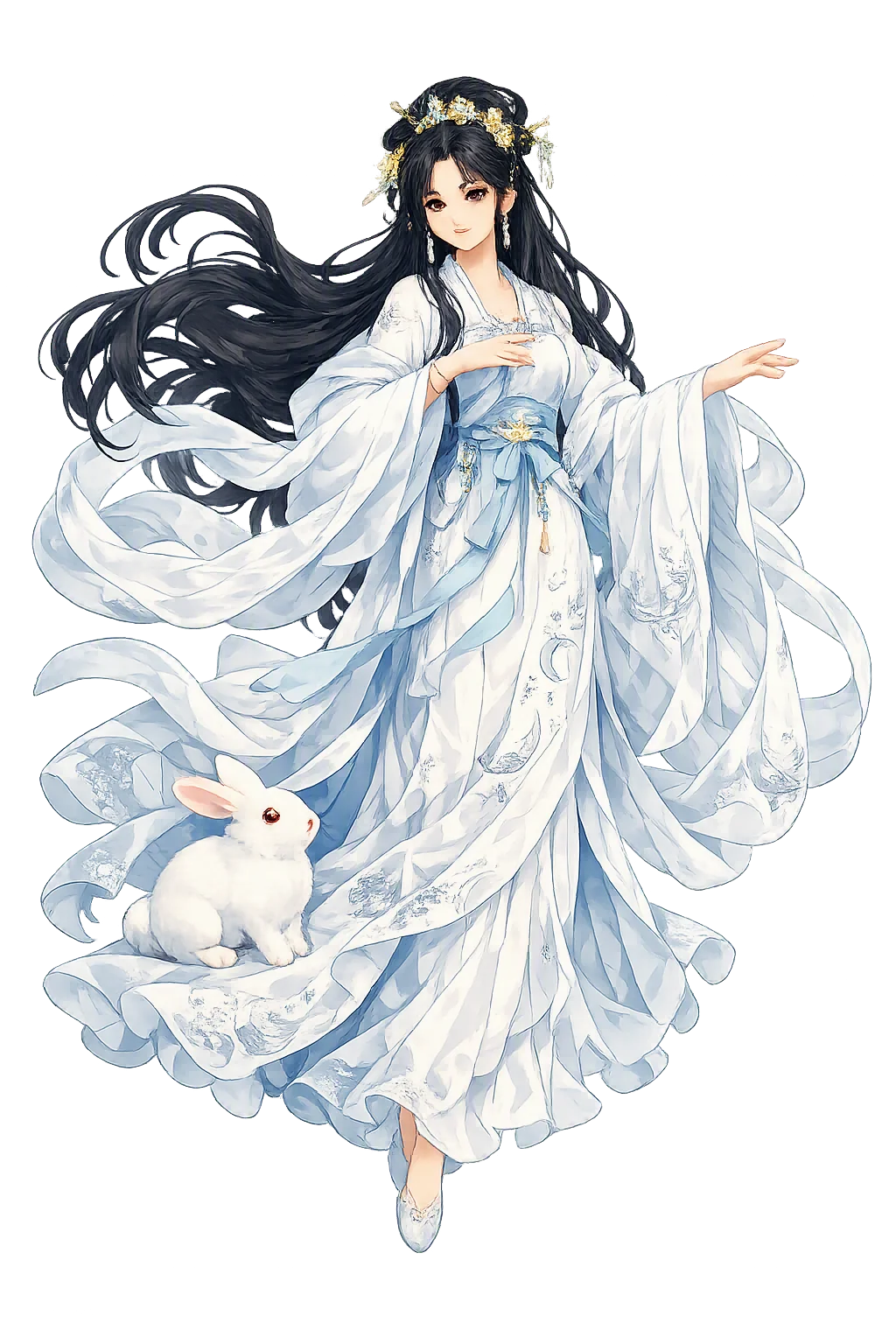
She entered art in flight. The earliest certain images of Chángé herself are Eastern Han pictorial stones from the Nanyang basin — the goddess hastening toward a disk-moon, robes arched behind her like a comet's tail, the toad already waiting in the disk; the Nanyang Han Stone Museum preserves the standard example. A generation older, the painted silk banner from Mawangdui (sealed 168 BCE) gives her setting without her person: the moon disk with its toad and rabbit. Through the Six Dynasties and Tang, painters preferred her household — palace, hare, cassia — to the goddess, and the moon roundels of Dunhuang carried the toad and tree into Buddhist cosmology. A settled portrait type is late and festive: Ming and Qing woodblock prints and porcelain show a court lady in billowing sleeves, sometimes with a cassia branch, posed against the full moon. New Year prints and paper-cuts froze that image, and it is the festival type — not the Han stones — that modern eyes call canonical.

06

Reception & Transformation

The name after its own age — transmission, translation, survival

Afterlives

Chángé's afterlife is a relay of short texts, each runner carrying her further from the sky. A Qin-dynasty version of her flight was buried at Wangjiatai on bamboo slips and recovered only in the 1990s, pushing the attestation of her story back to the third century BCE. The Huáinánzǐ (139 BCE) gave the myth its classical form; Zhang Heng's Língxiàn (c. 120 CE) already names Héng'é stealing the elixir, and Gan Bao's Sōushén jì (c. 350 CE) gave the tale the shape most later retellings keep. Tang poets made her loneliness canonical: Li Shangyin's quatrain "Cháng'é" — azure sea, blue sky, night after night of heart — is the poem every Chinese schoolchild meets her through. Song cities made her domestic, folding her into the Mid-Autumn festival; the Ming novel Journey to the West made her heaven's comic machinery, casting the drunken Marshal Tiānpéng's banishment for importuning her as the origin of Zhū Bājiè. A goddess transmitted not by clergy but by copyists, commentators, and novelists: the manuscript trail is her temple.

Identifications Across Traditions

The rabbit in the moon is older than any single nation's telling of it. Buddhist tradition carried the śaśajātaka — the tale of the rabbit who offered itself as food and was set in the moon as a reward — from India into East Asia, and scholars commonly link the Chinese moon rabbit to this transmission, though the Jade Rabbit's elixir-pounding is China's own elaboration. Taoist religion absorbed Chángé into its celestial bureaucracy, where she is often identified with the sovereign of the yin luminary (太陰). Japan received the moon rabbit without the elixir: there he pounds mochi instead, and the autumn moon-viewing custom (tsukimi) echoes Mid-Autumn without keeping its goddess. Korea's harvest festival Chuseok and Vietnam's Tết Trung Thu share the same full-moon night of cakes, lanterns, and family gathering — the festival traveled further than the myth, and in each harbor took local form.

Modern Legacy

Chángé has been China's shorthand for beautiful distance since the poets claimed her. Sū Shì's Mid-Autumn lyric closes with the wish that, though a thousand miles apart, we may share chánjuān 嬋娟 — the lovely one, the moon, her. The Mid-Autumn Festival remains one of the great holidays of the Chinese world, and the mooncake its edible emblem. In 2020 the animated film Over the Moon carried her to global audiences as a pop-diva goddess still waiting for Hòuyì. Most remarkably, she has gone back: China's lunar exploration program is named for her, and the probes Chángé 1 through 6 (2007–2024) orbited the moon, landed on it, achieved the first landing on its far side (Chángé 4), and returned samples to earth (Chángé 5 and 6). No other deity in this lexicon has been so literally restored to her own heaven.

08

The Original Script Note

What the written record preserves — and what it does not

Original Script

The original script is 嫦娥, written identically in traditional and simplified Chinese; the earlier form of the name is 姮娥, altered under the Han naming taboo on Emperor Wen's personal name. Pinyin Chángé (Tone 2 + Tone 2) is the Modern Standard Mandarin reading, recorded in the Unihan Database and standard dictionaries. The apostrophe is part of standard Hanyu Pinyin orthography, separating the two syllables so the name cannot be misread as a single syllable or wrongly divided; the display form Chángé keeps it, while the registrable domain label drops it, since IDN labels cannot contain an apostrophe — the tone-marked vowels alone carry the restoration into the domain system.

09

The Meditation

What Chángé means — beyond the dictionary

Chángé teaches that every ascent is also a departure. She took the one thing everyone is told to want — endless life — and found that it cost the one thing that makes life bearable: the person she left below. The myth refuses to resolve her motive, and that refusal is its honesty; we have all swallowed things half in longing and half in self-defense, and only later learned which. Her moon is the most beautiful object in the Chinese night precisely because it is the far side of reunion — the light by which the separated recognize one another.

To name a domain Chángé is to claim that paradox: the cold palace and the warm festival, the exile and the homecoming, the goddess who cannot return and the probes that returned for her. It is a name for anyone who understands that distance is not the opposite of devotion but, too often, its price.

10

Frequently Asked Questions

Deep-dives into the cult, attestation, reception, and sources of Chángé

01How do we know how Chángé was worshipped?

The flight to the moon is attested remarkably early. The full cult record →

02Where do the earliest attestations of Chángé come from?

The record rests on Huainanzi, Lǎnmíng xùn 覽冥訓 chapter (the earliest full surviving account), Guicang 歸藏 (divination text; Qin bamboo-slip fragments from Wangjiatai, c. 3rd century BCE, preserve an early version), Shanhaijing (Classic of Mountains and Seas), among 7 cited works. The full source apparatus →

03How did later traditions reinterpret Chángé?

Chángé's afterlife is a relay of short texts, each runner carrying her further from the sky. Reception & transformation →

04What do the surviving images of Chángé actually show?

She entered art in flight. The iconography →

05What does the written record of Chángé actually preserve?

The original script is 嫦娥, written identically in traditional and simplified Chinese; the earlier form of the name is 姮娥, altered under the Han naming taboo on Emperor Wen's personal name. The Original Script note →

11

Scholarly Sources

The philological foundations of this restoration

Every claim on this page is grounded in established scholarship. The orthographic restorations follow disciplinary convention. The etymological chain follows the best available reference works. This is not invention — it is resurrection through scholarship.

◈

Lexicography & Philology

  • Huainanzi
  • Chinese folklore
◎

Primary Texts

  • The Shan Hai Jing (Classic of Mountains and Seas); the Huainanzi; the Chuci.
◉

Archaeology & Art History

  • Chang, K. C. Art, Myth, and Ritual: The Path to Political Authority in Ancient China.
✦

Religious Studies

  • Huainanzi, Lǎnmíng xùn 覽冥訓 chapter (the earliest full surviving account)
  • Guicang 歸藏 (divination text; Qin bamboo-slip fragments from Wangjiatai, c. 3rd century BCE, preserve an early version)
  • Shanhaijing (Classic of Mountains and Seas)
  • Werner, Myths and Legends of China (1922)
  • Sū Shì, Mid-Autumn lyric 'Shuǐdiào Gētóu' (1076)
  • Chang'e — Encyclopaedia Britannica
  • Unihan Database (Unicode Consortium), kMandarin readings for 嫦 and 娥
Return

The Surface Awaits

You have traced the name from its earliest attestation to its Unicode restoration. Now return to the myth. The story is where the name lives.

Back to Lore
Chángé mascot