PuniCodex

Extended Lore

Ceridwen

Etymology · Orthography · Cult · Iconography · Reception · Sources

Tier 2 Ceridwen
Ceridwen — Inspiration, Transformation
01

Quick Facts

Essential information about Ceridwen, Inspiration, Transformation

Scholarly TransliterationCeridwen
Unicode RestorationCeridwen
Reconstructed Pronunciation/kɛrˈɪd.wɛn/
PantheonCeltic
DomainInspiration, Transformation
MeaningBent or crooked woman
ClassificationTier 2
Primary DomainCeridwen
Sacred SymbolsThe cauldron, The three drops, The high-crested black hen, The hide bag, The weir on the Dyfi
02

Etymology & Word Family

From original script to Unicode restoration

Scholarly Transliteration Ceridwen Ceridwen — "Bent or crooked woman"
Unicode Restoration Ceridwen Canonical scholarly spelling — ASCII-identical
Modern ASCII ceridwen Plain-ASCII fallback

The name Ceridwen reaches the modern world through scholarly transliteration of the celtic tradition. Because the conventional spelling uses only Latin letters, its Unicode and ASCII forms coincide — the tradition it carries is in the name itself, not in diacritics.

03

Unicode Character Breakdown

Character-by-character philological analysis

CharacterUnicodeNameBlockPhonetic Role
CU+0043Latin Capital Letter CBasic LatinSame, capitalized
eU+0065Latin Small Letter EBasic LatinSame
rU+0072Latin Small Letter RBasic LatinSame
iU+0069Latin Small Letter IBasic LatinSame
dU+0064Latin Small Letter DBasic LatinSame
wU+0077Latin Small Letter WBasic LatinSame
eU+0065Latin Small Letter EBasic LatinSame
nU+006ELatin Small Letter NBasic LatinSame

The Tier 2 classification here reflects fidelity to the attested tradition, not recovered diacritics: every character of Ceridwen already survives in ASCII. What the restoration preserves is the canonical spelling itself — the form scholarship standardised.

04

Cult & Worship

How the sacred was kept — rites, sanctuaries, remains

The Cult

No temple, priest, altar, or festival of Ceridwen is recorded anywhere, and Wales has left no sanctuary archaeology to fill the gap: her dossier is manuscripts and nothing else. Medieval Welsh verse attests the name — spelled Kerritwen, Kyrridven — and the triads concur on her single fixed attribute, the cauldron of awen; but no source shows anyone performing ritual to her in the Middle Ages. What functioned in place of a cult was the veneration of the thing she owns. Awen — the word her tale made the Welsh name for poetic inspiration — became the operative sacred term of the bardic orders, invoked in the ceremonies of the chair and the eisteddfod tradition, a current running from her cauldron through Welsh letters to the present day. Modern Druid and pagan circles address her directly as keeper of the cauldron; that devotion is two centuries old at most — a revival, honestly labelled, not a survival.

In the Earth

Ceridwen is a textual figure: no temple, votive deposit, or inscription names her, and pre-Christian Wales left no theonymic epigraphy of the continental kind. Her witnesses are manuscripts. The fullest early text of Hanes Taliesin is embedded in the great world-chronicle of Elis Gruffydd, compiled c. 1530–1552 (Aberystwyth, National Library of Wales, MS 5276D); a second version was copied by the recusant scribe John Jones of Gellilyfdy around 1607. The name itself is older than its tale: medieval Welsh poetry preserves it in spellings such as Kerritwen and Kyrridven, and the triads' editors record that the early sources agree on her one fixed attribute — the cauldron of awen. The geography of the story is real and still legible: Llyn Tegid, her lake, is Bala Lake in Gwynedd, the largest natural lake in Wales, which keeps her husband Tegid Foel's name; and Gwyddno's weir, where the bag comes ashore, stands in the tradition at the Dyfi estuary below his drowned realm. No sanctuary of hers is known, and none is claimed: her monument is the tale itself, and the lake that still carries the name.

05

Iconography

How Ceridwen was imaged across the ages

The Image

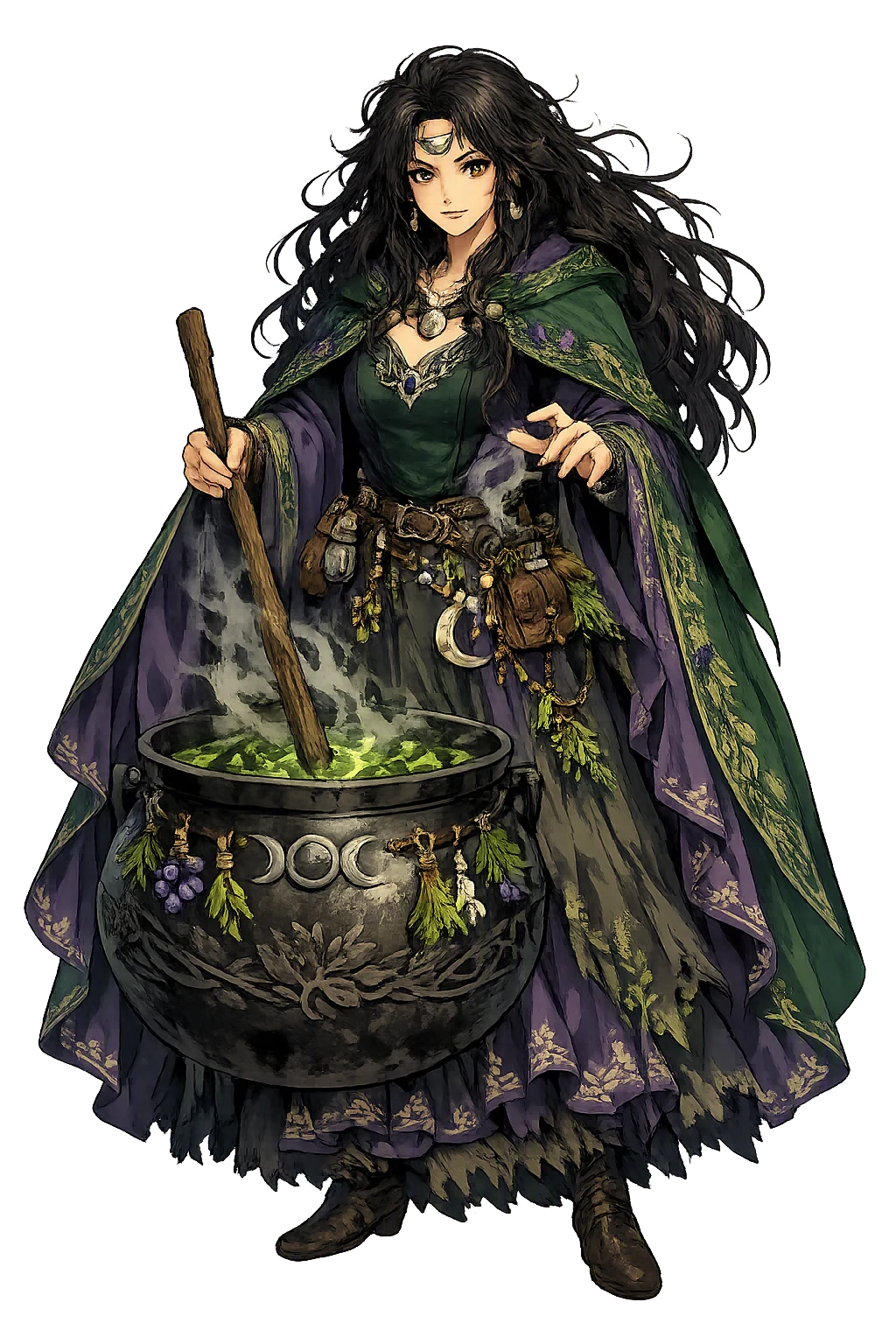
No image of Ceridwen survives from the Middle Ages — no illumination, no carving: Wales pictured her in words or not at all. The texts supply an implicit programme that every later artist followed: the great cauldron steaming over Morda's tended fire, the books of the feryllt, the greyhound, otter-bitch, hawk, and high-crested black hen of the chase, and the hide coracle sewn around the rejected child. Her visual history therefore begins late, with the Victorian appetite for the Mabinogion that Lady Charlotte Guest's translation fed. The founding image is modern: Christopher Williams's painting Ceridwen (1910, Glynn Vivian Art Gallery, Swansea) fixed the type for good — the wild-haired, white-robed woman bent over the steaming vessel, power and menace in a single figure. Twentieth-century book illustration multiplied that Williams type into the standard icon of the witch-goddess at her pot: an image drawn wholly from the tale's own inventory and from a canvas little more than a century old.

06

Reception & Transformation

The name after its own age — transmission, translation, survival

Afterlives

The Tale of Taliesin traveled oddly: it is no part of the Mabinogion proper — the Red Book and White Book do not carry it — but rode in chronicle miscellanies, above all the great world-chronicle of Elis Gruffydd (c. 1550) and a copy by John Jones of Gellilyfdy (c. 1607). Print found it late: the Myvyrian Archaiology of Wales (1801–07) gave it its first wide audience, and through that door it entered English letters — Thomas Love Peacock built his satire The Misfortunes of Elphin (1829) on it, and Lady Charlotte Guest carried it into the drawing rooms of two nations. Scholarship then took up the tale that Ifor Williams had made legible: the triads were edited by Rachel Bromwich, whose apparatus pinned Ceridwen's one secure trait to the cauldron of awen; folklorists set the chase beside its Irish cousins and filed it under the magic flight (Aarne–Thompson type 313); and Patrick Ford's edition and translation (1992) fixed the text the English-speaking world now reads. The transmission is a Welsh parable in itself: the most famous goddess of the tradition lives in a single tale, outside the canon, rescued for the world by chroniclers, satirists, and philologists in turn.

Identifications Across Traditions

The strongest cross-border parallels are Irish. The accidental acquisition of a wisdom brewed for another is the plot of the Irish boyhood deeds of Finn mac Cumaill: cooking the salmon of knowledge for his master Finnéces, the boy Finn burns his thumb, puts it in his mouth, and the knowledge intended for the teacher passes to the servant — the same economy of the three drops and the burning finger. The swallowing that becomes rebirth has its Irish twin in Tochmarc Étaíne, where Étaín, transformed into a fly, falls into a cup of wine, is swallowed by the wife of Étar, and is born again into the mortal world. And the cauldron itself is pan-Celtic furniture: [[dagda|the Dagda]]'s cauldron from Murias feeds every company that comes to it, while the Old Irish text The Cauldron of Poesy locates a cauldron of poetry inside every human being. Folklorists — Juliette Wood chief among them — have shown that Hanes Taliesin braids these native strands with international folktale types, above all the magic flight with its transformation chase. The last syncretism is modern: Iolo Morganwg's Barddas set Ceridwen and the awen at the centre of revival Druidry, and modern Druids and pagans honour her as goddess of the cauldron — a reception Ronald Hutton's histories of the revival document and dissect.

Modern Legacy

Lady Charlotte Guest carried the Tale of Taliesin into English in the nineteenth century, appended to her Mabinogion, and the witch of Llyn Tegid entered the English-speaking imagination beside the Four Branches she never belonged to. Patrick K. Ford's edition and translation fixed the tale's modern scholarly form. Robert Graves made her a figure of international consequence: The White Goddess (1948) read Ceridwen's cauldron and her hunt as the grammar of all true poetry, and though Celticists have never accepted Graves's method, his book set her at the centre of twentieth-century writing about the muse. In Wales the awen she brewed never left the tradition — the word still names poetic inspiration at the National Eisteddfod, and modern Druid orders invoke it in her name — while modern paganism worldwide honours her as keeper of the cauldron of transformation. The name itself, rare in the medieval record, has come back into use as a Welsh given name, carried by the only myth in the language in which a goddess's failure becomes a nation's poetry.

07

The Meditation

What Ceridwen means — beyond the dictionary

Ceridwen is the only great figure of Welsh tradition whose myth is a failure, and whose failure is a gift. She plans everything: the books consulted, the fire kept, the boy set to stir, the year counted to its day. And the plan is perfect except for the one thing no plan commands — where the drops fall. The inspiration she cooked for the son she pitied goes to the son she hunts, and everything she does to recover it only completes the gift: the chase teaches him every shape in creation, the swallowing carries him through the longest transformation of all, and the bag she sews to drown him is the coracle that brings him to his name.

That is the deepest thing the Welsh tradition knows about poetry: it cannot be inherited by arrangement. It is brewed in patience and received by accident; it belongs to whoever is standing by the pot with a burning finger. Ceridwen loses the awen and gains the poet — and the tale does not call her defeated. It simply follows the boy to the sea, and lets the witch of Llyn Tegid rest, her cauldron empty, her work done, her name over the door of every song that comes unplanned.

08

Frequently Asked Questions

Common questions about Ceridwen, Inspiration, Transformation, and Unicode restoration

01How do you pronounce Ceridwen?

In reconstructed pronunciation, Ceridwen is /kɛrˈɪd.wɛn/ — approximately 'keh-RID-wen' — every c is hard, the r is rolled, and the stress falls on the middle syllable, the Welsh penult.

02What does Ceridwen mean?

Ceridwen means Bent or crooked woman in the celtic tradition.

03What are the symbols of Ceridwen?

Ceridwen is associated with The cauldron (Inspiration brewed by art and patience — knowledge as something cooked, not granted), The three drops (The whole of awen compressed into an accident — inspiration that chooses its own vessel), The high-crested black hen (The final shape of the hunt: the swallowing that is not death but the first cell of a poet), The hide bag (The coracle-skin sewn round the unwanted child and given to the sea — rejection that becomes deliverance), The weir on the Dyfi (Gwyddno's salmon-weir where the bag comes to rest — the threshold between the hunted boy and the radiant brow).

04Why restore Ceridwen in Unicode?

Ceridwen is written entirely in ASCII letters, so its restoration is about canonical fidelity rather than recovered diacritics: the temple fixes the name in its scholarly standard spelling, attested in the source tradition, instead of leaving it to drift.

05What is the most important myth about Ceridwen?

“The Household by Llyn Tegid” — the Hanes Taliesin story that anchors the mythology of Ceridwen, told in full on the lore page.

09

Scholarly Sources

The philological foundations of this restoration

Every claim on this page is grounded in established scholarship. The orthographic restorations follow disciplinary convention. The etymological chain follows the best available reference works. This is not invention — it is resurrection through scholarship.

◈

Lexicography & Philology

  • Mabinogion
  • MacKillop
◎

Primary Texts

  • Bartrum, Peter C., A Welsh Classical Dictionary (Aberystwyth: National Library of Wales, 1993), s.v. Ceridwen — early spellings Kerritwen, Kyrridven
◉

Archaeology & Art History

  • Material evidence — iconography, inscriptions, and temple archaeology — for Ceridwen and related cults.
✦

Religious Studies

  • Hanes Taliesin (The Tale of Taliesin) — ed. Patrick K. Ford, Ystoria Taliesin (Cardiff: University of Wales Press, 1992); trans. Ford, The Mabinogi and Other Medieval Welsh Tales (Berkeley, 1977)
  • The Mabinogion, trans. Lady Charlotte Guest (1838–49; the Tale of Taliesin appended in later editions)
  • Bromwich, Rachel, ed., Trioedd Ynys Prydein: The Triads of the Island of Britain, 3rd ed. (Cardiff, 2006), p. 309 — 'the early sources concur in presenting Ceridwen as the owner of a cauldron which was the source of poetic inspiration (awen)'; Ifor Williams' proposed Cyridfen, 'crooked woman'
  • Macgnímartha Finn (The Boyhood Deeds of Fionn); Nagy, Joseph Falaky, The Wisdom of the Outlaw (Berkeley, 1985) — the salmon of knowledge parallel
  • Tochmarc Étaíne, ed. and trans. Bergin and Best, Ériu 12 (1938) — the swallowing and rebirth parallel
  • Wood, Juliette, 'The Elphin Section of Hanes Taliesin', Études Celtiques 18 (1981) — the folktale structure of the tale
  • Hutton, Ronald, The Druids (London, 2007) — Iolo Morganwg, the Barddas, and the awen in the Druid revival
Return

The Surface Awaits

You have traced the name from its earliest attestation to its Unicode restoration. Now return to the myth. The story is where the name lives.

Back to Lore
Ceridwen mascot