PuniCodex

Extended Lore

Κέρβερος Kérberos

Etymology · Orthography · Cult · Iconography · Reception · Sources

Tier 2 Kérberos.com
Kérberos — Underworld Guardian
01

Quick Facts

Essential information about Kérberos, Underworld Guardian

Original ScriptΚέρβερος
Unicode RestorationKérberos
Reconstructed Pronunciation/ˈker.be.ros/
PantheonGreek
DomainUnderworld Guardian
MeaningSpot, darkness
ClassificationTier 2
Primary DomainKérberos.com
Sacred SymbolsThe many heads, The mane of serpents, The honeyed cake, The chain of Heracles
02

Etymology & Word Family

From original script to Unicode restoration

Original Script Κέρβερος Kérberos — "Spot, darkness"
Unicode Restoration Kérberos Restored stress, length, and script
Modern ASCII cerberus Plain-ASCII fallback

The name Kérberos carries the orthographic signature of the greek tradition: Κέρβερος. Unicode restoration recovers what ASCII flattens.

03

Unicode Character Breakdown

Character-by-character philological analysis

CharacterUnicodeNameBlockPhonetic Role
KU+004BLatin Capital Letter KBasic LatinGreek kappa (Κ)
éU+00E9Latin Small Letter E with AcuteLatin-1 SupplementAcute on e
rU+0072Latin Small Letter RBasic Latinr same
bU+0062Latin Small Letter BBasic Latinb same
eU+0065Latin Small Letter EBasic Latine same
rU+0072Latin Small Letter RBasic Latinr same
oU+006FLatin Small Letter OBasic LatinGreek omicron (Latin -u- for Greek -ο-)
sU+0073Latin Small Letter SBasic Latins same

The Tier 2 classification reflects how much of the original phonology this restoration preserves — stress and vowel length for Greek names, distinctive letters and diacritics for every other tradition.

04

Cult & Worship

How the sacred was kept — rites, sanctuaries, remains

The Cult

No sanctuary, altar, priesthood, or festival of Kérberos is attested anywhere in the surviving record: he is the rare major figure of Greek myth who was never the recipient of cult, only its guardian-symbol. What the sources give instead is the ritual complex gathered around him. The honey-cake the Sibyl feeds him in the Aeneid reflects real Roman practice: at the Feralia, the closing day of the Parentalia in February, Ovid describes an old woman baking honeyed liba for the Manes, and honeyed sops were a standing grave-offering — the passage-rite made edible. His threshold was localized in living sanctuaries of the dead: the cave at Cape Tainaron with its temple of Poseidon (Pausanias 3.25.5), the oracle of the dead at Ephyra on the Acheron in Thesprotia (Pausanias 1.17.5), and the sanctuary of Clymenos — a name of Hades — at Hermione (Pausanias 2.35). On Roman cinerary urns and sarcophagi he stands at the tomb's door doing the job no priest could: keeping what is inside, in.

In the Earth

Greek art drew him early and often: black-figure vases of the sixth century BCE show Heracles leading the hound on a chain, usually with two or three heads though Hesiod says fifty, and the type persists through the Caeretan hydriai and Attic red-figure. The Greeks pointed to real descents: the cave at Cape Tainaron in the southern Peloponnese was shown as the mouth by which Heracles dragged him up (Pausanias 3.25), and Heracleia Pontica claimed the same honor on the Black Sea. His lines in the Theogony remain the oldest written portrait of the underworld's watch-dog.

05

Iconography

How Kérberos was imaged across the ages

The Image

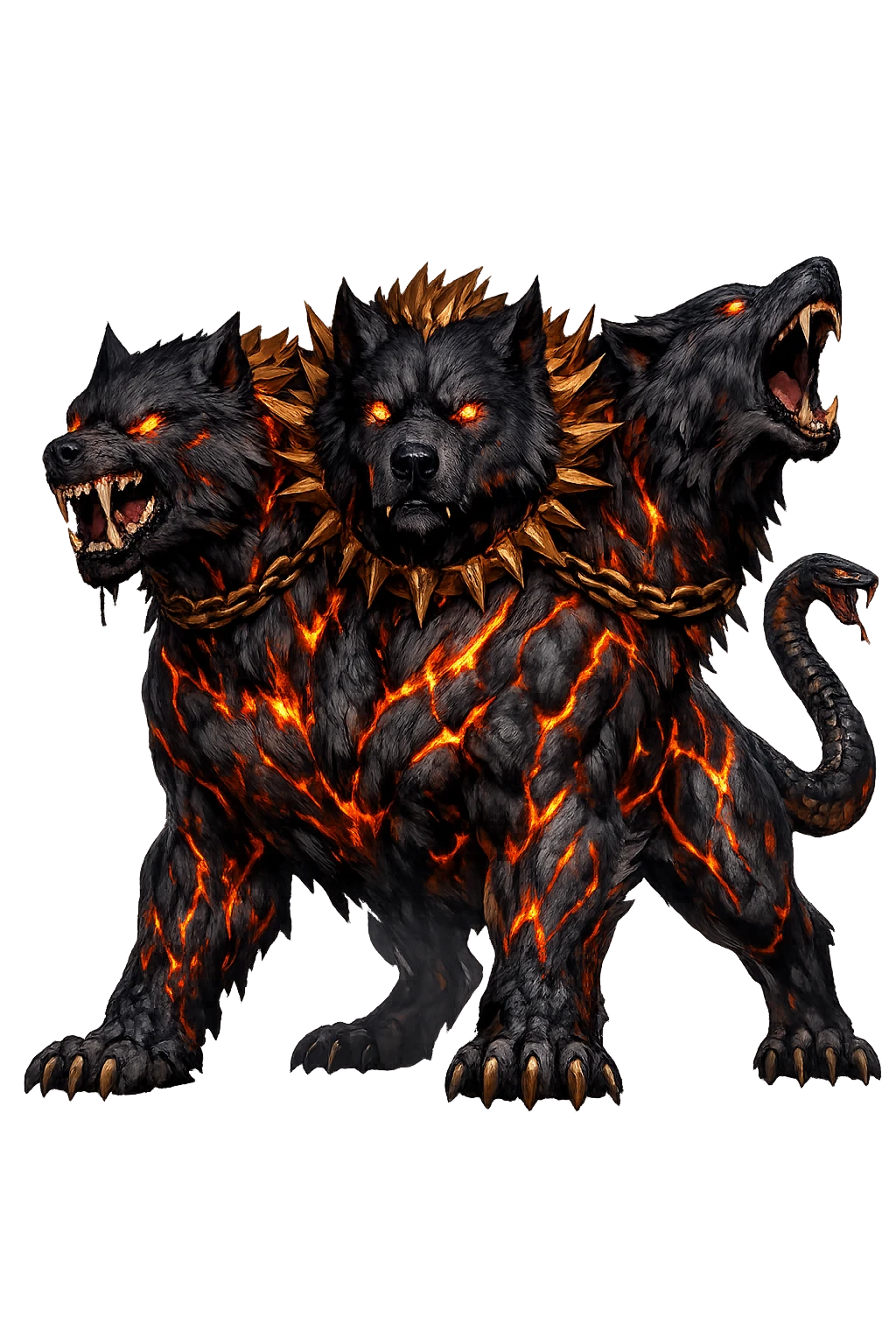
Greek artists drew the hound early, often, and with editorial freedom about the head-count. Black-figure vase-painters of the sixth century BCE show Heracles leading him up on a chain, usually with two or three heads — Hesiod's fifty were never attempted — and on a Caeretan hydria of about 525 BCE in Vienna the terrified Eurystheus hides in his storage pithos as the hero presents the dog. The twelfth labor closes the metope cycle of the temple of Zeus at Olympia (c. 460 BCE): Heracles, club laid aside, delivers the leashed hound to an attentive Athena, the slab now in the Archaeological Museum of Olympia. Classical painters enrich the zoology with a serpent mane and serpent tail, and an Attic cup of about 430 BCE attributed to the Codrus Painter, now in the Louvre, gathers the whole underworld court — Hades, Persephone, Hermes — around the leashed guest. Three heads become canonical only in Roman art, matching Virgil's triceps; the imperial centuries then station him at tombs, on sarcophagi, mosaics, and gems, and that tri-throated Roman form — not Hesiod's fifty — is the image that survived into Dante and after.

06

Reception & Transformation

The name after its own age — transmission, translation, survival

Afterlives

Every age that read Homer or Hesiod re-encountered the hound, and the chain of encounters runs unbroken. Euripides already stages the labor's aftermath, Heracles returning from the dead having tamed the three-headed dog (Heracles 24–25); Apollodorus' Library preserves the fullest connected account. Virgil fixed the two scenes every later century reused — Orpheus' song stalling the three mouths in the Georgics, the Sibyl's drugged honey-cake in Aeneid 6 — and Seneca dramatized the drag home in the Hercules Furens, the hound's three throats baying in the theater. Humanist mythographers from Boccaccio to Natale Conti folded him into the Renaissance reference shelf, and illustrated Virgil codices kept the sop scene before readers from late antiquity onward. Dante made the decisive move: in Inferno 6 the courteous guardian is degraded to the third circle's torturer of gluttons, and Virgil silences him by stuffing his three throats with earth — a reinvention so powerful that Blake's watercolors for the Comedy (1824–27, Tate) and Doré's 1861 engravings still stage the medieval dog, not the Greek one. Nineteenth-century scholarship then recovered the older animal: the black-figure corpora were catalogued, the Olympia metope excavated and published, and the Lexicon Iconographicum Mythologiae Classicae (1992) counted every surviving ancient image — restoring, piece by piece, the two-headed archaic hound the vase-painters actually drew.

Identifications Across Traditions

Rome naturalized him wholesale — Virgil, Ovid, Horace, and Statius all keep him at his post — and Dante demoted him to overseer of the third circle, the three-throated beast clawing the gluttons in the rain until Virgil clogs his throats with earth. His real cross-cultural argument is etymological: the nineteenth century matched him with Yama's spotted hounds of the Ṛgveda (śárvara), a comparison that would make him the oldest watchdog in the Indo-European family; Beekes and the modern handbooks prefer a Pre-Greek origin and leave the match unproven. Either way, the shape of him — the plural-headed guardian of a gate that opens only inward — recurs wherever the dead need keeping.

Modern Legacy

"Cerberus" is the living language's word for the guardian who cannot be bought: firms, firewalls, and customs houses borrow the name when they want menace with seniority. His labor completed Heracles' curriculum and fixed the katabasis as the hero's final exam, and his three throats gave painters, from black-figure vase-men to modern film, the underworld's most durable mascot. The restoration Kérberos returns the name to its Greek accent — the Latinized Cerberus had been wearing Rome's pronunciation for two thousand years.

07

The Meditation

What Kérberos means — beyond the dictionary

Kérberos is courteous to everything that accepts the terms and merciless to everything that argues with them. Every threshold worth having — a discipline, a vow, a border of the self — keeps some form of him: the part of the gate that cannot be reasoned with, because reasoning is not its job. The question he asks every visitor is the simplest one: are you here to stay, or are you here to leave — because only one of those is offered.

08

Frequently Asked Questions

Common questions about Kérberos, Underworld Guardian, and Unicode restoration

01How do you pronounce Kérberos?

In reconstructed pronunciation, Kérberos is /ˈker.be.ros/ — approximately KAIR-beh-ros — the acute falls on the first syllable; sound the final -ros with a light trill.

02What does Kérberos mean?

Kérberos means Spot, darkness in the greek tradition.

03What are the symbols of Kérberos?

Kérberos is associated with The many heads (Watchfulness that cannot be flanked: every approach covered, every exit denied), The mane of serpents (The poets and painters crest him with snakes — the underworld's own fur), The honeyed cake (The Sibyl's drugged sop in the Aeneid: the one bribe the gate accepts), The chain of Heracles (The only leash ever to hold him — the hero’s bare-handed grip, remembered on vases from the sixth century BCE).

04Why restore Kérberos in Unicode?

Plain ASCII cerberus strips the stress, length, and script that make the name specific. Unicode restoration returns the name to its original written dignity.

05What is the most important myth about Kérberos?

“Born of Typhon and Echidna” — the Theogony story that anchors the mythology of Kérberos, told in full on the lore page.

09

Scholarly Sources

The philological foundations of this restoration

Every claim on this page is grounded in established scholarship. The orthographic restorations follow disciplinary convention. The etymological chain follows the best available reference works. This is not invention — it is resurrection through scholarship.

◈

Lexicography & Philology

  • Beekes, R. S. P. Etymological Dictionary of Greek. Leiden: Brill, 2010.
◎

Primary Texts

  • Hesiod
  • Hesiod, Theogony 306–312, 767–773.
  • Homer, Odyssey 11.623–626; Iliad 8.367–369.
  • Apollodorus, Library 2.5.12.
  • Virgil, Georgics 4.483; Aeneid 6.417–423.
  • Pausanias 3.25.5–6 (the Tainaron descent).
◉

Archaeology & Art History

  • Material evidence — iconography, inscriptions, and temple archaeology — for Kérberos and related cults.
✦

Religious Studies

  • Beekes, R. S. P., Etymological Dictionary of Greek, s.v. Κέρβερος (Brill, 2010).
Return

The Surface Awaits

You have traced the name from its earliest attestation to its Unicode restoration. Now return to the myth. The story is where the name lives.

Back to Lore
Kérberos mascot