The Living Myth
First God of the Norse Pantheon, Progenitor of the Æsir · The First to Wake from Ice
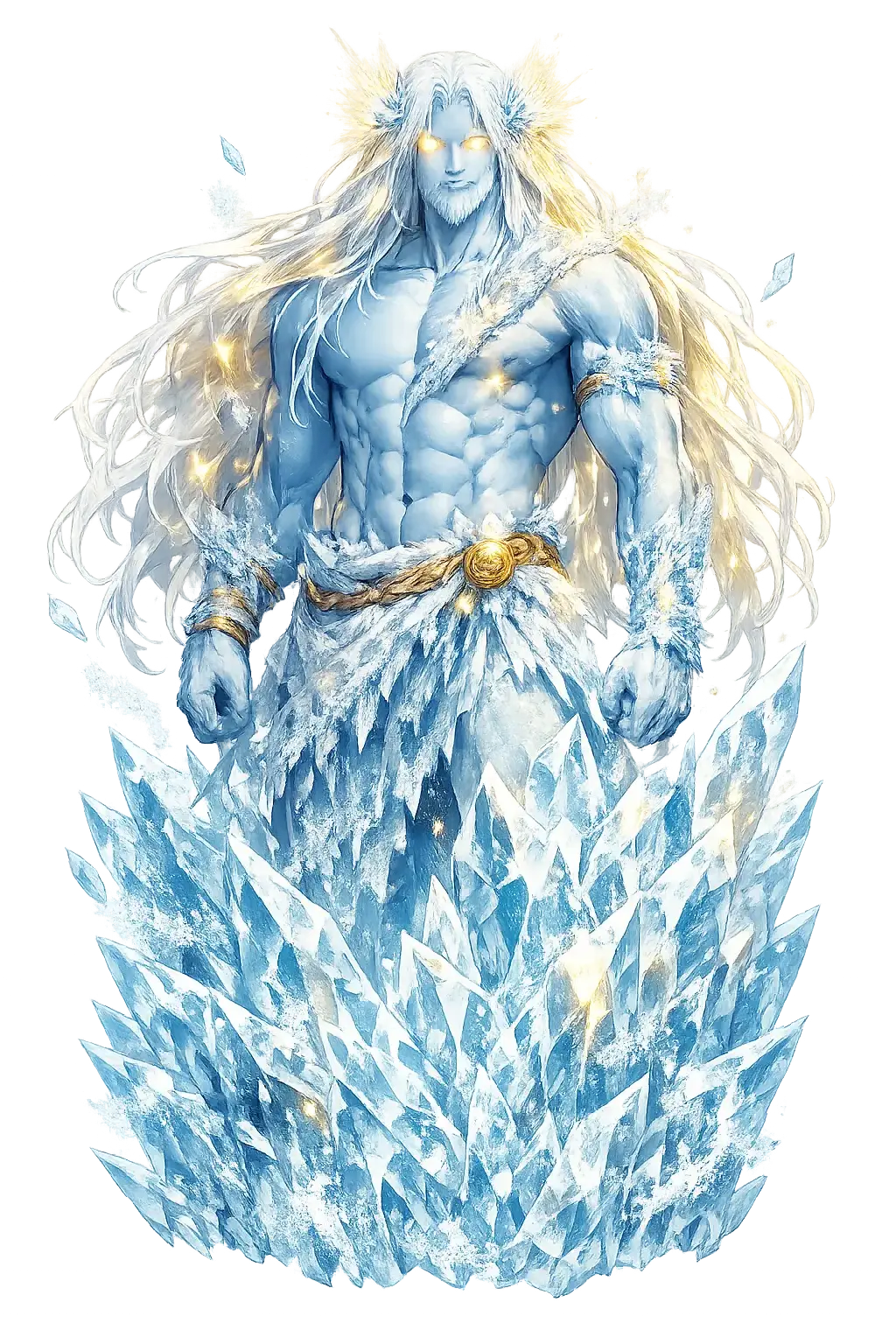
Stories of Búri
Búri has no adventures, no conflicts, no cult. His entire myth is cosmogonic: he is the first divine being, the point at which the inanimate cosmos becomes personal. Everything that follows in Norse mythology follows from his emergence.
In Gylfaginning 6 Snorri gives Búri his entire recorded life in one scene. The primeval cow Auðumla, who fed herself by licking the salty rime that covered the stones of Niflheimr, licked and licked until a shape appeared in the ice: on the first day, hair; on the second, a head; on the third, a whole man. This was Búri — beautiful to look at, great in size and strength — and he begot a son, Burr, who married Bestla, daughter of the giant Bölþorn. Her sons were Óðinn, Vili, and Vé, who would one day kill the giant Ymir and make the world of his body. A god is not born here but uncovered, licked into personhood by patient animal care: the first theology of the North is a cow grooming the ice until it wakes. Creation as tending, not commanding, is the note the whole cosmogony sounds.
Búri's emergence only makes sense against the world that produced him. Snorri describes Ginnungagap, the yawning void, lying between the blazing Múspellsheimr to the south and the frozen Niflheimr to the north, from whose rivers, the Élivágar, flowed a venom that hardened into the rime. Where the hot air from the south met the rime, the ice thawed and quickened, and from the drops of poisoned meltwater grew the hermaphroditic giant Ymir, ancestor of every frost giant. The same thaw that quickened Ymir nourished the rime that Auðumla licked: giant and god are siblings of a single thaw, one formed from venom-melt, the other revealed by a cow's tongue. The Norse cosmos begins with a paradox it never resolves — life and the forces of chaos are made of the same water, at the same temperature, at the same moment. The war of gods and giants is, cosmically speaking, a family quarrel between two kinds of meltwater.
The Prose Edda never tells us where Auðumla came from — she is simply present, like the ice itself. While her tongue shaped Búri out of the rime, her udder fed Ymir: four rivers of milk ran from her, and on them the first giant grew (Gylfaginning 6). One animal, therefore, nourishes both antagonists of the coming world; the cow is the common source of god and giant, order and chaos alike. Later readers have found in her a memory of the pastoral economy of the North — wealth, survival, and gentleness concentrated in a single bovine life — and the image is strikingly un-warlike for a mythology that ends in war. Before any weapon is forged, everything that will eventually fight is being breastfed by the same foster-mother. Auðumla is the Norse cosmos' great neutral power: the source that refuses, from the very first day, to take sides.
The Poetic Edda knows Búri only through his son. Völuspá 4, singing the world's beginning, names the next generation as Búrs synir — Burr's sons — who 'lifted up the lands' and shaped the dwelling of men, and it is through Burr's marriage to Bestla that the divine line acquires the giant blood that will mark it ever after. Snorri's genealogy makes the point explicit: Búri → Burr → Óðinn, Vili, Vé — three generations, each shorter in the telling, carrying the story from personless ice to the gods who build the world. Genealogy is doing real theological work here. It anchors the Æsir's authority in unbroken (if partly giant) descent, while letting the giants descend from the murdered Ymir: a clean origin set against a violent one. Two family trees explain why the war was, in the end, inevitable — and why the gods could never quite call themselves pure.
The Primeval Ancestor of the Æsir
Búri is the first god in Norse mythology, the ancestor from whom all the Æsir descend. He was not born but revealed: the primeval cow Auðumla licked the salty rime of Niflheimr until a human shape emerged. From Búri came Burr, from Burr came Óðinn, Vili, and Vé, and from them came the world as we know it.
Licked free from the ice of Niflheimr by the primeval cow Auðumla.
His son Borr/Burr fathers Óðinn, Vili, and Vé.
Every major god of the Norse pantheon traces descent from him.
A human-shaped god emerging from the inanimate ice, the first animate divine being.
From the original script to the living URL
ᛒᚢᚱᛁ
The name in its original Norse form. Búri (ᛒᚢᚱᛁ) is attested in the source tradition — “In the Prose Edda, Búri is the primeval ancestor born from the salty rime, father of Borr and grandfather of Óðinn.”. Its acute stress marks carry the full phonetic and orthographic weight of the source tradition.
buri
Reduced to plain buri, the name loses everything that made it specific: acute stress marks. What remains is an ASCII string that machines can parse but that no longer speaks with its original voice.
Búri
The Unicode restoration recovers what ASCII flattened. Búri restores acute stress marks, returning the name to its original written dignity. The domain encodes to Punycode, but the browser displays the truth.
Búri.com → xn--bri-8na.com
The non-ASCII characters in Búri are encoded while the ASCII remains visible. To the DNS, it is Punycode. To humanity, it is Búri.
Owned, ideal, and ASCII forms of Búri
Búri
Restores ᛒᚢᚱᛁ. The live temple domain — búri.com.
buri
Flattens ᛒᚢᚱᛁ. The plain ASCII fallback — what DNS and legacy systems see.
How Búri was spoken
How Búri travels from ancient script to the modern URL
The lore you have read is the living myth. Extended Lore opens the scholarly vault beneath it: the cult and its material remains, a history of the image, the name after antiquity, a meditation on what the name still means, and the full scholarly apparatus — etymology, orthography, sources.
Enter Extended Lore