
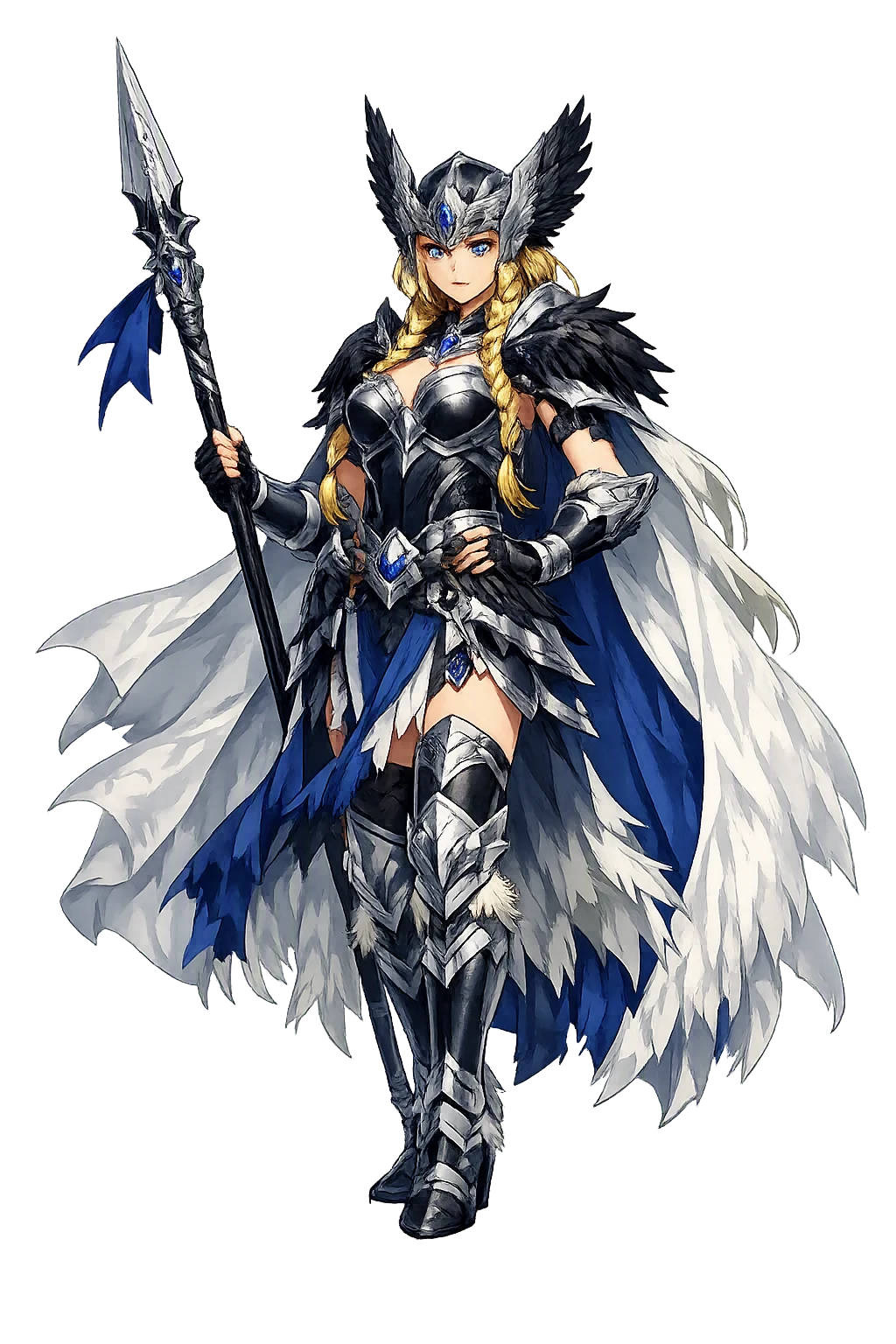
The hidden history behind Brynhildr
Behind the modern ASCII form brynhildr hides a much longer story. Brynhildr reaches back through manuscripts, inscriptions, and oral tradition long before it ever touched a keyboard, and every mark in the restored spelling is a receipt from that journey. In what follows we trace the name from its Younger Futhark attestations through its mythology, its cult, its symbols, and its afterlife in other cultures — and we show how the PuniCodex project turned that philological record into a Unicode domain that resolves today. The history was never lost. It was only waiting for the infrastructure to catch up.
At a Glance
- Restored name: Brynhildr
- ASCII form: brynhildr
- Meaning: "Armor battle"
- Domain of influence: Valkyrie, Shieldmaiden
- Pantheon: Norse
- Classification: Tier 2
- Original script: ᛒᚱᚢᚾᚼᛁᛚᛏᚱ (Younger Futhark)
Overview
Brynhildr (brynhildr) — Valkyrie, Shieldmaiden · Armor battle — is the tragic center of the Vǫlsung cycle: the valkyrie whom Óðinn pricked with the sleep-thorn for judging a battle against his promise, the shieldmaiden Sigurðr woke behind the wall of flame on Hindarfjall, the sworn beloved betrayed by a draught of forgetfulness and an exchanged shape, and the woman who burned herself on the dragonslayer's pyre with a drawn sword between them.
Old Norse Brynhildr compounds bryn- ‘mail-coat, byrnie’ (the noun brynja) with hildr ‘battle’: ‘armor battle’ — the battle-maid in her mail. The prose frame of Sigrdrífumál names her Sigrdrífa, ‘victory-urger’; Vǫlsunga saga makes the identification with Brynhildr explicit, and the heroic lays tell her whole arc — the sentence, the waking, the oath, the deceit, the quarrel of the queens, the pyre, and the ride to Hel.
PuniCodex restores the name as Brynhildr — identical to the ASCII input, because normalized Old Norse writes no diacritic in this name. The mechanical rule therefore places it in Tier 2: nothing distinctive is lost in transit, a statement about orthography and never about the figure. The temple is domain-less: the plain-ASCII brynhildr.com is registered outside the collection and watched for release.
The Name
The name is attested in Old Norse as Brynhildr (nominative). It is a transparent compound of two of the most productive name-elements in Germanic: bryn-, the stem of brynja ‘coat of mail, byrnie’, and hildr ‘battle’ — the same element carried by the valkyrie names Hildr, Gunnhildr, and Ragnhildr — hence ‘armor battle’, the battle-maid in her mail. The final -r is the Old Norse nominative ending.
The ASCII form is not a fallback but the medieval spelling itself: normalized Old Norse writes Brynhildr in plain Latin letters, with no acute accent, no thorn, and no eth. The restoration is therefore a matter of canonical reference, not rescued diacritics, and the mechanical tier rule — distinctive feature preserved, or not — classifies the name Tier 2.
The letter-by-letter transformation runs:
- b → B — Same, capitalized
- r → r — Same
- y → y — Same
- n → n — Same
- h → h — Same
- i → i — Same
- l → l — Same
- d → d — Same
- r → r — Same
Because the name is pure ASCII, its domain was registered in the ordinary way decades ago: brynhildr.com is held by a third party outside the PuniCodex collection and is watched for release; this temple claims no domain.
The Original Script
The name is preserved in medieval Icelandic manuscripts in the Latin alphabet as Brynhildr — Old Norse (North Germanic), attested 13th c. CE in the Codex Regius of the Poetic Edda (GKS 2365 4to) and the vellum tradition of Vǫlsunga saga, recording material centuries older. Before the Latin bookhand, Old Norse names were carved in the younger futhark; no runic attestation of the legendary Brynhildr survives, so the manuscript form is the primary witness.
A hypothetical younger-futhark rendering runs ᛒᚱᚢᚾᚼᛁᛚᛏᚱ (b-r-u-n-h-i-l-t-R): the ᚢ rune covers u and y alike, and the ᛏ rune writes both t and d. The normalized Old Norse form Brynhildr carries no feature the runes would have underspecified and nothing the ASCII alphabet loses — no acute, no thorn, no eth — which is why the restoration is already ASCII-clean and the name is Tier 2.
Pronunciation
The reconstructed pronunciation of the name is /ˈbryn.hil.dr̩/ — Old Norse Reconstruction.
Phoneme by phoneme:
- Bryn- — Voiced bilabial stop [b], trilled [r], and the close front rounded vowel [y] — the sound of German ‘ü’ or French ‘tu’; the ‘mail-coat’ element, stressed on the first syllable as in all Old Norse compounds
- -hildr — Voiceless glottal [h], short [i], lateral [l], voiced stop [d], and the syllabic nominative [r̩]; the ‘battle’ element
For the modern speaker, the closest approximation is: ‘BRÜN-hild-r’ — round the lips for the y as in German ‘für’, and let the final r sound lightly as its own beat, as in Icelandic Brynhildur.
Kindred and historical forms of the name:
- Old Norse — Brynhildr, the valkyrie of the Vǫlsung cycle; also Sigrdrífa, ‘victory-urger’, the name Sigrdrífumál itself gives her
- Old High German — Brünhilt, the queen of the Nibelungenlied and Þiðreks saga
- Historical — Brunhilda, the Merovingian queen of Austrasia (d. 613), long linked by scholars to the legendary name
- Modern Icelandic — Brynhildur, the name's unbroken living form
Brynhildr is Tier 2 because the restoration preserves nothing the ASCII form loses: nine plain Latin letters and a capital. The tier is a report on orthography, not a judgment on the figure — the most famous valkyrie in the North happens to carry an ASCII-clean name.
Mythology
Brynhildr's mythology is a single arc — sentenced, woken, sworn, deceived, avenged, and burned — told across the heroic lays and Vǫlsunga saga with a consistency the corpus rarely achieves.
The Valkyrie's Sentence (Sigrdrífumál)
Two kings fought, Hjálmgunnarr the old and Agnar the young, and Óðinn had promised the victory to Hjálmgunnarr. The valkyrie Sigrdrífa judged otherwise and gave the day to Agnar. Óðinn pricked her with the sleep-thorn in revenge and declared she should never again fight in victory and should be given in marriage — and she answered that she had bound herself with an oath to wed no man who knew fear. The whole tragedy grows from this: an independent verdict, punished with sleep.
The Waking on Hindarfjall (Vǫlsunga saga)
Sigurðr, fresh from the hoard of Fáfnir, saw a light burning on Hindarfjall and rode Grani through the vafrlogi. Within the wall stood a hall, and in the hall a figure in full armor; he cut the byrnie from her with Gramr, from the neck down, for it had grown fast to her flesh, and she woke. She taught him the runes of victory and the counsels of Sigrdrífumál, and they plighted their troth.
The Ale of Forgetfulness (Guðrúnarkviða II · Vǫlsunga saga)
At the court of Gjúki, Grímhildr gave Sigurðr a draught of forgetfulness, and the memory of Brynhildr went out of him; he married Guðrún and swore brotherhood with Gunnarr and Hǫgni. When Gunnarr desired Brynhildr and his horse would not take the flame, the two men exchanged shapes: Sigurðr rode the vafrlogi in Gunnarr's form, won the bride for his sworn brother, and lay three nights beside her with the drawn sword between them — taking from her hand the ring Andvaranautr.
The Quarrel of the Queens (Guðrúnarkviða II)
At the river, washing their hair, Brynhildr waded the farther out for the sake of her husband's deed; Guðrún answered with the truth and held up Andvaranautr as proof. Brynhildr knew the ring, turned white as a dead woman, and went home silent. The revelation — woman to woman, by a token of gold — brings the whole world of the cycle down.
The Pyre and the Road to Hel (Sigurðarkviða hin skamma · Helreið Brynhildar)
Brynhildr turned Gunnarr to vengeance, and Sigurðr was slain in his bed by young Guthormr, the one brother bound by no oath. When Guðrún's wail rose, Brynhildr laughed once, from the bottom of her heart; then she stabbed herself and asked to be burned beside Sigurðr with a drawn sword between them, as when they had been called by the name of man and wife. Helreið Brynhildar follows her past the fire: a giantess by her mound chides her, and Brynhildr answers with her whole life — the sleep, the waking, the oath kept, the deceit endured.
Symbols & Iconography
The iconography of Brynhildr is narrative rather than cultic — the corpus gives her no temple regalia, but the cycle fixed around her a set of objects no retelling can omit:
- The sleep-thorn (svefnþorn) — Óðinn's instrument of sentence: sleep as the price of an independent verdict
- The vafrlogi — the flickering wall of flame around her hall on Hindarfjall, crossable only by Grani and only by the fearless
- The byrnie grown fast to her flesh — war-gear become skin, cut away with Gramr: the valkyrie woken out of her own armor
- The drawn sword between the lovers — Gramr laid naked in the bed of the deception, and laid between them again on the pyre
- The ring Andvaranautr — the ring from the hoard of Andvari, taken in the exchanged shapes and produced at the quarrel as the proof of deceit
Archaeology & Evidence
Brynhildr herself has no cult site, votive deposit, or named image — she is a figure of heroic legend, not of cult. The material record attests the legend around her. The Sigurðr carvings of Södermanland — the Ramsund carving (Sö 101) and the Gök stone (Sö 327), both eleventh century — depict the slaying of Fáfnir, the roasting heart, the talking birds, and the slain Reginn, proving the Vǫlsung cycle's visual currency in the late Viking Age.
The carved portal of Hylestad stave church in Norway (c. 1200) retells the saga's scenes in wood, and the Kirk Andreas cross on the Isle of Man shows Sigurðr roasting the dragon's heart. The Drävle runestone (U 1163) shows a woman offering a drinking horn to a rider, sometimes interpreted as Sigrdrífa or Brynhildr, though the identification is debated. The textual witnesses hang on thin threads: the heroic lays survive in the Codex Regius of the Poetic Edda (GKS 2365 4to, c. 1270) — with the famous lacuna of a lost gathering that Brot af Sigurðarkviðu breaks across — and Vǫlsunga saga is preserved in a vellum fragment (NGU 182 4to) and paper copies.
Realm & Domain
Brynhildr is catalogued under the domain Valkyrie, Shieldmaiden — and the sources earn both terms.
The Valkyrie
Sigrdrífumál's prose names her among the valkyries — Óðinn's choosers of the slain — and gives her the valkyrie name Sigrdrífa, ‘victory-urger’; her fall from Óðinn's service for an independent judgment is the myth's first cause.
The Shieldmaiden
Sigurðr finds her in full war-gear, the byrnie grown fast to her flesh — armor and woman so long one that they must be cut apart with Gramr. The image fixes her as the corpus's type of the martial woman.
The Keeper of the Oath
Her sworn word — to wed no man who knew fear — outlives sleep, deceit, and death itself; the cycle measures every other character's oath-breaking against her fidelity.
The Dead Who Ride
Helreið Brynhildar follows her past the pyre onto the road to Hel, where she answers a giantess's chiding with her whole life's account — the dead heroine still pleading her own case.
Across Cultures
Brynhildr lives two lives in the medieval record. The Norse tradition makes her a valkyrie: sentenced by Óðinn, woken by Sigurðr, self-immolated on his pyre. The continental tradition makes her human: the Nibelungenlied's Brünhilt is the proud queen of Iceland whose strength no suitor could master until Siegfried, invisible in his cloak of power, won her for Gunther — and whose quarrel with Kriemhilt at the minster door replays the quarrel at the river. Þiðreks saga stands between the two, keeping a martial Brunhild in the far north.
Since the Grimms, scholars have linked the legendary name to the historical Brunhilda of Austrasia, the Merovingian queen executed in 613 — a connection plausible for the continental strand and unnecessary for the Norse. The Grimm brothers also heard the svefnþorn echoing in the thorn-hedged sleep of Dornröschen: the fairy tale keeping the valkyrie's sentence alive in the nursery. Within the corpus, her closest kin are the valkyries Gunnr and Skuld, and the Freyja-figure of Freyja, who shares with the valkyries the choosing of the slain.
Cultural Legacy
Brynhildr's modern afterlife is Wagner's: the Ring cycle made Brünnhilde the most famous valkyrie in the world, and her immolation — riding Grane into Siegfried's pyre with the ring returned to the Rhine — is opera's great closing image of a world redeemed by a woman's refusal to accept its lies. Wagner built her from the Norse sources, not the German: Wotan's daughter and Siegfried's doom is the Edda's figure, not the Nibelungenlied's queen.
Behind Wagner stand the Victorian rediscoveries: William Morris's The Story of Sigurd the Volsung (1876) gave English readers the whole arc, sleep-thorn to pyre, and the archetype she fixed — the warrior woman asleep behind fire, won only by the fearless — runs through the fairy tale of Sleeping Beauty and every later shieldmaiden of fiction. In Iceland the name never left: Brynhildur remains a living given name, and Old Norse Brynhildr stays the standard citation form in every handbook of heroic legend.
The Scholarly Record
The account of Brynhildr given in this edition rests on the witnesses and reference works listed below. The Poetic Edda's heroic lays supply the narrative; Vǫlsunga saga the continuous prose account; the Prose Edda Snorri's summary; the lexica secure the name's etymology; the continental witnesses carry the parallel tradition.
- The Poetic Edda, trans. Carolyne Larrington, 2nd ed. (Oxford: Oxford University Press, 2014): Sigrdrífumál, Grípisspá, Brot af Sigurðarkviðu, Guðrúnarkviða I–II, Sigurðarkviða hin skamma, Helreið Brynhildar.
- Vǫlsunga saga, trans. Jesse L. Byock (Berkeley: University of California Press, 1990).
- Snorri Sturluson, Edda, Skáldskaparmál (the Sigurðr and Brynhildr narrative), trans. Anthony Faulkes (London: Everyman, 1987).
- Cleasby, Richard, and Guðbrandur Vigfússon, An Icelandic-English Dictionary, 2nd ed. (Oxford: Clarendon Press, 1957), s.v. Brynhildr, brynja, hildr, svefnþorn.
- Zoëga, Geir T., A Concise Dictionary of Old Icelandic (Oxford: Clarendon Press, 1910), s.v. Brynhildr.
- Gordon, E. V., An Introduction to Old Norse, 2nd ed. rev. A. R. Taylor (Oxford: Clarendon Press, 1957).
- Das Nibelungenlied, trans. A. T. Hatto (Harmondsworth: Penguin, 1965); Þiðreks saga af Bern.
- Simek, Rudolf, Dictionary of Northern Mythology, trans. Angela Hall (Cambridge: D. S. Brewer, 1993), s.v. Brunhild, Sigrdrífa.
- Orchard, Andy, Dictionary of Norse Myth and Legend (London: Cassell, 1997), s.v. Brynhild.
- Lindow, John, Norse Mythology: A Guide to the Gods, Heroes, Rituals, and Beliefs (Oxford: Oxford University Press, 2001), s.v. Brunhild, Sigurd, valkyries.
A Meditation
Brynhildr is the tradition's figure of the oath that outlives its world. Everything taken from her is taken by small magic — a thorn, a draught, a borrowed shape, a ring — and none of it touches the thing she actually is: the woman who judged rightly against a god, who asked only for a man without fear, and who kept her account with the truth to the last breath.
Her one laugh, heard as the world breaks, is among the most unsettling sounds in the Edda; her pyre, with the drawn sword between the dead, is its clearest statement that a marriage made by deceit could be annulled only by fire. The cycle does not ask us to forgive her vengeance. It asks whether any of the men around her — the forgetful hero, the oath-bound brothers, the scheming queen — ever matched the standard she set: to know what happened, and to refuse to pretend otherwise.
The Unicode Restoration
Brynhildr is classified as Tier 2: the restoration needs no distinctive letters or diacritics its ASCII form would lose. The ASCII fallback brynhildr still resolves everywhere, but it is the restored form that carries the name's full information. That is the whole thesis of this temple: the marks are the message.
Why This Restoration Matters
The story of Brynhildr did not end in antiquity; it changed medium. Names that survive for millennia do so because each generation finds a new carrier for them — clay, papyrus, print, and now DNS. The PuniCodex restoration simply makes the carrier honest: the spelling that resolves is the spelling the evidence supports. If this post showed anything, it is that brynhildr and Brynhildr are not the same name with different styling. They are a summary and the text it summarizes. The web can now serve the text.
Explore Further
This post is one doorway into the temple. The home page carries the full character breakdown and the ambient canvas; the lore page tells the myths in long form; the Scholarly Edition preserves the sources, pronunciation data, and revision history; and the patron wall supports the restoration directly. For the wider map, browse the Lexicon, explore the Pantheon, or return to the PuniCodex blog.
Related Names
Sources
The full scholarly apparatus — every citation, revision, and review — lives in the Scholarly Edition. Key references for this post:
- The Poetic Edda, trans. Carolyne Larrington, 2nd ed. (Oxford: Oxford University Press, 2014): Sigrdrífumál, Guðrúnarkviða I–II, Sigurðarkviða hin skamma, Helreið Brynhildar.
- Vǫlsunga saga, trans. Jesse L. Byock (Berkeley: University of California Press, 1990).
- Cleasby, Richard, and Guðbrandur Vigfússon, An Icelandic-English Dictionary, 2nd ed. (Oxford: Clarendon Press, 1957), s.v. Brynhildr, brynja, hildr.
- Zoëga, Geir T., A Concise Dictionary of Old Icelandic (Oxford: Clarendon Press, 1910), s.v. Brynhildr, brynja, hildr.
- Lexicon authorities for this entry: Poetic Edda, Cleasby-Vigfusson.