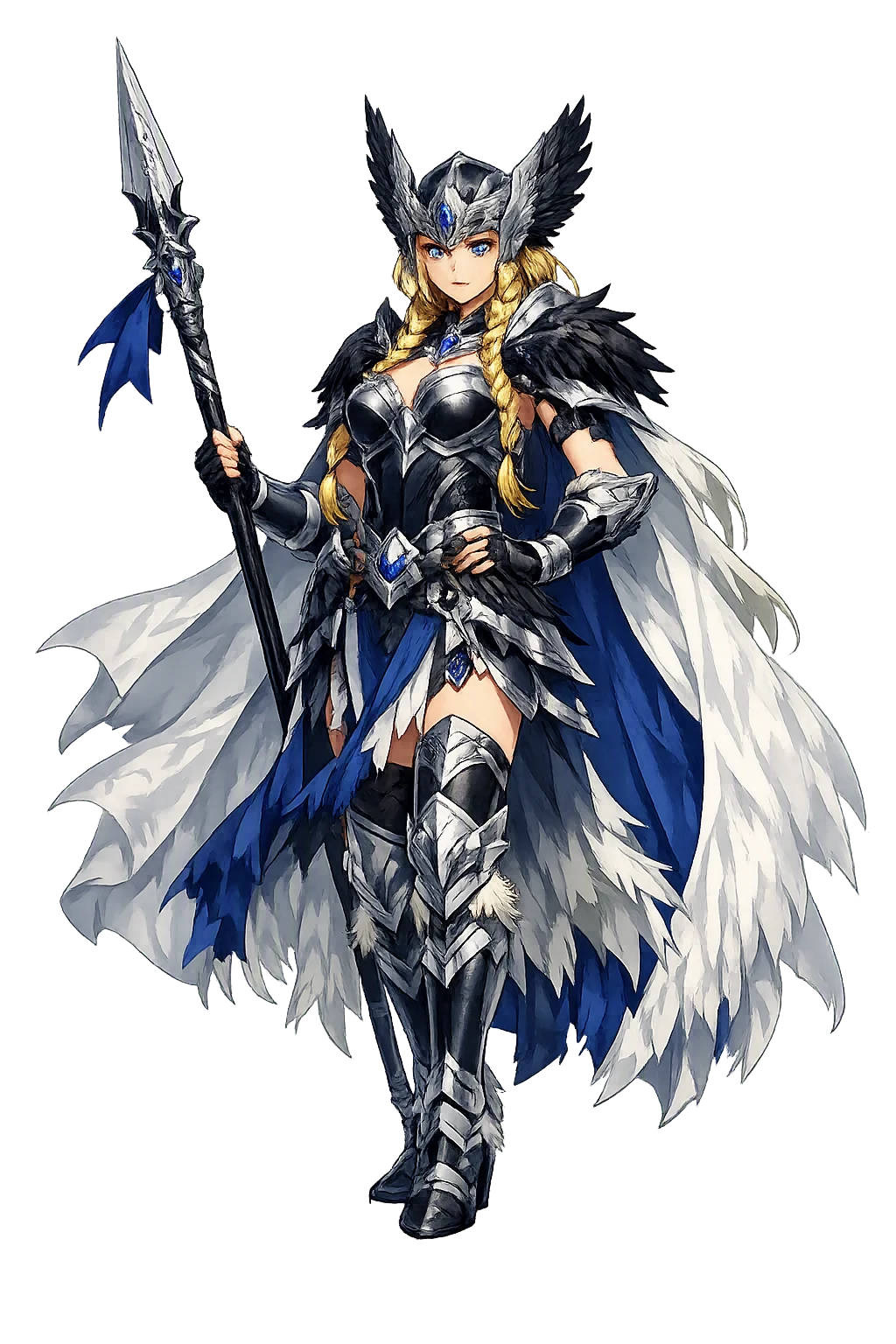
PuniCodex

Extended Lore

ᛒᚱᚢᚾᚼᛁᛚᛏᚱ Brynhildr

Etymology · Phonology · Orthography · Cultural Legacy · Primary Sources

Tier 2 Brynhildr
Brynhildr — Valkyrie, Shieldmaiden
01

Quick Facts

Essential information about Brynhildr, Valkyrie, Shieldmaiden

Original Scriptᛒᚱᚢᚾᚼᛁᛚᛏᚱ
Unicode RestorationBrynhildr
Reconstructed Pronunciation/ˈbryn.hil.dr̩/
PantheonNorse
DomainValkyrie, Shieldmaiden
MeaningArmor battle
ClassificationTier 2
Primary DomainBrynhildr
Sacred SymbolsThe sleep-thorn (svefnþorn), The wall of flame (vafrlogi), The byrnie grown fast to her flesh, The drawn sword between the lovers, The ring Andvaranautr
02

Etymology & Word Family

From original script to Unicode restoration

Original Script ᛒᚱᚢᚾᚼᛁᛚᛏᚱ Brynhildr — "Armor battle"
Unicode Restoration Brynhildr Restored stress, length, and script
Modern ASCII brynhildr Plain-ASCII fallback

Old Norse Brynhildr is a transparent compound: bryn- 'mail-coat, byrnie' (the noun brynja) + hildr 'battle' — 'armor battle', the battle-maid in her mail. The normalized Old Norse form is already plain ASCII: no diacritic, no thorn, no eth for the restoration to recover. Tier-2 by the mechanical rule: nothing distinctive is lost in transit — a statement about orthography, never about the figure.

03

Unicode Character Breakdown

Character-by-character philological analysis

CharacterUnicodeNameBlockPhonetic Role
BU+0042Latin Capital Letter BBasic LatinSame, capitalized
rU+0072Latin Small Letter RBasic LatinSame
yU+0079Latin Small Letter YBasic LatinSame
nU+006ELatin Small Letter NBasic LatinSame
hU+0068Latin Small Letter HBasic LatinSame
iU+0069Latin Small Letter IBasic LatinSame
lU+006CLatin Small Letter LBasic LatinSame
dU+0064Latin Small Letter DBasic LatinSame
rU+0072Latin Small Letter RBasic LatinSame

The Tier 2 classification reflects how much of the original phonology this restoration preserves — stress and vowel length for Greek names, distinctive letters and diacritics for every other tradition.

04

Cultural Significance

From ancient cult to modern Unicode

Ancient Domain

Brynhildr is the valkyrie of the Vǫlsung cycle: the battle-maid Óðinn pricked with the sleep-thorn for defying his judgment, the shieldmaiden Sigurðr woke behind a wall of flame, the sworn beloved whom a draught of forgetfulness and a changed shape betrayed — and the woman who would not outlive the deceit, burning herself on the dragonslayer's pyre with a drawn sword between them.

Brynhildr in Later Traditions

Brynhildr lives two lives in the medieval record. The Norse tradition — Sigrdrífumál, the heroic lays, Vǫlsunga saga — makes her a valkyrie, sentenced by Óðinn and woken by Sigurðr. The continental tradition makes her human: the Nibelungenlied's Brünhilt is the proud queen of Iceland whose strength no suitor could master until Siegfried, invisible in his cloak of power, won her for Gunther; Þiðreks saga stands between the two, keeping a martial Brunhild in the far north. Since the Grimms, scholars have linked the legendary name to the historical Brunhilda of Austrasia, the Merovingian queen executed in 613 — a connection plausible for the continental strand and unnecessary for the Norse. Wagner refused the choice: his Brünnhilde is built from the Norse sources, Wotan's daughter and Siegfried's doom, and the Grimm brothers had already heard the svefnþorn echoing in the thorn-hedged sleep of Dornröschen — the fairy tale keeping the valkyrie's sentence alive in the nursery.

Modern Legacy

Brynhildr's modern afterlife is Wagner's: the Ring cycle made Brünnhilde the most famous valkyrie in the world, and her immolation — riding Grane into Siegfried's pyre with the ring returned to the Rhine — is opera's great closing image of a world redeemed by a woman's refusal to accept its lies. Behind Wagner stand the Victorian rediscoveries: Morris's Sigurd the Volsung gave English readers the whole arc, sleep-thorn to pyre. The archetype she fixed — the warrior woman asleep behind fire, won only by the fearless — runs through the fairy tale of Sleeping Beauty and every later shieldmaiden of fiction. In Iceland the name never left: Brynhildur remains a living given name, and Old Norse Brynhildr stays the standard citation form in every handbook of heroic legend.

Unicode Restoration as Cultural Act

Restoring Brynhildr in a domain name is more than orthographic accuracy. It is a statement that the internet should recognize the full range of human writing — not only the ASCII keyboard.

05

Frequently Asked Questions

Common questions about Brynhildr, Valkyrie, Shieldmaiden, and Unicode restoration

01How do you pronounce Brynhildr?

In reconstructed pronunciation, Brynhildr is /ˈbryn.hil.dr̩/ — approximately BRÜN-hild-r — the y is the rounded front vowel of German 'ü'; stress the first syllable; the final -r is the nominative ending, lightly sounded, as in modern Icelandic Brynhildur..

02What does Brynhildr mean?

Brynhildr means Armor battle in the norse tradition.

03What are the symbols of Brynhildr?

Brynhildr is associated with The sleep-thorn (svefnþorn) (Óðinn's sentence on disobedience — sleep as the price of an independent judgment), The wall of flame (vafrlogi) (The test that admits only the fearless — the fire no coward's horse will cross), The byrnie grown fast to her flesh (War-gear become skin: the valkyrie so long asleep that armor and woman had to be cut apart), The drawn sword between the lovers (The chaste bed of the deception — and the same sword laid between them in death), The ring Andvaranautr (The token that proves what memory was made to forget — gold as witness).

04Why restore Brynhildr in Unicode?

Plain ASCII brynhildr strips the stress, length, and script that make the name specific. Unicode restoration returns the name to its original written dignity.

05What is the most important myth about Brynhildr?

The prose frame of Sigrdrífumál gives her the name Sigrdrífa, 'victory-urger', and tells how she fell: two kings fought, Hjálmgunnarr the old and Agnar the young, and Óðinn had promised the victory to Hjálmgunnarr. The valkyrie judged otherwise and gave the day to Agnar. Óðinn pricked her with the sleep-thorn in revenge and declared she should never again fight in victory and should be given in marriage — and she answered that she had bound herself with an oath to wed no man who knew fear. The whole tragedy is already here: a woman whose only crime was an independent verdict, sentenced to sleep until a fearless man should come.

06

Scholarly Sources

The philological foundations of this restoration

Every claim on this page is grounded in established scholarship. The orthographic restorations follow disciplinary convention. The etymological chain follows the best available reference works. This is not invention — it is resurrection through scholarship.

Lexicography & Philology

  • Poetic Edda
  • Cleasby-Vigfusson

Primary Texts

  • Poetic Edda: Sigrdrífumál (the sleep-thorn, the waking, the rune-counsels), Grípisspá (the foretold arc), Brot af Sigurðarkviðu, Guðrúnarkviða I–II, Sigurðarkviða hin skamma (her death on the pyre), Helreið Brynhildar (the ride to Hel), trans. Carolyne Larrington
  • Snorri Sturluson, Prose Edda: Skáldskaparmál (the Sigurðr and Brynhildr narrative), trans. Anthony Faulkes

Archaeology & Art History

  • Material evidence — iconography, inscriptions, and temple archaeology — for Brynhildr and related cults.
  • Brynhildr herself has no cult site, votive deposit, or named image — she is a figure of heroic legend, not of cult. The material record attests the legend around her. The Sigurðr carvings of Södermanland — the Ramsund carving (Sö 101) and the Gök stone (Sö 327), both eleventh century — depict the slaying of Fáfnir, the roasting heart, the talking birds, and the slain Reginn, proving the Vǫlsung cycle's visual currency in the late Viking Age. The carved portal of Hylestad stave church in Norway (c. 1200) retells the saga's scenes in wood, and the Kirk Andreas cross on the Isle of Man shows Sigurðr roasting the dragon's heart. The Drävle runestone (U 1163) shows a woman offering a drinking horn to a rider, sometimes interpreted as Sigrdrífa or Brynhildr, though the identification is debated. The textual witnesses hang on thin threads: the heroic lays survive in the Codex Regius of the Poetic Edda (GKS 2365 4to, c. 1270) — with the famous lacuna of a lost gathering that Brot af Sigurðarkviðu breaks across — and Vǫlsunga saga is preserved in a vellum fragment (NGU 182 4to) and paper copies.

Religious Studies

  • Vǫlsunga saga (the fullest continuous narrative; the identification of Sigrdrífa with Brynhildr), trans. Jesse L. Byock
  • Das Nibelungenlied (Brünhilt; the quarrel of the queens), trans. A. T. Hatto; Þiðreks saga af Bern
  • Cleasby–Vigfusson, An Icelandic-English Dictionary, s.v. Brynhildr, brynja, hildr, svefnþorn
  • Zoëga, A Concise Dictionary of Old Icelandic, s.v. Brynhildr, brynja, hildr
  • Simek, Dictionary of Northern Mythology; Orchard, Dictionary of Norse Myth and Legend; Lindow, Norse Mythology: A Guide — s.v. Brynhildr/Brunhild, Sigrdrífa (the valkyrie identification, the Brunhilda-of-Austrasia question)
Return

The Surface Awaits

You have traced the name from its earliest attestation to its Unicode restoration. Now return to the myth. The story is where the name lives.

Back to Lore
Brynhildr mascot