
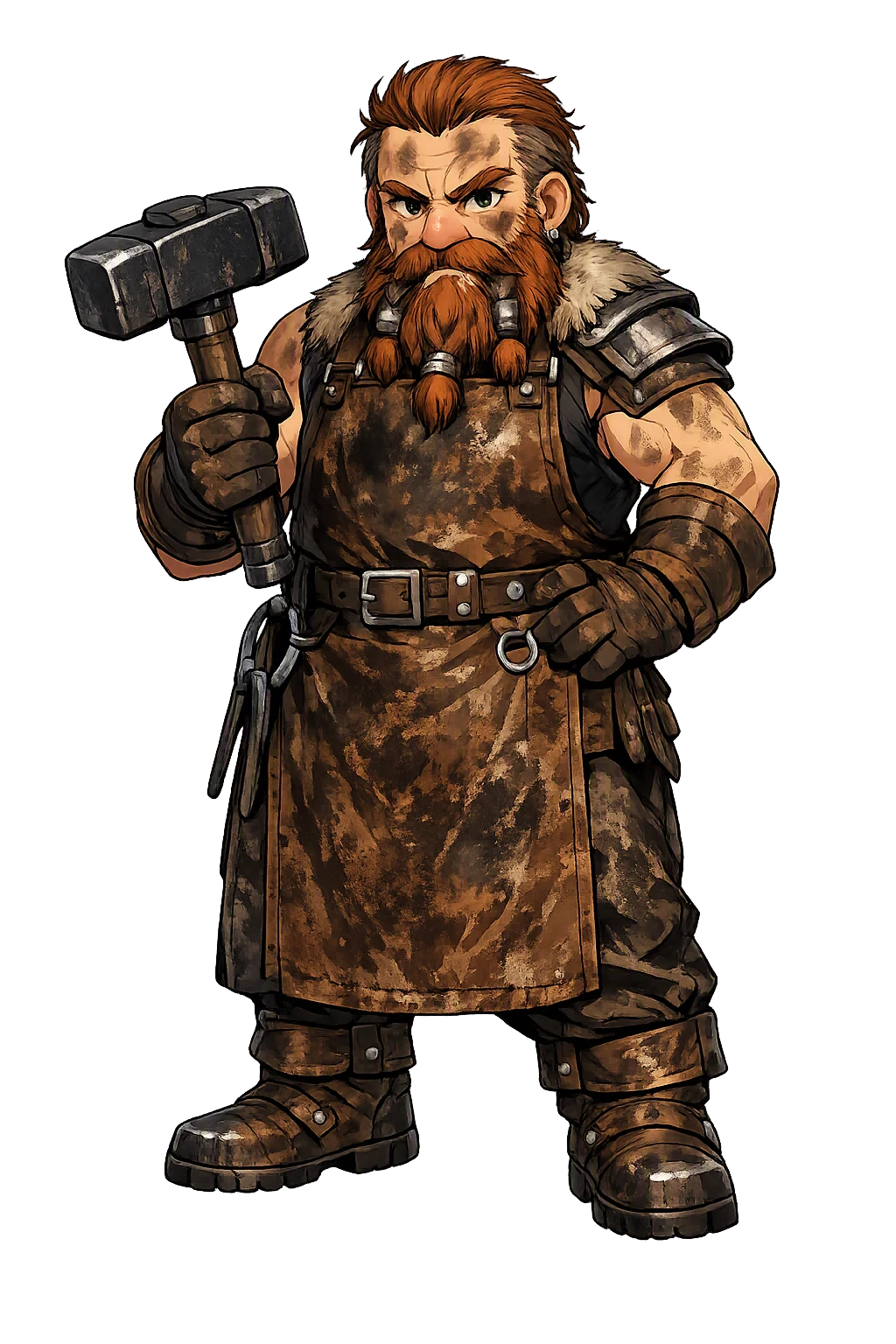
From Younger Futhark to Unicode: the journey of Brokkr
Long before it was a domain, this name traveled through scripts. Brokkr begins in Younger Futhark, passes through scholarly transliteration, and ends — for now — inside the punycode machinery of the global DNS. Each stage of that journey preserves some information and loses some, and the craft of restoration is knowing exactly which marks matter. This post follows the name stage by stage: the original script, the reconstructed pronunciation, the mythological record, the material evidence, and finally the Unicode form that carries all of it into the address bar. Think of it as a biography of a name, told through its spelling.
At a Glance
- Restored name: Brokkr
- ASCII form: brokkr
- Meaning: "Badger, panting"
- Domain of influence: Dwarf Smith
- Pantheon: Norse
- Classification: Tier 2
- Original script: ᛒᚱᚢᚴᚴᚱ (Younger Futhark)
Overview
Brokkr (brokkr) — Dwarf Smith · Badger, panting — is the smith who took the strangest wager in the northern corpus: his craft against Loki's head. While his brother worked the forge, Brokkr worked the bellows through three castings — the golden-bristled boar Gullinbursti, the drip-gold ring Draupnir, and the hammer Mjǫllnir — and the Æsir judged the last of them the best treasure ever made.
Old Norse Brokkr is attested only in Snorri's Prose Edda, where the episode of the wager is told in Skáldskaparmál with a smith's precision: what was laid in the fire, what came out, and what each interruption cost. Beside the proper name stands the common noun brokkr, 'a badger', and whether the dwarf carried the animal-name or a separate formation is unsettled in the handbooks. His brother at the forge is named Eitri in the main text of the Prose Edda; some manuscripts read Sindri, and the reference works register both.
PuniCodex restores the name as Brokkr — identical to the ASCII input, because normalized Old Norse writes no diacritic in this name; the mechanical rule therefore places it in Tier 2. The temple is domain-less: the plain-ASCII brokkr.com is held outside the collection and watched for release, and no form of the name is claimed here.
The Name
The name is attested in normalized Old Norse as Brokkr (nominative; genitive Brokks). It is a strong masculine with the nominative ending -r and a geminate -kk- that the spelling records faithfully; the ASCII fallback brokkr loses nothing but the capital, which is precisely why the name is Tier 2 under the mechanical rule.
The etymology is an honest open question. Cleasby–Vigfusson gloss the common noun brokkr 'a badger' (comparing Danish brok), and the dictionaries note figurative senses; the traditional glosses carried by the lexicon — 'badger, panting' — reflect this noun and the older suggestion of a connection with heavy breathing. Whether the dwarf's name is the animal-name, a byname turned proper name, or a separate formation is unsettled: Simek registers the obscurity rather than settling it, and so does this temple.
The letter-by-letter transformation runs:
- b → B — Same, capitalized
- r → r — Same
- o → o — Same
- k → k — Same
- k → k — Same
- r → r — Same
The project holds no domain for this name: brokkr.com was registered in the ordinary way outside the collection and is watched for release.
The Original Script
The name is preserved in medieval Icelandic manuscripts in the Latin alphabet as Brokkr — Old Norse (North Germanic), attested 13th–14th c. CE in the Codex Regius of the Prose Edda and its sister codices, recording material generations older. Before the Latin bookhand, Old Norse names were carved in the younger futhark; no runic attestation of this name survives, so the manuscript form is the primary witness.
The scholarly rendering proceeds step by step:
- The name is a strong masculine: stem Brokk- with the nominative singular ending -r.
- The geminate -kk- is a true long consonant, held across the syllable boundary; the manuscripts write it double, and the spelling is exact.
- In the Younger Futhark the name would have been carved ᛒᚱᚢᚴᛦ (b-r-u-k-R), with úr writing the o and ᛦ the final nominative -r.
- The Unicode restoration Brokkr loses nothing to ASCII but the capital: the normalized Old Norse form is already plain ASCII, which is why the name stands in Tier 2 — an orthographic report, not a judgment on the smith.
Pronunciation
The reconstructed pronunciation of the name is /ˈbrok.kr̩/ — Old Norse Reconstruction.
Phoneme by phoneme:
- Br- — Voiced bilabial stop [b] into a trilled [r]; stress on the first syllable, as in every Old Norse word
- -o- — A short open back vowel [ɔ]-[o]; the manuscripts write a plain short o, and the Younger Futhark would carve it with the úr-rune
- -kkr — A true geminate [kː], the doubled k held long across the syllable boundary, closing into the syllabic nominative [r̩]
For the modern speaker, the closest approximation is: 'BROK-ur' — two beats, the o short as in lot, the double k held a moment longer than English allows.
Kindred and historical forms of the name:
- Old Norse — Brokkr, the dwarf of Skáldskaparmál; beside it the common noun brokkr, 'a badger'
- Younger Futhark — ᛒᚱᚢᚴᛦ, the Viking-Age runic rendering (b-r-u-k-R)
- Companion name — Eitri, the brother at the forge; some manuscripts read Sindri
Brokkr is Tier 2 because the restoration preserves nothing the ASCII form loses: the name is already plain ASCII, and the tier rule is a report on orthography, not on the smith.
Mythology
Brokkr's mythology is a single, perfectly shaped narrative — the wager of the head — preceded by the mischief that made it necessary and closed by the loophole that shaped its price.
The Hair of Gold and the Sons of Ívaldi (Skáldskaparmál 35)
Loki cut off all the hair of Sif, Þórr's wife, for a prank; Þórr caught him and was set to break every bone when Loki swore to have the svartálfar make hair of gold that would grow like other hair. He went to the dwarfs called the sons of Ívaldi, who made the hair, the ship Skíðblaðnir, and the spear Gungnir. Grímnismál keeps the ship's making in verse: 'Ívaldi's sons went in days of old to make Skíðblaðnir, best of ships, for bright Freyr.'
The Wager of the Head (Skáldskaparmál 35)
On his way home Loki stopped at Brokkr's forge and wagered his own head that Brokkr's brother could not make three treasures as good. Snorri names the brother Eitri; some manuscripts read Sindri, and the handbooks register both. The terms placed Brokkr at the bellows: the breath was not to falter until each work came out of the fire.
Three Castings, Three Stings
A pig's skin went in first, and a fly stung Brokkr's hand; he blew on, and out came the boar Gullinbursti, bristles of gold. Gold went in next; the fly stung his neck twice as hard; he blew on, and out came Draupnir. Iron went in last, with Eitri's warning that all would be spoiled if the blast faltered now; the fly stung between his eyes until blood ran into one eye, Brokkr swept it away and paused the bellows for an instant — and the hammer came out with a short handle. The story never names the fly; it never needs to.
The Judgment of the Æsir
At Ásgarðr, Óðinn, Þórr, and Freyr judged. Loki gave Gungnir to Óðinn, the hair to Þórr for Sif, Skíðblaðnir to Freyr. Brokkr gave Gullinbursti to Freyr — running through air and water better than any horse, its bristles lighting the dark — Draupnir to Óðinn, dripping eight rings of equal weight every ninth night, and Mjǫllnir to Þórr: unerring, returning to the hand, small enough to hide in the shirt, flawed only in the handle. The judgment was that the hammer was best of all, the greatest defense against the rime-giants. Loki owed his head.
The Head and the Neck
Loki offered ransom; Brokkr refused all gold. Loki fled on his sky-shoes; Þórr caught him at Brokkr's request. Then the letter of the bargain: the head was Brokkr's, but no part of the neck might be cut. The court allowed it, and Brokkr took the price another way — he sewed Loki's lips together with the thread called Vartari. The episode ends there: the gods keep the treasures, Loki keeps his head, and Brokkr keeps the record of having made Mjǫllnir.
Symbols & Iconography
Brokkr's iconography is the iconography of his episode — the corpus gives him no cult regalia, but the wager fixed a small set of objects no retelling can omit:
- The bellows — his station in the forge: the unbroken breath on which every casting depended, and the one duty the wager allowed no rest from
- The fly — the small sabotage aimed at the work rather than the worker: twice it failed, and at the last it bought only a shortened handle
- Mjǫllnir's short handle — the honest flaw in the perfect weapon; the Æsir judged the marred hammer best of all the treasures all the same
- The awl and the thread Vartari — the instruments of the bargain's enforcement: the head won, the neck denied, and the price taken another way
- The head as stake — the highest wager the corpus records: a trickster's life against a smith's confidence
Archaeology & Evidence
Brokkr is a purely literary figure: no runestone, votive deposit, or named image records him, and his name survives in the epigraphic record, if at all, only as raw anthroponymic material. His attestation is textual and, for an Eddic episode, unusually well witnessed: the wager stands in the principal codices of the Prose Edda — the Codex Regius GKS 2367 4to (c. 1300–1325) and its sister manuscripts — with the brother's name given as Eitri in the main text and Sindri in some copies.
The myth's material world, by contrast, is richly documented. The Mästermyr find from Gotland — a Viking-Age smith's complete tool chest buried about the year 1000 — preserves the bellows, hammers, tongs, and anvil of exactly the forge-culture the story presumes. And the wager's third casting left the deepest material trace of all: Thor's-hammer amulets, cast in silver and worn across the Viking world from the ninth century onward, are the archaeological footprint of Mjǫllnir — the smith's work carried at thousands of necks.
Realm & Domain
Brokkr is catalogued under the domain Dwarf Smith — and the corpus earns the label in a single afternoon's work: three castings, three treasures, and a wager collected to its letter.
The Smith of the Wager
When Loki boasted that no dwarf could match the sons of Ívaldi's treasures, Brokkr staked the boast against Loki's head — and won. His is the only smith in the corpus whose skill is proved in open competition.
The Bellows
His own station was the bellows: the unbroken breath that held each heat. Twice a fly's sting failed to move him; the third sting, on the eyelid, cost the hammer its handle — the one flaw sabotage ever bought from him.
The Three Treasures
Gullinbursti for Freyr, Draupnir for Óðinn, Mjǫllnir for Þórr: the boar that outruns horses, the ring that drips eight rings every ninth night, the hammer that never misses. Every one remains a working tool of the gods through the rest of the corpus.
The Letter of the Bargain
When Loki pleaded that the head was staked but not the neck, Brokkr honored the reading — and sewed the trickster's lips shut with the thread called Vartari. Craft, patience, and a lawyer's precision in one figure.
Across Cultures
The smithing dwarf is native Germanic stock and needs no foreign original. The corpus keeps a guild of him: Sindri the sparkler, Andvari the gold-guardian, the sons of Ívaldi, and Vǫlundr of Vǫlundarkviða — 'prince of elves', smith of the heroic hoard, whose English cognate Wayland is named in Beowulf and pictured on the eighth-century Franks Casket. The dwarf-kennings of skaldic verse treat the whole tribe as the makers of every precious thing.
The comparison with the Greek smith-god Hēphaistos has been tried since the interpretatio romana paired Vulcan with the northern forge-figures, but the families differ where it matters: Hēphaistos is a god who makes wonders for gods, while Brokkr is a tradesman who beats the gods' own suppliers in open competition and collects on the debt. The sharpest contrast lives inside the corpus itself, between two dwarf-rings: Draupnir, made freely in a wager, drips eight rings every ninth night, while Andvari's ring, extorted under threat, kills every hand that holds it — the given ring multiplies, the taken ring devours.
Within the corpus, closely related figures include Loki (the wager's loser), Þórr (the hammer's owner), Freyr (the boar's), and Svartálfaheimr (the world of the black-elves whose work the wager judged).
Cultural Legacy
Brokkr's afterlife is the afterlife of his hammer: every retelling of the Norse myths that shows Mjǫllnir made must walk back into his forge. The Victorian mythographies retold the wager as a set-piece of dwarf-craft, and every modern handbook keeps the episode as the founding legend of the gods' treasures.
Wagner's Ring rebuilt the dwarf-smith as Mime and Alberich — crossed with Andvari's cursed gold — and Tolkien's dwarves, miners and master-smiths whose craft outlasts kingdoms, descend from the same þulur that list Brokkr's kin. Popular culture has since made the forge scene canonical: Marvel's Thor comics know both Brokk and Eitri as dwarf-smiths, and the films set the making of Thor's weapons in the dwarf-realm of Nidavellir — Snorri's episode retold for the largest audience the myth has ever had.
In Iceland the name itself survives as a rarity, and in the dictionaries as a word for a badger — the animal-name the smith may or may not have carried into myth. Modern Heathen and Ásatrú retellings keep the wager as the tradition's standing proof that craft, patiently kept, beats cunning every time it is tested.
The Scholarly Record
The account of Brokkr given in this edition rests on the witnesses and reference works listed below. Skáldskaparmál supplies the whole narrative; Grímnismál and the þulur the poetic corroboration; the lexica secure the name; the handbooks arbitrate the Eitri/Sindri question and the dwarf-smith complex.
- Snorri Sturluson, Edda, Skáldskaparmál 35 (the cutting of Sif's hair, the sons of Ívaldi, the wager, the three castings, the judgment, the sewn lips), ed. and trans. Anthony Faulkes (London: Everyman, 1987).
- The Poetic Edda, trans. Carolyne Larrington, 2nd ed. (Oxford: Oxford University Press, 2014): Grímnismál 43 (Ívaldi's sons and Skíðblaðnir); Vǫlundarkviða (the corpus's other great smith).
- Simek, Rudolf, Dictionary of Northern Mythology, trans. Angela Hall (Cambridge: D. S. Brewer, 1993), s.v. Brokk, Eitri, Sindri, Mjǫllnir, Draupnir, Gullinbursti.
- Orchard, Andy, Cassell's Dictionary of Norse Myth and Legend (London: Cassell, 1997), s.v. Brokk, dwarfs.
- Lindow, John, Norse Mythology: A Guide to the Gods, Heroes, Rituals, and Beliefs (Oxford: Oxford University Press, 2001), s.v. Brokk, dwarfs, Mjǫllnir.
- Cleasby, Richard, and Guðbrandur Vigfússon, An Icelandic-English Dictionary, 2nd ed. (Oxford: Clarendon Press, 1957), s.v. brokkr, Eitri, Sindri, Draupnir, Mjǫllnir, Vartari.
- Zoëga, Geir T., A Concise Dictionary of Old Icelandic (Oxford: Clarendon Press, 1910), s.v. brokkr, draupnir, mjǫllnir, gullinbursti.
- Gordon, E. V., An Introduction to Old Norse, 2nd ed. rev. A. R. Taylor (Oxford: Clarendon Press, 1957).
- Arwidsson, Greta, and Gösta Berg, The Mästermyr Find: A Viking Age Tool Chest from Gotland (Stockholm: Almqvist & Wiksell, 1983).
A Meditation
Brokkr is the patron of the work that speaks for itself. He does not argue with the boast that the sons of Ívaldi cannot be matched; he takes the boast as a stake and makes three treasures in an afternoon. He is stung, and blows on. He is sabotaged at the last instant, and the flaw that results — a short handle — is the only thing the trickster ever wins from him; the Æsir judge the marred hammer best of all.
And when the bargain's letter is turned against him, he does not rage at the loophole: he honors it, and takes what the letter leaves. The corpus is full of oaths broken and bargains twisted, and against them all it sets this small, perfectly kept account — a smith who bet everything on his craft, lost nothing that mattered, and sewed shut, for a while, the mouth that thought skill was a bluff.
The Unicode Restoration
Brokkr is classified as Tier 2: the restoration needs no distinctive letters or diacritics its ASCII form would lose. The ASCII fallback brokkr still resolves everywhere, but it is the restored form that carries the name's full information. That is the whole thesis of this temple: the marks are the message.
Why This Restoration Matters
Every stage of the journey from Younger Futhark to Unicode was an act of care: the scribe who first wrote the name, the lexicographer who glossed it, the engineer who taught the DNS to carry it. The PuniCodex restoration is the latest stage, not the last word — the Scholarly Edition is revised as the evidence improves. What does not change is the principle: a name deserves to be written the way its own tradition wrote it. Brokkr in the address bar is that principle, made routable.
Explore Further
This post is one doorway into the temple. The home page carries the full character breakdown and the ambient canvas; the lore page tells the myths in long form; the Scholarly Edition preserves the sources, pronunciation data, and revision history; and the patron wall supports the restoration directly. For the wider map, browse the Lexicon, explore the Pantheon, or return to the PuniCodex blog.
Related Names
Sources
The full scholarly apparatus — every citation, revision, and review — lives in the Scholarly Edition. Key references for this post:
- Snorri Sturluson, Edda, Skáldskaparmál 35 (the wager of the head and the making of the three treasures), ed. and trans. Anthony Faulkes (London: Everyman, 1987).
- Cleasby, Richard, and Guðbrandur Vigfússon, An Icelandic-English Dictionary, 2nd ed. (Oxford: Clarendon Press, 1957), s.v. brokkr.
- Simek, Rudolf, Dictionary of Northern Mythology, trans. Angela Hall (Cambridge: D. S. Brewer, 1993), s.v. Brokk, Eitri, Sindri.
- Zoëga, Geir T., A Concise Dictionary of Old Icelandic (Oxford: Clarendon Press, 1910), s.v. brokkr.
- Lexicon authorities for this entry: Prose Edda, Cleasby-Vigfusson.