PuniCodex

Extended Lore

ᛒᚱᚢᚴᚴᚱ Brokkr

Etymology · Phonology · Orthography · Cultural Legacy · Primary Sources

Tier 2 Brokkr
Brokkr — Dwarf Smith
01

Quick Facts

Essential information about Brokkr, Dwarf Smith

Original Scriptᛒᚱᚢᚴᚴᚱ
Unicode RestorationBrokkr
Reconstructed Pronunciation/ˈbrok.kr̩/
PantheonNorse
DomainDwarf Smith
MeaningBadger, panting
ClassificationTier 2
Primary DomainBrokkr
Sacred SymbolsThe bellows, The fly's sting, The short handle, The sewn lips, The head as stake
02

Etymology & Word Family

From original script to Unicode restoration

Original Script ᛒᚱᚢᚴᚴᚱ Brokkr — "Badger, panting"
Unicode Restoration Brokkr Restored stress, length, and script
Modern ASCII brokkr Plain-ASCII fallback

Brokkr is Tier 2 by the mechanical rule: the normalized Old Norse form is already plain ASCII — no diacritic, no distinctive letter — so the ASCII alphabet loses nothing in copying it. The smith's fame rides on three treasures, not on his orthography; only the capital distinguishes the restored form from the input.

03

Unicode Character Breakdown

Character-by-character philological analysis

CharacterUnicodeNameBlockPhonetic Role
BU+0042Latin Capital Letter BBasic LatinSame, capitalized
rU+0072Latin Small Letter RBasic LatinSame
oU+006FLatin Small Letter OBasic LatinSame
kU+006BLatin Small Letter KBasic LatinSame
rU+0072Latin Small Letter RBasic LatinSame

The Tier 2 classification reflects how much of the original phonology this restoration preserves — stress and vowel length for Greek names, distinctive letters and diacritics for every other tradition.

04

Cultural Significance

From ancient cult to modern Unicode

Ancient Domain

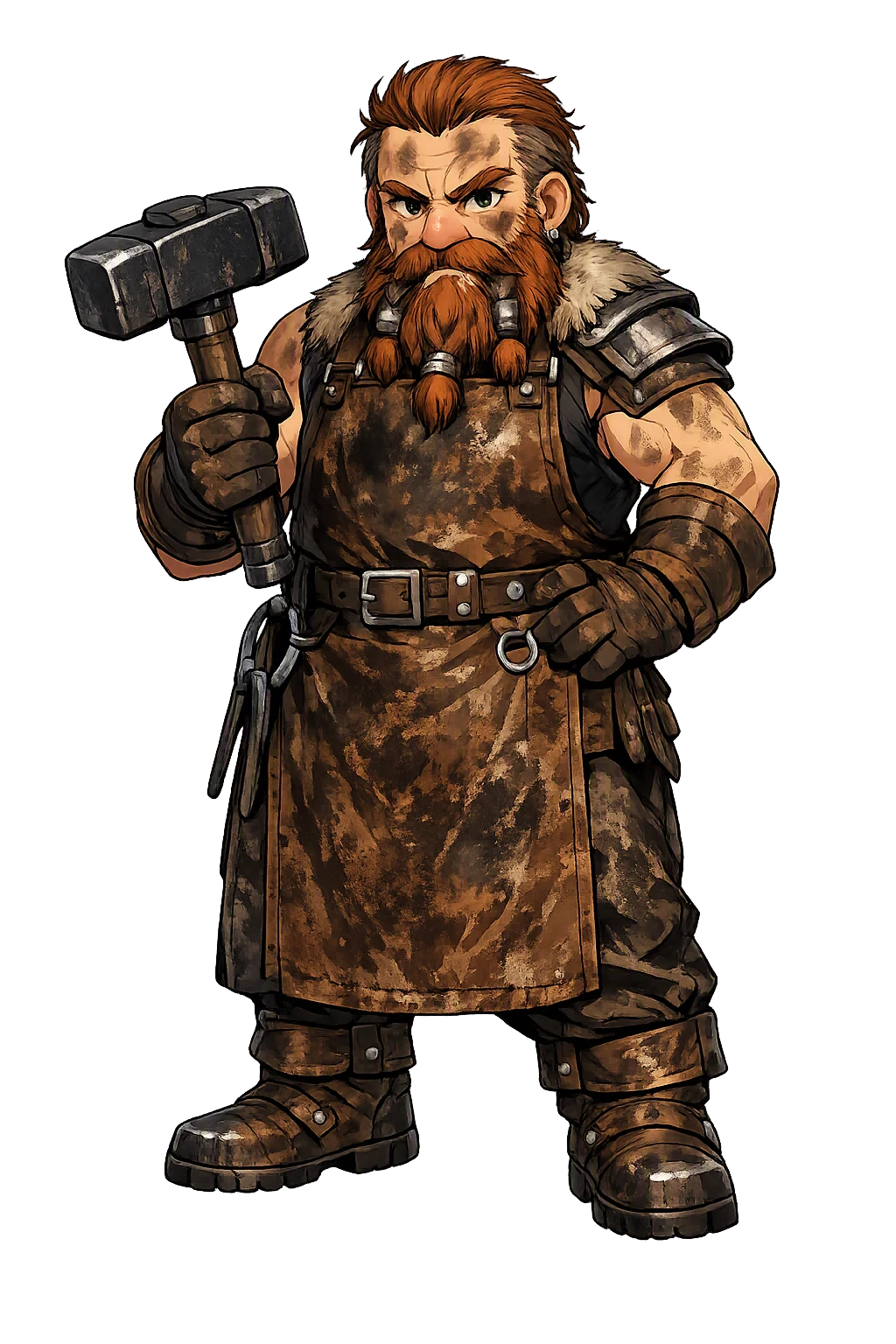
Brokkr is the dwarf who worked the bellows while his brother worked the forge: the smith who took Loki's head as a stake and cast, in three heats, the boar Gullinbursti, the ring Draupnir, and the hammer Mjǫllnir — the greatest single afternoon's work in the northern corpus, interrupted only by a fly.

Brokkr in Later Traditions

The dwarf-smith needs no foreign original: the smithing dwarf is native Germanic stock, and the corpus keeps a whole guild of him — [[sindri|Sindri]] the sparkler, [[andvari|Andvari]] the gold-guardian, the sons of Ívaldi, and the Vǫlundr of Vǫlundarkviða, 'prince of elves' and smith of the Nibelung hoard, whose English cognate Wayland haunts the Franks Casket and Beowulf alike. The comparison with the Greek smith-god Hēphaistos has been tried since the interpretatio romana paired Vulcan with the northern forge-figures, but the families differ where it matters: Hēphaistos is a god who makes wonders for gods, while Brokkr is a tradesman who beats the gods' own suppliers in open competition and collects on the debt. The sharpest contrast lives inside the corpus itself, between two dwarf-rings: Draupnir, made freely in a wager, drips eight rings every ninth night, while Andvaranaut, extorted under threat, kills every hand that holds it — the given ring multiplies, the taken ring devours.

Modern Legacy

Brokkr's afterlife is the afterlife of his hammer: every retelling of the Norse myths that shows Mjǫllnir made — and most now do — must walk back into his forge. Wagner's Ring rebuilt the dwarf-smith as Mime and Alberich, crossed with [[andvari|Andvari]]'s cursed gold; Tolkien's dwarves, miners and master-smiths whose craft outlasts kingdoms, descend from the same þulur that list Brokkr's kin. Modern popular culture has made the forge scene canonical in its own right: Marvel's Thor comics know both Brokk and Eitri as dwarf-smiths, and the films set the making of Thor's weapons in the dwarf-realm of Nidavellir — Snorri's episode, retold for the largest audience the myth has ever had. In Iceland the name survives as a rarity and in the dictionaries as a word for a badger, the animal-name the smith may or may not have carried into myth.

Unicode Restoration as Cultural Act

Restoring Brokkr in a domain name is more than orthographic accuracy. It is a statement that the internet should recognize the full range of human writing — not only the ASCII keyboard.

05

Frequently Asked Questions

Common questions about Brokkr, Dwarf Smith, and Unicode restoration

01How do you pronounce Brokkr?

In reconstructed pronunciation, Brokkr is /ˈbrok.kr̩/ — approximately 'BROK-ur' — two beats, stress on the first, the o short as in 'lot', the double k held a moment longer than English allows, the ending a light syllabic r as in modern Icelandic..

02What does Brokkr mean?

Brokkr means Badger, panting in the norse tradition.

03What are the symbols of Brokkr?

Brokkr is associated with The bellows (The unbroken breath of the forge — the one duty the wager allowed no rest from), The fly's sting (The small sabotage aimed at the work, not the worker — malice that could only manage a short handle), The short handle (The honest flaw in the perfect weapon — the mark the wager left on Mjǫllnir, judged best all the same), The sewn lips (The bargain enforced to its letter — the head won, the neck denied, and the price taken another way), The head as stake (Craft backed by the highest wager the corpus records — a smith's confidence staked against a trickster's).

04Why restore Brokkr in Unicode?

Plain ASCII brokkr strips the stress, length, and script that make the name specific. Unicode restoration returns the name to its original written dignity.

05What is the most important myth about Brokkr?

It begins with Loki's mischief: for a prank, he cut off all the hair of [[sif|Sif]], [[thor|Þórr]]'s wife. Þórr caught him and was set to break every bone in his body when Loki swore to go to the svartálfar, the black-elves, and have them make for Sif a head of hair from gold that would grow like other hair. Loki went to the dwarfs called the sons of Ívaldi, and they made the hair, and with it two more wonders: the ship Skíðblaðnir, which has a fair wind wherever it is bound and folds up like a cloth into a pouch, and the spear Gungnir, which never stops in its thrust. Three treasures stood finished — and Loki, rich in gifts he had not paid for, looked for one more bargain.Grímnismál in the Poetic Edda keeps the first half of the record in verse: 'Ívaldi's sons went in days of old to make Skíðblaðnir, best of ships, for bright Freyr.' The poem names the ship and its makers; Snorri supplies the rest of the morning's work.

06

Scholarly Sources

The philological foundations of this restoration

Every claim on this page is grounded in established scholarship. The orthographic restorations follow disciplinary convention. The etymological chain follows the best available reference works. This is not invention — it is resurrection through scholarship.

Lexicography & Philology

  • Prose Edda
  • Cleasby-Vigfusson

Primary Texts

  • Snorri Sturluson, Prose Edda: Skáldskaparmál 35 (the cutting of Sif's hair, the sons of Ívaldi's three treasures, the wager of the head, the three castings, the judgment of the Æsir, and the sewing of Loki's lips with the thread Vartari)
  • Snorri Sturluson, Prose Edda: Gylfaginning (the svartálfar and their world; Draupnir laid on Baldr's pyre; the þulur of dwarf names)
  • Poetic Edda: Grímnismál 43 (Ívaldi's sons and the making of Skíðblaðnir, best of ships)
  • Poetic Edda: Vǫlundarkviða (Vǫlundr, 'prince of elves' — the corpus's other great smith narrative)

Archaeology & Art History

  • Material evidence — iconography, inscriptions, and temple archaeology — for Brokkr and related cults.
  • Brokkr is a purely literary figure: no runestone, votive deposit, or named image records him, and his name survives in inscriptions, if at all, only as raw anthroponymic material. The narrative itself is unusually well witnessed for an Eddic episode: Skáldskaparmál's account stands in the principal codices of the Prose Edda — the Codex Regius GKS 2367 4to (c. 1300–1325) and its sister manuscripts — with the brother's name given as Eitri in the main text and Sindri in some copies. The myth's material world, by contrast, is richly documented: the Mästermyr find from Gotland, a Viking-Age smith's complete tool chest buried about the year 1000, preserves the bellows, hammers, tongs, and anvils of exactly the forge-culture the story presumes. And the treasures Brokkr made left the deepest material trace of all: Thor's-hammer amulets, cast in silver and worn across the Viking world from the ninth century onward, are the archaeological footprint of the wager's third casting.

Religious Studies

  • Cleasby–Vigfusson, An Icelandic-English Dictionary, s.v. brokkr ('a badger'), Eitri, Sindri, Draupnir, Mjǫllnir, Gullin-bursti, Vartari
  • Zoëga, A Concise Dictionary of Old Icelandic, s.v. brokkr, draupnir, mjǫllnir, gullinbursti
  • Simek, Dictionary of Northern Mythology; Orchard, Dictionary of Norse Myth and Legend; Lindow, Norse Mythology: A Guide — s.v. Brokk, Eitri/Sindri, the sons of Ívaldi, Mjǫllnir, Draupnir, Gullinbursti
Return

The Surface Awaits

You have traced the name from its earliest attestation to its Unicode restoration. Now return to the myth. The story is where the name lives.

Back to Lore
Brokkr mascot