The Living Myth
Ultimate Reality · The Absolute, the World-Ground · The sacred utterance that became the Absolute — the power of prayer expanded into the world-ground of the Upaniṣads
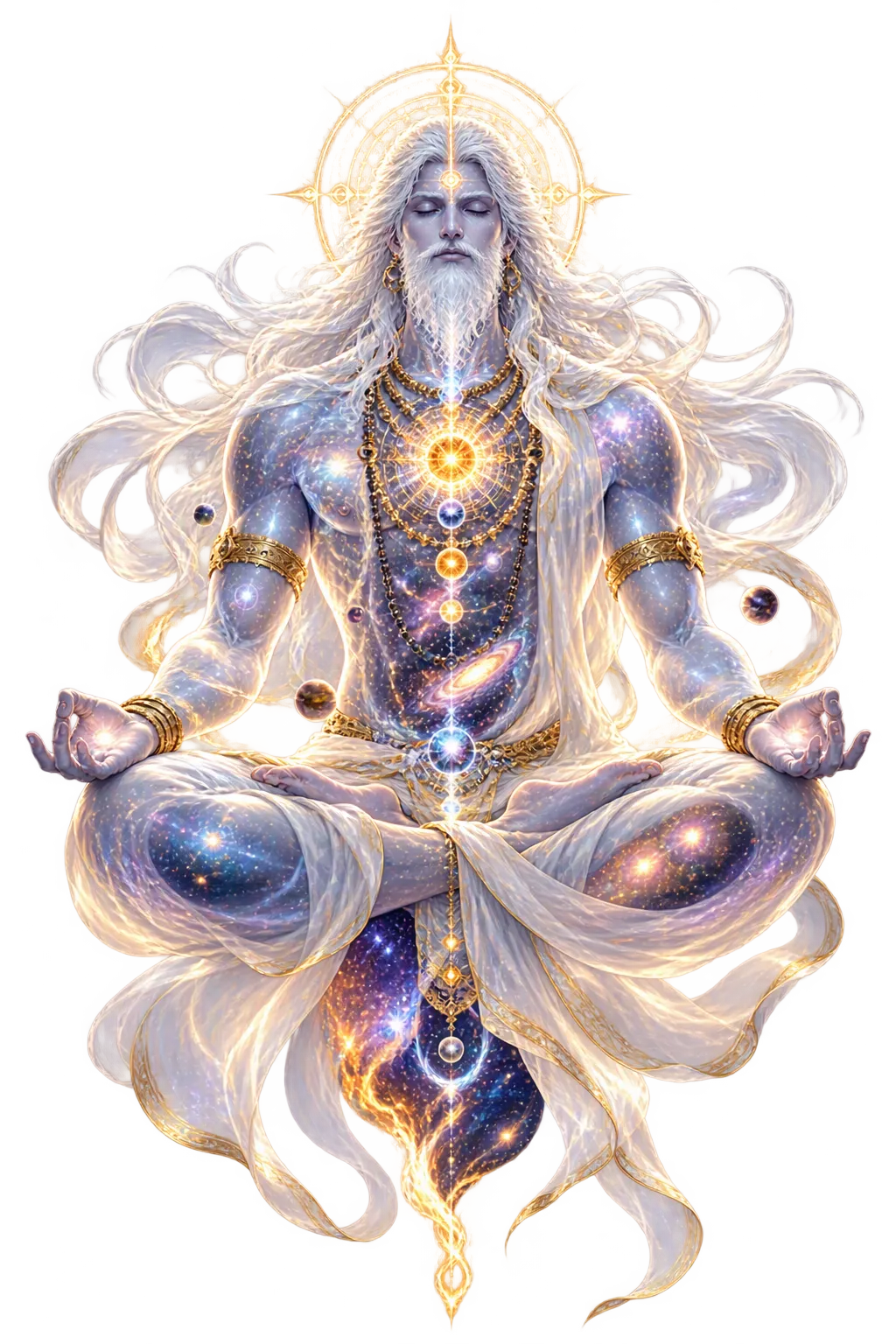
Stories of Brahman
Brahman has no myths — it is what myths are made of. Its ‘stories’ are the doctrine’s own ascent: the Vedic priest’s formula becoming the cosmic principle, the forest sages’ equation of the self with the all, and the grammarians’ discovery that the sacred syllable AUM is brahman compressed into sound.
The Nāsadīya sūkta contemplates the state before creation — ‘there was neither existence nor non-existence’ — and names the One that breathed without breath. The hymn refuses to say what that One is; the later tradition named it brahman, and built the Upaniṣadic quest on the hymn’s silence.
The Taittirīya builds the cosmos from nourishment: food is brahman, the eater is brahman, the eater of the eater is brahman. The sequence — food, breath, mind, knowledge, bliss — is the Upaniṣadic ladder of the self, each rung a thicker description of the absolute.
Nine times the teacher Uddālaka tells his son Śvetaketu ‘tat tvam asi’ — that thou art — reasoning from salt dissolved in water: invisible, present everywhere, the ground of taste. The sentence became the keystone of Vedānta, quoted by every commentator from Śaṅkara to the modern sages.
The great dialogue has Yājñavalkya answer the question ‘what is brahman?’ only by negations — neti neti, not this, not this. The method is the tradition’s most honest: the absolute cannot be described, only approached by stripping away every description. The gods, the world, and the self remain — as its body.
The Sacred Utterance That Became the All
Brahman is the load-bearing concept of Indian thought: the absolute reality beneath gods, world, and self. The word begins as the Vedic priest’s formula — the verse whose correct utterance moves the cosmos — and ends as the Upaniṣads’ world-ground, that which speech cannot reach but without which no speech sounds. In the lexicon it stands for the principle personified: not a god among gods, but what the gods are made of.
The Vedic brahman is the spoken formula — the verse whose pronunciation is ritual power.
In the Upaniṣads, brahman is the all: “from which words turn back, together with the mind, unable to reach it”.
“That thou art”: the Chandogya’s equation of brahman and the self — the tradition’s most quoted sentence.
Neti neti — the negative path: brahman defined by what it is not, since it is everything that is.
From the original script to the living URL
ब्रह्मन्
The name in its original Sanskrit form. Brahman (ब्रह्मन्) is attested in the source tradition — “The sacred utterance that became the Absolute — the power of prayer expanded into the world-ground of the Upaniṣads”. Its original diacritics and script distinctions carry the full phonetic and orthographic weight of the source tradition.
brahman
The plain brahman form is identical to the Unicode restoration. Because this name is already written in Latin letters, no diacritics, stress, or script information were lost — only capitalization differs.
Brahman
The Unicode restoration does not need to recover lost marks for Brahman. Its value is canonical spelling and consistent cataloguing, not the reconstruction of erased orthography. The domain is readable as-is to both DNS and humanity.
Brahman.com
This restoration is written entirely in ASCII letters — no Punycode encoding stands between Brahman and the DNS. The domain reads identically to machines and to human eyes.
The attested spelling family of Brahman
Brahman
Restores ब्रह्मन्. The full Unicode restoration. brahman.com is not in the PuniCodex collection — it is watched for release; if it drops, this temple upgrades to an owned flagship. Attested by MW, Upanishads.
How Brahman was spoken
How Brahman travels from ancient script to the modern URL
The lore you have read is the living myth. Extended Lore opens the scholarly vault beneath it: the cult and its material remains, a history of the image, the name after antiquity, a meditation on what the name still means, and the full scholarly apparatus — etymology, orthography, sources.
Enter Extended Lore