
The Cult
Its liturgy is recitation: the Veda read aloud is brahman’s daily performance. The upanayana initiation — the thread-ceremony — admits a boy to the utterance; every subsequent recitation keeps the absolute in circulation.
Extended Lore
Etymology · Orthography · Cult · Iconography · Reception · Sources
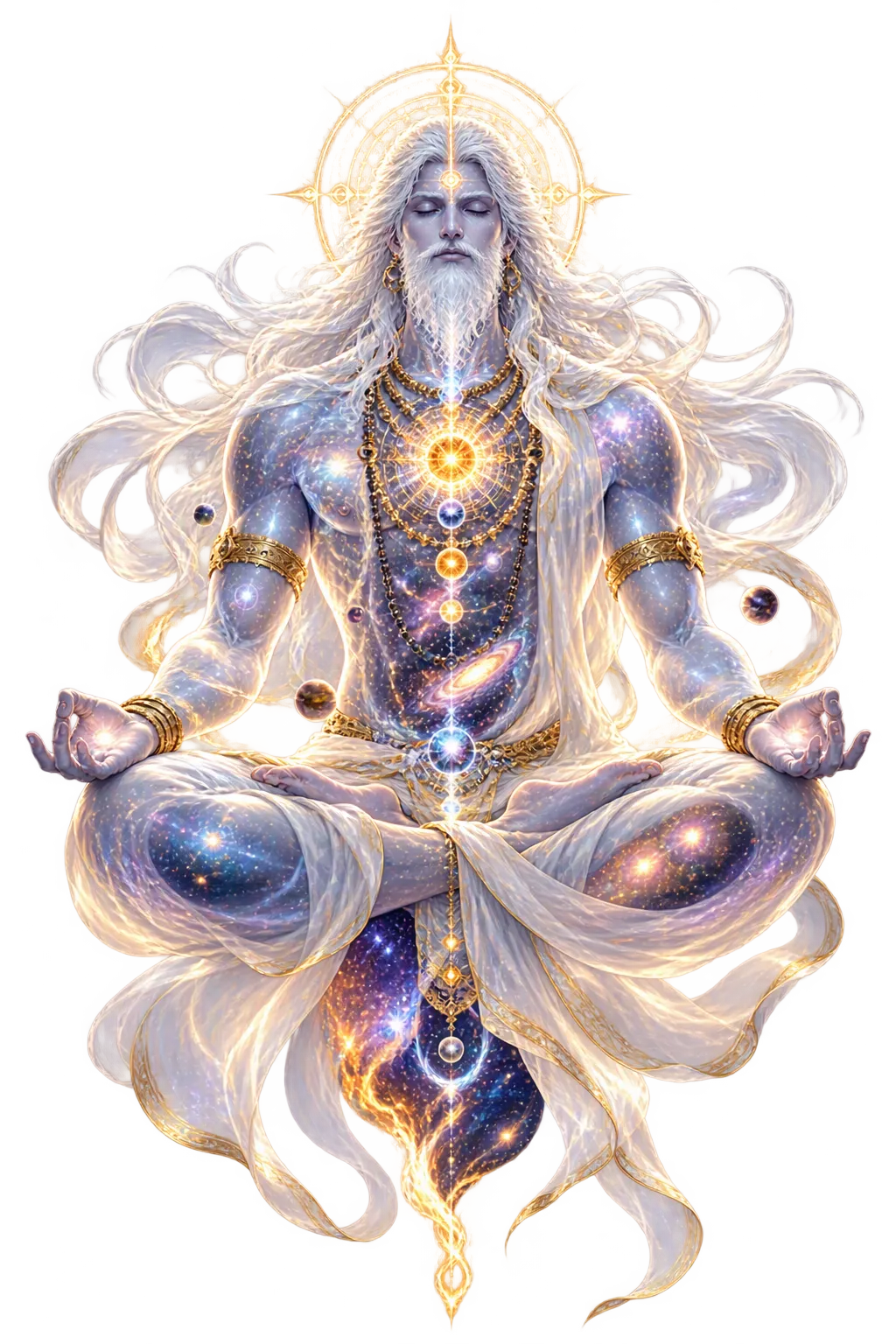
Essential information about Brahman, Ultimate Reality
From original script to Unicode restoration
The name Brahman reaches the modern world through scholarly transliteration of the sanskrit tradition. Because the conventional spelling uses only Latin letters, its Unicode and ASCII forms coincide — the tradition it carries is in the name itself, not in diacritics.
Character-by-character philological analysis
| Character | Unicode | Name | Block | Phonetic Role |
|---|---|---|---|---|
| B | U+0042 | Latin Capital Letter B | Basic Latin | Same, capitalized |
| r | U+0072 | Latin Small Letter R | Basic Latin | Same |
| a | U+0061 | Latin Small Letter A | Basic Latin | Same |
| h | U+0068 | Latin Small Letter H | Basic Latin | Same |
| m | U+006D | Latin Small Letter M | Basic Latin | Same |
| a | U+0061 | Latin Small Letter A | Basic Latin | Same |
| n | U+006E | Latin Small Letter N | Basic Latin | Same |
This restoration reflects fidelity to the attested tradition, not recovered diacritics: every character of Brahman already survives in ASCII. What the restoration preserves is the canonical spelling itself — the form scholarship standardised.
How the sacred was kept — rites, sanctuaries, remains
Its liturgy is recitation: the Veda read aloud is brahman’s daily performance. The upanayana initiation — the thread-ceremony — admits a boy to the utterance; every subsequent recitation keeps the absolute in circulation.
Brahman leaves no temple — it is the reason temples are redundant. Its monuments are manuscripts: the Upaniṣads’ palm-leaf lines, the Vedānta commentaries’ endless recursion, and the syllable AUM carved over every doorway of the tradition.
How Brahman was imaged across the ages
AUM is brahman’s only image — the three curves and the dot, mapped by the tradition onto waking, dream, deep sleep, and the absolute. Where a temple must show something, it shows the syllable.
The name after its own age — transmission, translation, survival
Arthur Schopenhauer called the Upaniṣadic brahman the highest product of human thought before Kant; theosophy and then physics popularized it (‘the universe is brahman’ reads like an early draft of certain cosmologies). The word entered the world’s philosophical vocabulary — the absolute that needs no capital letter.
Brahman absorbed every rival absolute: the Vedic ṛta, the Upaniṣadic ātman, the grammarian’s śabda, and — through the Vedānta commentaries — the personal gods themselves, who turned out to be brahman’s named aspects. Buddhism defined its nirvāṇa partly against brahman, which kept the concept honest; and modern Indian philosophy still uses the word for the ultimate in any school.
The word gave India its most quoted sentence (‘tat tvam asi’), its most quoted method (‘neti neti’), and its most quoted sound (AUM). ‘Brahman’ passed into English as the learned word for the absolute; and the identification of brahman and ātman remains, after a century of translation, the central puzzle of comparative philosophy — the self and the world, one or two.
What Brahman means — beyond the dictionary
Brahman: the name that refuses to be a name. Restored plainly, it demonstrates the lexicon’s wager — that plain letters can carry what the Upaniṣads said words cannot carry. Say it, and the utterance is the thing: a two-syllable formula older than the temples built to out-shout it.
Common questions about Brahman, Ultimate Reality, and Unicode restoration
In reconstructed pronunciation, Brahman is /ˈbrɑːhmən/ — approximately “BRAH-mun”.
Brahman means The sacred utterance that became the Absolute — the power of prayer expanded into the world-ground of the Upaniṣads in the sanskrit tradition.
Brahman is associated with The Utterance (The Vedic brahman is the spoken formula — the verse whose pronunciation is ritual power.), The World-Ground (In the Upaniṣads, brahman is the all: “from which words turn back, together with the mind, unable to reach it”.), Tat Tvam Asi (“That thou art”: the Chandogya’s equation of brahman and the self — the tradition’s most quoted sentence.), Not This, Not This (Neti neti — the negative path: brahman defined by what it is not, since it is everything that is.).
Brahman is written entirely in ASCII letters, so its restoration is about canonical fidelity rather than recovered diacritics: the temple fixes the name in its scholarly standard spelling, attested in the source tradition, instead of leaving it to drift.
“The Creation Hymn” — the Ṛgveda 10.129 story that anchors the mythology of Brahman, told in full on the lore page.
The philological foundations of this restoration
Every claim on this page is grounded in established scholarship. The orthographic restorations follow disciplinary convention. The etymological chain follows the best available reference works. This is not invention — it is resurrection through scholarship.
You have traced the name from its earliest attestation to its Unicode restoration. Now return to the myth. The story is where the name lives.
Back to Lore