
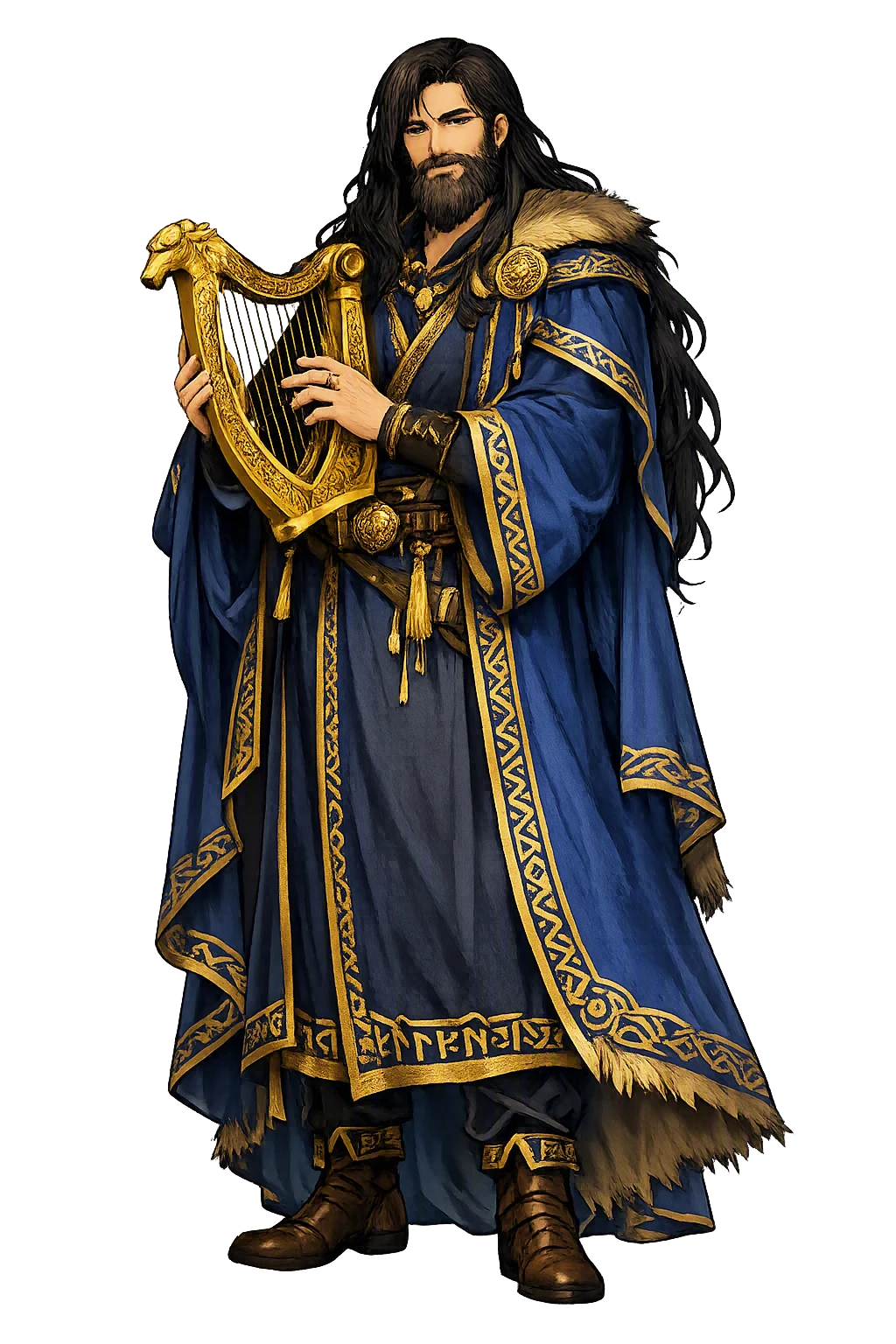
Why Bragi belongs in your address bar
Every address bar is a choice. When you type Bragi, you are not typing a novelty; you are restoring a name that the early DNS, built for English typewriters, could not carry. The plain ASCII form bragi is a leftover of that constraint, not the name itself. This post is the long version of the restoration: where the name comes from, how the Younger Futhark tradition wrote it, how it is pronounced, what the myths and the material record preserve, and why its Unicode form now lives as a working domain. The claim throughout is simple — the original spelling is not decoration. It is the name.
At a Glance
- Restored name: Bragi
- ASCII form: bragi
- Meaning: "Poet, first"
- Domain of influence: Poetry, Eloquence
- Pantheon: Norse
- Classification: Tier 2
- Original script: ᛒᚱᛅᚴᛁ (Younger Futhark)
Overview
Bragi (bragi) — Poetry, Eloquence · The Skald Among the Gods — is the Norse god of poetry and of the well-turned word: husband of Iðunn, the voice Snorri seats beside Ægir to narrate the myths, and the god Óðinn sends out to greet dead kings at the door of Valhǫll.
His attestation is a voice rather than an adventure. Snorri's catalogue of the Æsir praises him as renowned for wisdom and most of all for eloquence and skill with words, and derives the word bragr — 'poetry', and 'foremost' — from his name; Grímnismál's litany of the world's best things calls him the best of skalds. The Prose Edda's own frame makes him the gods' storyteller, and the court poems Hákonarmál and Eiríksmál give him the solemn office of welcoming the slain into Óðinn's hall.
PuniCodex restores the name as Bragi — identical to the ASCII input, because normalized Old Norse writes no diacritic in this name. The mechanical rule therefore places it in Tier 2: nothing distinctive is lost in transit, a statement about orthography and never about the god. No domain is claimed: the plain-ASCII bragi.com is registered to a third party outside the collection and is watched for release.
The Name
The name is attested in Old Norse as Bragi (nominative; genitive Braga). It is bound to the Old Norse poetic noun bragr, which carries two senses at once: 'poetry', and 'foremost, chief, the best' — whence the lexicon's gloss 'Poet, first'. Snorri runs the derivation from the god outward: from Bragi's name bragr is called, and from it a man or woman who surpasses others in eloquence is a bragr-maðr or bragr-kona. Modern etymologists are less certain of the direction, and the deeper question — whether the god was made out of the noun, or a historical skald deified into it — is registered rather than settled by Simek and Lindow.
The ASCII form is not a compromise here: normalized Old Norse Bragi is already written in plain ASCII letters. There is no diacritic, no thorn or eth, no vowel-length mark for the early domain-name system to have stripped. The name is classified Tier 2 by the project's mechanical rule — the restoration preserves nothing the ASCII form loses — which is a statement about orthography, never about the god Grímnismál calls the best of skalds.
The letter-by-letter transformation runs:
- b → B — Same, capitalized
- r → r — Same
- a → a — Same
- g → g — Same
- i → i — Same
The project holds no domain for this name: bragi.com is registered to a third party outside the PuniCodex collection and is watched for release. The temple lives at its canonical lexicon address.
The Original Script
The name is preserved in medieval Icelandic manuscripts in the Latin alphabet as Bragi — Old Norse (North Germanic), attested 13th c. CE in the Codex Regius of the Poetic Edda and the Codex Regius of the Prose Edda, recording material centuries older. Before the Latin bookhand, Old Norse names were carved in the younger futhark; no runic attestation of this theonym survives, so the manuscript form is the primary witness.
The scholarly rendering proceeds step by step:
- The name is attested as Bragi (nominative; genitive Braga), bound to the poetic noun bragr, 'poetry; foremost'.
- Old Norse orthography here writes no long vowel and no special letter: there is no acute accent and no thorn or eth to restore.
- In the Younger Futhark the name would have been carved ᛒᚱᛅᚴᛁ (b-r-a-k-i, the ᚴ rune writing g as well as k) — a normalized reconstruction, not an attested carving.
- The Unicode restoration Bragi therefore differs from the ASCII input only in its capital: the name is plain ASCII in its medieval form, and Tier 2 by the project's mechanical rule.
Pronunciation
The reconstructed pronunciation of the name is /ˈbrɑ.ɣi/ — Old Norse Reconstruction.
Phoneme by phoneme:
- Bra- — Voiced bilabial stop [b], trilled [r], and the short open back [ɑ]; the syllable carries the stress, as on every Old Norse first syllable
- -gi — The medial g softens between vowels to the voiced velar fricative [ɣ], a light 'gh' rather than a stop, closing on short [i]
For the modern speaker, the closest approximation is: 'BRAH-ghi' — a short open 'ah', the g softened to a gentle fricative between the vowels.
Kindred and historical forms of the name:
- Old Norse — Bragi, genitive Braga; beside the common noun bragr, 'poetry; foremost'
- Modern Icelandic — Bragi, the unbroken living form as a male given name
- Norwegian — Brage, as in the Brage Prize for literature
- Latinized — Brago, the form Saxo Grammaticus writes
Bragi is Tier 2 by the mechanical rule: the normalized Old Norse form is already plain ASCII — no diacritic and no distinctive letter for the ASCII alphabet to lose. Only the capital distinguishes the restored form from the input.
Mythology
Bragi acts in almost nothing and speaks in everything: his mythology is a voice — the catalogue portrait, the storytelling frame, the flyting answer, and the welcome at the door of the dead.
The Catalogue Portrait (Gylfaginning 26)
Snorri numbers him among the Æsir with the formula the tradition never varies: renowned for wisdom and most of all for eloquence and skill with words, knowing more of poetry than any other; from his name bragr is called, and his wife is Iðunn. Grímnismál's litany seals it in verse — Bragi is best of skalds.
The Gods' Storyteller (Skáldskaparmál)
When Ægir came to the feast in Ásgarðr he was seated beside Bragi, and the myths they talked over are the ones the book exists to record: the truce-spittle that became Kvasir, the dwarfs' brewing of his blood with honey into the mead that makes a skald, the mead's capture by Suttungr, and Óðinn's theft of Óðrerir in three gulps as Bǫlverkr. Bragi also tells how the giant Þjazi, in eagle shape, carried off Iðunn and her apples of youth, and how Loki won her back. When the book later asks how Bragi himself shall be kennt, the answer is his identity in one line: husband of Iðunn, first maker of poetry, the long-bearded god, and son of Óðinn.
The Flyting (Lokasenna 11–18)
When Loki forced his way into Ægir's feast, Bragi was the first to refuse him a seat; when Loki's flyting began, he taunted the god of the word as the most cowardly of the Æsir in war, shyest of the bow-shot. Bragi answered in kind, and it was Iðunn who did the scene's true eloquent work, calming her husband before the quarrel ran further.
The Greeter of Dead Kings (Hákonarmál · Eiríksmál)
Eyvindr skáldaspillir's funeral poem for Hákon the Good (c. 961) gives Bragi his solemn office: Óðinn sends 'Hermóðr and Bragi' to meet the slain king coming to Valhǫll. In the anonymous Eiríksmál, woven for Eiríkr Bloodaxe, Bragi asks Óðinn why he robbed the bravest king of victory — and receives the corpus's coldest answer: the grey wolf gapes ever at the dwellings of the gods.
Symbols & Iconography
Bragi's iconography is literary rather than cultic — the corpus gives him no temple regalia, but the tradition fixed a small set of attributes around his voice:
- The mead of poetry — the blood-and-honey mead brewed from wise Kvasir, hoarded by the giant Suttungr and stolen by Óðinn: the myth of poetry's origin that Bragi himself narrates to Ægir in Skáldskaparmál
- The bragarfull — the 'foremost cup' drained with binding vows at the great feasts, named from the same word as the god: the spoken word made contractual over drink
- The long beard — skegg-Bragi: Skáldskaparmál's kenning calls him the long-bearded god, the old skald's visible mark of office
- The bench in Ægir's hall — the storyteller's seat at the feast, where Bragi both bars Loki in Lokasenna and narrates the myths in the Prose Edda's frame
- The greeting at Valhǫll's door — the welcome spoken over dead kings: praise as the North's answer to mortality
The harp of the familiar nineteenth-century images is a Romantic addition; the Eddas give him no instrument, only the voice.
Archaeology & Evidence
No cult site, votive deposit, or named image of Bragi is known, and the place-name record offers no secure theophoric site — the silence that leads the handbooks to weigh him as a late literary personification rather than an old cult figure. The runic corpus knows the name only as an ordinary human anthroponym: Bragi is well attested as a Viking-Age man's name in Scandinavian inscriptions, which is precisely the problem for cult-hunters, since no carving can be tied to the god.
The witnesses are therefore the manuscripts. Lokasenna and Grímnismál survive in the thirteenth-century Codex Regius of the Poetic Edda; Gylfaginning and the Skáldskaparmál frame in the Codex Regius and sister manuscripts of the Prose Edda, with Skáldatal in the Uppsala codex; Hákonarmál rides inside the Heimskringla tradition and Eiríksmál inside Fagrskinna. The material corollary is negative but telling: where Þórr's hammer-pendants survive by the thousand, no object in the ground bears Bragi's mark — his medium was never metal or stone, but the trained voice at the feast.
Realm & Domain
Bragi is the god of poetry and eloquence — and, characteristically for the North, of the offices eloquence performs: the telling of the myths, the toasting of vows, and the welcoming of the dead.
Poetry
Grímnismál 44 calls him the best of skalds, in the same breath that names Sleipnir best of horses and Bifrǫst of bridges; Snorri derives the very word bragr, 'poetry', from his name.
Eloquence
Snorri's catalogue portrait praises his wisdom and his skill with words above all, and coins the compliment that survives him: the bragr-maðr and bragr-kona, the man or woman of surpassing eloquence.
The Storyteller's Office
In Skáldskaparmál's frame, the sea-god Ægir sits beside Bragi at the feast in Ásgarðr, and the myths of the mead of poetry and of Iðunn's abduction are told in Bragi's voice — the Prose Edda's own image of where tradition lives.
The Greeter of Kings
In Hákonarmál, Óðinn sends Bragi and Hermóðr out to greet the slain Hákon the Good as he approaches Valhǫll; in Eiríksmál, Bragi is the voice that asks Óðinn why the bravest kings must fall.
Husband of Iðunn
Skáldskaparmál's first kenning for him is 'husband of Iðunn' — the god of the word wedded to the goddess of the ever-young apples, poetry married to what keeps the gods alive.
Across Cultures
The honest comparisons for Bragi are typological, not genealogical. His closest structural kin in the neighbouring tradition is the Irish Ogma of the Tuatha Dé Danann — the champion of eloquence credited with the Ogham script: two Indo-European cultures that each enthroned the well-spoken word among their gods, with no borrowing argued or needed. The Greek comparison is weaker: Bragi is no Apollo — he leads no choir and prophesies nothing — and the North already assigned the conquest of the poetic mead to Óðinn, leaving Bragi the distinct office of the professional praiser.
The deepest debate is internal. Since the nineteenth century scholars have asked whether the god is the deified Bragi Boddason, the ninth-century Norwegian skald whose Ragnarsdrápa Skáldskaparmál quotes stanza by stanza; the handbooks register the theory without settling it. Simek notes the colder alternative — that Bragi may be a late literary personification of bragr, poetry itself, with no old cult behind him — and Lindow treats him as essentially a figure of the poetic tradition he personifies. Within the corpus, closely related figures include Óðinn (the mead's winner and, per Snorri's kenning, his father), Iðunn (his wife), and Sága (the other divine figure bound to story and drink, who shares Óðinn's cups at Sǫkkvabekkr).
Cultural Legacy
Bragi's afterlife lives in the language itself. Bragr remained the Old Norse word for poetry; the bragr-maðr and bragr-kona kept his name in everyday compliment; and the bragarfull — the foremost cup of the vow-toast that Ynglinga saga sets at the great inheritance feasts — carried the word into the drinking customs of medieval Scandinavia. Revived in the sumbel of modern Heathen practice, the custom still opens with a hail to Bragi as patron of poets before the boasting rounds begin.
The name never died in the North: Bragi remains a living Icelandic given name, Brage its Norwegian and Swedish form, and Norway's premier literary award, the Brage Prize, has borne it since 1992. The visual afterlife is later and thinner: the white-bearded Bragi with a harp who appears in nineteenth-century Scandinavian painting and sculpture is a Romantic invention, answering the period's hunger for a northern bard — the Eddas knew him by voice alone.
The Scholarly Record
The account of Bragi given in this edition rests on the witnesses and reference works listed below. The Eddas supply the portrait and the narrative frame; the court poems the office of the king's greeter; the lexica secure the name's bond with bragr; the handbooks arbitrate the personification and Bragi Boddason debates.
- Snorri Sturluson, Edda, Gylfaginning 26 (the catalogue portrait of Bragi), ed. and trans. Anthony Faulkes (London: Everyman, 1987).
- Snorri Sturluson, Edda, Skáldskaparmál (the frame with Ægir; the mead of poetry; the abduction of Iðunn; kennings for Bragi; Ragnarsdrápa), ed. and trans. Anthony Faulkes (London: Everyman, 1987).
- The Poetic Edda, trans. Carolyne Larrington, 2nd ed. (Oxford: Oxford University Press, 2014): Lokasenna 11–18; Grímnismál 44.
- Eyvindr Finnsson skáldaspillir, Hákonarmál, in Snorri Sturluson, Heimskringla, Hákonar saga góða, ed. Bjarni Aðalbjarnarson, Íslenzk fornrit 26 (Reykjavík: Hið íslenzka fornritafélag, 1941).
- Eiríksmál (anonymous), preserved in Fagrskinna, ed. Bjarni Einarsson, Íslenzk fornrit 29 (Reykjavík: Hið íslenzka fornritafélag, 1985).
- Snorri Sturluson, Heimskringla, Ynglinga saga (the bragarfull), ed. Bjarni Aðalbjarnarson, Íslenzk fornrit 26 (Reykjavík: Hið íslenzka fornritafélag, 1941).
- Cleasby, Richard, and Guðbrandur Vigfússon, An Icelandic-English Dictionary, 2nd ed. (Oxford: Clarendon Press, 1957), s.v. Bragi, bragr, bragarfull.
- Zoëga, Geir T., A Concise Dictionary of Old Icelandic (Oxford: Clarendon Press, 1910), s.v. Bragi, bragr.
- de Vries, Jan, Altnordisches etymologisches Wörterbuch, 2nd ed. (Leiden: Brill, 1962), s.v. Bragi, bragr.
- Simek, Rudolf, Dictionary of Northern Mythology, trans. Angela Hall (Cambridge: D. S. Brewer, 1993), s.v. Bragi.
- Orchard, Andy, Dictionary of Norse Myth and Legend (London: Cassell, 1997), s.v. Bragi.
- Lindow, John, Norse Mythology: A Guide to the Gods, Heroes, Rituals, and Beliefs (Oxford: Oxford University Press, 2001), s.v. Bragi, Hákonarmál, Eiríksmál.
A Meditation
Bragi is the god a culture of oral memory had to invent. In a world without archives, the skald was the archive: the king's deeds, the clan's honour, the boundary between being remembered and being nothing all ran through one trained voice at the feast. The North looked at that voice and saw a god in it — and then put the god to work at the door of the dead, because the only immortality the Edda truly promises is the welcome spoken over you when you arrive.
The division of labour is the deepest thing the tradition says about poetry. Óðinn wins the mead — by disguise, seduction, and theft — but Bragi pours it. Inspiration is ordeal; eloquence is hospitality: the craft of receiving greatness and giving it words. The god whose name means 'foremost' is the one who stands where the living greet the dead and finds the sentence both can bear.
The Unicode Restoration
Bragi is classified as Tier 2: the restoration needs no distinctive letters or diacritics its ASCII form would lose. The ASCII fallback bragi still resolves everywhere, but it is the restored form that carries the name's full information. That is the whole thesis of this temple: the marks are the message.
Why This Restoration Matters
Restoring Bragi is part of a larger effort to make the web multilingual by default. The PuniCodex project does not ask users to learn a new alphabet; it asks the infrastructure to respect the alphabets that already exist. Every section of this post — the script, the sound, the myths, the evidence — converges on the same point: the marks in Bragi are information, and information deserves an address of its own. A single Unicode domain is a small proof, but it is a proof that scales: every name restored makes the next one easier, and every visit to the temple is a vote for the restored form.
Explore Further
This post is one doorway into the temple. The home page carries the full character breakdown and the ambient canvas; the lore page tells the myths in long form; the Scholarly Edition preserves the sources, pronunciation data, and revision history; and the patron wall supports the restoration directly. For the wider map, browse the Lexicon, explore the Pantheon, or return to the PuniCodex blog.
Related Names
Sources
The full scholarly apparatus — every citation, revision, and review — lives in the Scholarly Edition. Key references for this post:
- Snorri Sturluson, Edda, Gylfaginning 26 (the catalogue portrait of Bragi), ed. and trans. Anthony Faulkes (London: Everyman, 1987).
- Grímnismál 44 (Poetic Edda), trans. Carolyne Larrington, The Poetic Edda, 2nd ed. (Oxford: Oxford University Press, 2014).
- Eyvindr Finnsson skáldaspillir, Hákonarmál, in Heimskringla, Hákonar saga góða; Eiríksmál, preserved in Fagrskinna.
- Cleasby, Richard, and Guðbrandur Vigfússon, An Icelandic-English Dictionary, 2nd ed. (Oxford: Clarendon Press, 1957), s.v. Bragi, bragr.
- Lexicon authorities for this entry: Poetic Edda, Cleasby-Vigfusson.