The Living Myth
Protection, Childbirth, Joy · The Protector of Hearth and Childbirth · The protector
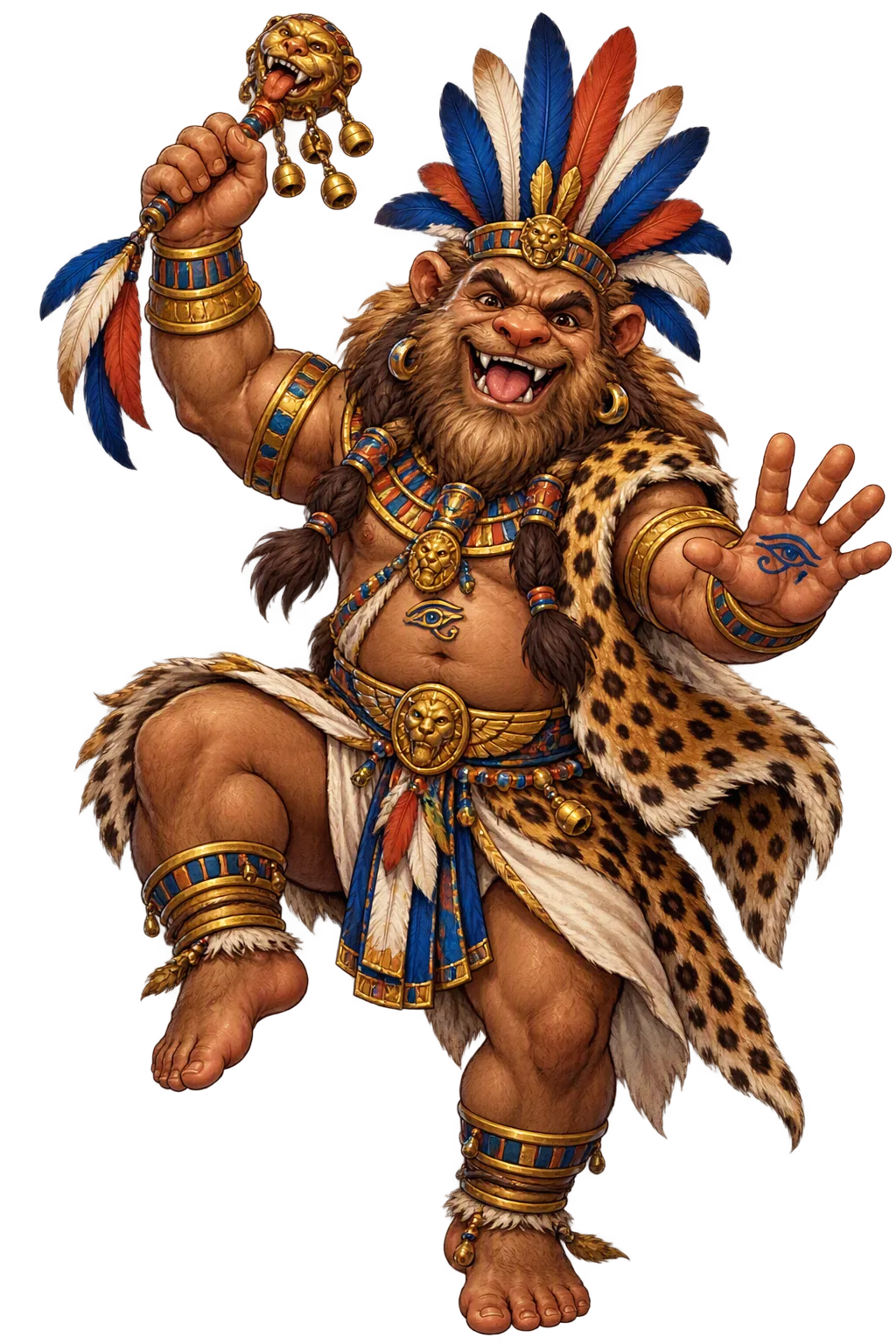
Stories of Bs
Bes has no myth because he was always already there — at the door, at the bed, at the birth. His ‘theology’ is apotropaic: power through ugliness, protection through fright. Later tradition gave him a birth and a family (the lion-dwarf Pantheos of the late period), but his real domain never moved from the threshold of ordinary Egyptian life.
In the birth-chamber, the midwife donned the Bes-mask and danced his dance; his grimace drew the malign spirits’ attention onto himself and away from mother and child. The Beset-amulets and the ‘Bes-chamber’ scenes of Deir el-Medina show the rite in domestic detail.
The Westcar Papyrus’ wonder-tale of the dwarf Dedi, who dances and performs before the court, is read as Bes’ narrative shadow — the small deformed being whose skill and humour carry more power than the great. Bes never speaks in the texts; he dances.
By the Late Period, Bes absorbed attributes of every major god — the wings of Horus, the crown of Amun, the snakes of Mehen — becoming the ‘Pantheos-Bes’, one dwarf wearing the whole pantheon’s power. The type, with its many arms and animal faces, spread through the Greco-Roman world as an amulet-image.
At Saqqara and in the demotic tales, Bes appears as the son of Neith, sent against the enemies of the gods — a dwarf-hero with a sword. The strand gives him a genealogy the earlier household cult never needed: the protector domesticated into a champion.
The Dwarf at the Door, Enemy of Every Evil Eye
Bs — Bes — is Egypt’s household god: the dwarf with the lion’s mane and the fright-mask face who stands at the head of the bed, the birth-brick, the mirror-handle and the harp, keeping every dangerous thing away from the vulnerable. No temple was his; every home was. He is the most reproduced and least narrated god of Egypt.
His image watched over beds, births, and mirrors — the god of the domestic threshold.
His terrifying face and acrobatic dance frighten away the demons of childbirth and sleep.
The birth-brick and the Bes-mask of the midwife: he presided over every Egyptian child’s first hour.
Bes-guardians on headrests and bed-legs watched the sleeper through the dangerous night.
From the original script to the living URL
𓃀𓋴𓄜
The name in its original Egyptian form. Bs (𓃀𓋴𓄜) is attested in the source tradition — “The protector”. Its original diacritics and script distinctions carry the full phonetic and orthographic weight of the source tradition.
bes
The plain bes form is identical to the Unicode restoration. Because this name is already written in Latin letters, no diacritics, stress, or script information were lost — only capitalization differs.
Bs
The Unicode restoration does not need to recover lost marks for Bs. Its value is canonical spelling and consistent cataloguing, not the reconstruction of erased orthography. The domain is readable as-is to both DNS and humanity.
Bs.com
This restoration is written entirely in ASCII letters — no Punycode encoding stands between Bs and the DNS. The domain reads identically to machines and to human eyes.
The attested spelling family of Bs
Bs
Restores 𓃀𓋴𓄜. The full Unicode restoration. bs.com is not in the PuniCodex collection — it is watched for release; if it drops, this temple upgrades to an owned flagship. Attested by Faulkner, Wb.
How Bs was spoken
How Bs travels from ancient script to the modern URL
Egyptian Bs; the original vocalisation is unknown. The dwarf-lion deity who protects mothers and children.
The lore you have read is the living myth. Extended Lore opens the scholarly vault beneath it: the cult and its material remains, a history of the image, the name after antiquity, a meditation on what the name still means, and the full scholarly apparatus — etymology, orthography, sources.
Enter Extended Lore