
The Cult
His cult was the cult of the home: images instead of priests, dances instead of hymns. In the Greco-Roman period formal Bes-oracles appeared — the dwarf who answered questions by the cast of knucklebones — Egypt’s most demotic divination.
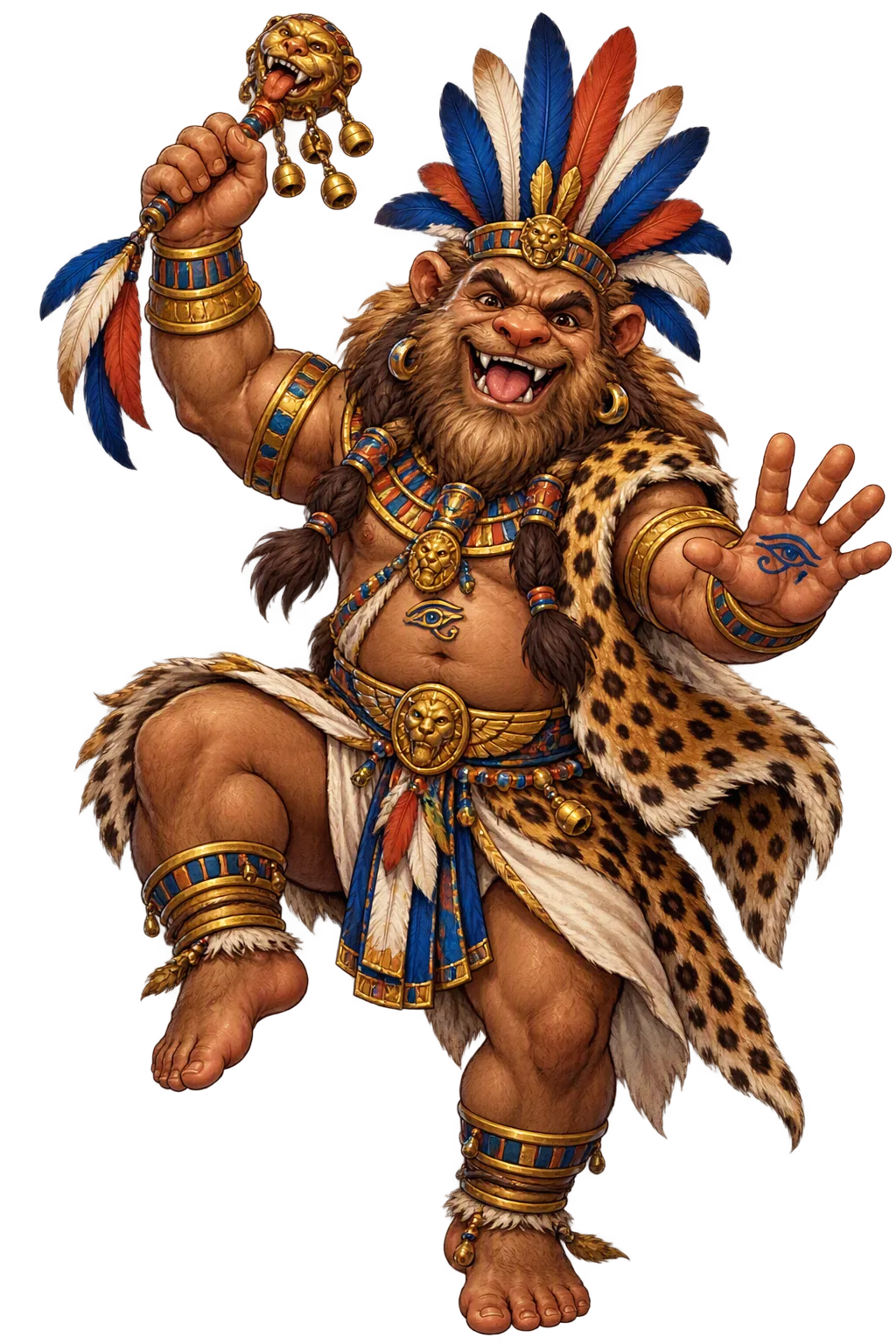
Essential information about Bs, Protection, Childbirth, Joy
From original script to Unicode restoration
The name Bs reaches the modern world through scholarly transliteration of the egyptian tradition. Because the conventional spelling uses only Latin letters, its Unicode and ASCII forms coincide — the tradition it carries is in the name itself, not in diacritics.
Character-by-character philological analysis
| Character | Unicode | Name | Block | Phonetic Role |
|---|---|---|---|---|
| B | U+0042 | Latin Capital Letter B | Basic Latin | Same, capitalized |
| s | U+0073 | Latin Small Letter S | Basic Latin | Special phonetic character |
| — | N/A | Dropped character | Egyptian orthography | Dropped: vowel not written |
This restoration reflects fidelity to the attested tradition, not recovered diacritics: every character of Bs already survives in ASCII. What the restoration preserves is the canonical spelling itself — the form scholarship standardised.
How the sacred was kept — rites, sanctuaries, remains
His cult was the cult of the home: images instead of priests, dances instead of hymns. In the Greco-Roman period formal Bes-oracles appeared — the dwarf who answered questions by the cast of knucklebones — Egypt’s most demotic divination.
No temple — ten thousand objects: amulets, mirror-handles, headrests, column-capitals from Dendera, the mammisi-birth-houses where his dance rings the walls. Saqqara’s Bes-chapels and the demotic tales’ dwarf-hero give him late-period shrines after all.
How Bs was imaged across the ages
Dwarf-frontal, bandy-legged, lion-maned, tongue out, hands on hips or drumming, feather-crowned; the only major Egyptian god drawn face-on — the better to stare down what comes through the door. Beset, his feminine form, mirrors him for the birth-chamber.
The name after its own age — transmission, translation, survival
Greek and Roman Egyptomania made Bes a fixture of grotesque art; he survives in the Kasperle-puppet of German folk theatre and in the modern ‘Egyptian dwarf’ of tattoo flash. Egyptology uses him as the standing example that the most-loved gods need no myths and no temples — only a doorway to guard.
Bes is the great syncretic absorber of the late period: Pantheos-Bes carries the attributes of all gods. The Greeks equated him with their own apotropaic dwarves and the Pataikos figures, and Roman soldiers carried his amulets across the empire — the household god travelled as military gear.
He is the most popular Egyptian god in modern museum shops — a whole civilization’s amulet-cabinet distilled into one grinning dwarf. The ‘Bes-image’ entered European art through Renaissance prints and became a standard figure of grotesque ornament; his name is a loan-word in half the world’s languages of Egyptology.
What Bs means — beyond the dictionary
Bs: two letters, one syllable, zero temple — and more images than any god in Egypt. His restoration is the shortest in the batch, as it should be: the household god kept his name small so it would fit on a bed-leg, a mirror, a child’s amulet. Say it and he is already there, grimacing at the threshold.
Common questions about Bs, Protection, Childbirth, Joy, and Unicode restoration
In reconstructed pronunciation, Bs is /bɛs/ (conventional) — approximately “BESS”.
Bs means The protector in the egyptian tradition.
Bs is associated with Guardian of the Hearth (His image watched over beds, births, and mirrors — the god of the domestic threshold.), The Dancer-Demon (His terrifying face and acrobatic dance frighten away the demons of childbirth and sleep.), Lord of Childbirth (The birth-brick and the Bes-mask of the midwife: he presided over every Egyptian child’s first hour.), Protector of Sleep (Bes-guardians on headrests and bed-legs watched the sleeper through the dangerous night.).
Bs is written entirely in ASCII letters, so its restoration is about canonical fidelity rather than recovered diacritics: the temple fixes the name in its scholarly standard spelling, attested in the source tradition, instead of leaving it to drift.
“The Mask of the Midwife” — the Birth Protection story that anchors the mythology of Bs, told in full on the lore page.
The philological foundations of this restoration
Every claim on this page is grounded in established scholarship. The orthographic restorations follow disciplinary convention. The etymological chain follows the best available reference works. This is not invention — it is resurrection through scholarship.
You have traced the name from its earliest attestation to its Unicode restoration. Now return to the myth. The story is where the name lives.
Back to Lore