
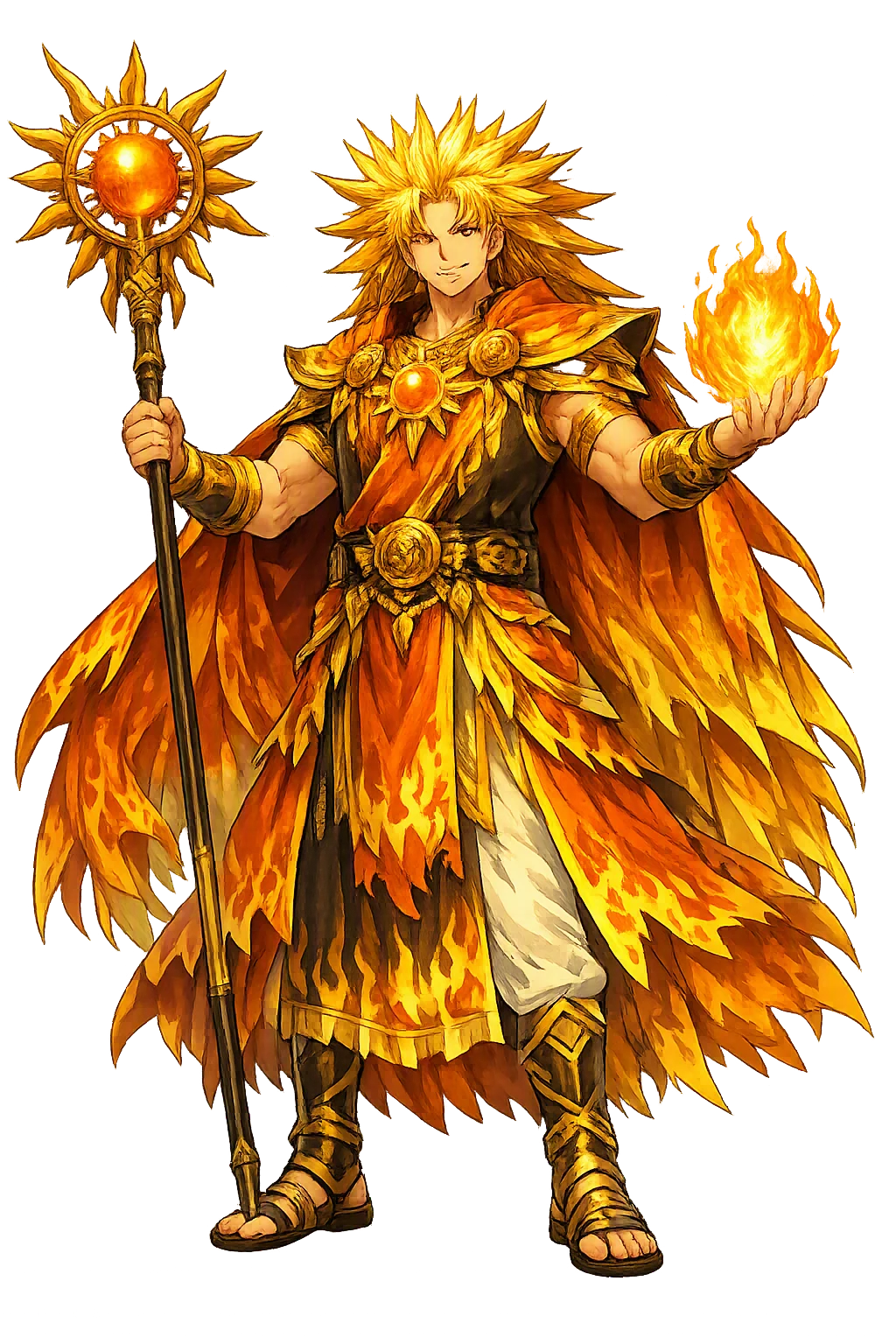
The many faces of Beli
No important name has only one face. Beli appears as a figure of myth, a scholarly reconstruction, a piece of material culture, a memory carried across languages, and — most recently — a Unicode domain. This post looks at each face in turn: the name and its roots, the Celtic transcription original, the reconstructed pronunciation, the mythological record, the symbols and sanctuaries, the cross-cultural afterlife, and the engineering that lets the restored spelling resolve in a browser. Taken together, those faces explain why beli was never going to be enough — and why the restored form is worth a domain of its own.
At a Glance
- Restored name: Beli
- ASCII form: beli
- Meaning: "Bright, shining"
- Domain of influence: Light, Sun
- Pantheon: Celtic
- Classification: Tier 2
Overview
Beli (beli) — Light, Sun · Bright, shining — is Beli mawr, Beli the Great, son of Manogan: the ancestor-king who stands at the head of the Mabinogion's British dynasties. The tale of Lludd and Llefelys opens with him — king of the Island of Britain, father of Lludd, Caswallawn, Nynniaw, and 'a fourth son called Llefelys' — and finishes him in a sentence; the Second Branch then watches his son Caswallawn take the crown from the children of Llŷr under a veil of illusion.
Beyond the tales, Beli's real dominion was genealogical. The Harleian genealogies carry the royal pedigrees of the Welsh kingdoms back to Beli mawr, and the convention held for centuries: descent from Beli the Great was the deepest legitimacy a British dynasty could print. Geoffrey of Monmouth Latinized him as Heli, father of Lud, Cassibelaunus, and Nennius, and through Geoffrey his house entered the bloodstream of European letters.
The name's traditional gloss is 'bright, shining', reached through its long-proposed connection with the continental Celtic god Belenos — Tertullian's god of the Noricans, the Apollo Belis of Aquileia — conventionally derived from the root *bhel-, 'to shine'. The derivation of Belenos itself is debated, and the identification of the Welsh ancestor with the god is a venerable possibility, not a proof; the lexicon records the gloss as the tradition gives it.
PuniCodex restores the name as Beli — identical to the ASCII input, because Middle Welsh writes no diacritic in this name. The mechanical rule therefore places it in Tier 2: nothing distinctive is lost in transit, a statement about orthography and never about the figure. No domain is claimed: the plain-ASCII beli.com is registered to a third party outside the collection and is watched for release.
The Name
The name is attested in Middle Welsh as Beli, characteristically with the epithet — Beli mawr uab Manogan, 'Beli the Great, son of Manogan' — in the Mabinogion and in the genealogical tracts. Geoffrey of Monmouth writes it in Latin as Heli, a form his translators later Englished as both Heli and Beli.
The traditional gloss is 'bright, shining', and it arrives by way of the continental theonym Belenos / Belinus — the god the Latin tradition equated with Apollo — whose name has conventionally been derived from Proto-Indo-European *bhel-, 'to shine'. The link between the Welsh ancestor and the god is one of the oldest proposals in Celtic scholarship and remains unproven; the etymology of Belenos itself is disputed, and rival derivations exist. This edition records the gloss as the tradition hands it down, with the uncertainty attached.
The name should also be distinguished from its homonyms. Geoffrey's Belinus, son of Dunvallo and brother of Brennius, is a different figure who shares nothing with Beli Mawr but the name; and several historical Welsh dynasts bore Beli as a personal name — Beli son of Rhun stands in the Gwynedd pedigree — without being the ancestor-king.
The ASCII form beli loses nothing, because the attested Welsh spelling is already plain Latin letters; the restoration is a matter of canonical reference, not rescued diacritics, and the name is classified Tier 2 by the project's mechanical rule.
The letter-by-letter transformation runs:
- b → B — Same, capitalized
- e → e — Same
- l → l — Same
- i → i — Same
The project holds no domain for this name: beli.com is registered to a third party outside the PuniCodex collection and is watched for release. The temple lives at its canonical lexicon address.
The Original Script
The name is preserved in Middle Welsh in the Latin alphabet as Beli — attested in the White Book of Rhydderch (c. 1350) and the Red Book of Hergest (c. 1382–1410), the two great codices of the Mabinogion, and in the genealogical collections preserved in Harley MS 3859 and its sister manuscripts. Middle Welsh writes the name in plain ASCII letters: there is no diacritic and no distinctive letter for the restoration to recover, which is why the name stands in Tier 2.
The scholarly rendering proceeds step by step:
- Welsh was written in the Latin alphabet from the early medieval period; the spelling Beli requires no diacritic.
- Geoffrey of Monmouth's Latin form Heli reflects the same name carried into the orthographic conventions of twelfth-century Anglo-Latin.
- The proposed connection with Gaulish Belenos is a question of etymology and mythography, not of attestation: no British inscription preserves the name in either form.
- The Unicode restoration Beli is therefore identical to the ASCII form apart from the capital; the temple form is a canonical reference, not a rescued spelling.
One caution attaches to the record: the traditional gloss 'bright, shining' belongs to the Belenos connection and is recorded here as tradition, not as a demonstrated derivation of the Welsh name.
Pronunciation
The pronunciation of the name is /ˈbɛlɪ/ — Modern Welsh standard.
Phoneme by phoneme:
- Be- — Voiced bilabial stop [b], then the open front vowel [ɛ] of English 'bed', stressed
- -li — Clear lateral [l], closing on the short close vowel [ɪ]
For the modern speaker, the closest approximation is: 'BEL-ee' — two syllables, stress on the first, the e open as in 'bed', never the long ay of 'bailey'.
Kindred and historical forms of the name:
- Middle Welsh — Beli mawr uab Manogan, the Mabinogion form
- Latin — Heli, Geoffrey of Monmouth's form
- Proposed cognate — Gaulish Belenos / Latin Belinus, the continental theonym
- Attested form — Beli, identical to the manuscript spelling
Beli is Tier 2 because the restoration preserves nothing ASCII loses: the letters of the manuscript form are the letters of the keyboard. The capital alone marks the temple form.
Mythology
Beli has no adventure of his own: his story is his house. The Mabinogion knows him as the dead king whose sons inherit Britain, France, and the quarrels of the next generation; the pedigrees know him as the root; Geoffrey knows him as the father of the builder of London.
The Four Sons of Beli (Mabinogion, Lludd a Llefelys)
The tale opens with the settlement of the island: Beli the Great, son of Manogan, was king of this island, and he had three sons — Lludd, Caswallawn, Nynniaw — and, as the story tells, a fourth son called Llefelys. When Beli died, the kingdom of the Island of Britain fell to Lludd as the eldest; Lludd ruled prosperously, rebuilt the walls of London, and lived there for most of the year. Llefelys went to France, won the old king's only daughter, and inherited that kingdom in his turn. What follows — the three plagues, the counsel from the middle of the Channel — belongs to the sons; Beli's part is finished in the opening lines, which is precisely his function: the point from which legitimacy flows.
Caswallawn's Veil (Mabinogion, Branwen ferch Llŷr)
While Brân the Blessed marched into Ireland, he left seven regents in Britain, his son Caradog at their head. Caswallawn son of Beli marched against them wearing a veil of illusion, so that no one could see him — only his sword killing. He slew the seven; Caradog died of a broken heart; and Caswallawn son of Beli became king in London. The branch never explains or excuses the usurpation: while the children of Llŷr spent themselves overseas, the children of Beli took the island.
The Root of the Royal Trees (Harleian Genealogies)
The Harleian genealogies — the Welsh royal pedigrees preserved in British Library, Harley MS 3859 (c. 1100) — carry the lines of the British kingdoms back generation by generation until they reach Beli mawr, who stands near the root of the trees. To claim a throne in early Wales was in part to publish a pedigree, and the pedigrees converge on him; the convention held for centuries in the genealogical tracts.
Heli, Father of Lud (Geoffrey of Monmouth)
Geoffrey's Historia Regum Britanniae (c. 1136) carried Beli into Latin as Heli, father of Lud, Cassibelaunus, and Nennius. Lud rebuilt Trinovantum with noble walls and renamed it Kaerlud — whence London, Geoffrey says, and the gate called Ludgate; Cassibelaunus became the enemy of Caesar. Through the Historia, one of the most copied books of the Middle Ages, Beli's house entered European letters.
The Bright One Behind the King (Tertullian; Herodian)
Around the year 200 Tertullian lists the local gods of the provinces and gives the Noricans Belenus; a generation later Herodian tells how, at the siege of Aquileia in 238, the citizens credited their deliverance to Apollo, the god the region worshipped under the name Belis. The altars agree — dedications Belino Augusto sacrum cluster at Aquileia and across the eastern Alpine provinces. Whether the Welsh ancestor descends from this 'bright, shining' god is the standing question of Beli scholarship; no text performs the identification, and the honest verdict is the one the handbooks give: a venerable possibility, unproven.
Symbols & Iconography
Beli's attributes are institutional rather than mythic — the regalia of a founding king rather than the wonders of a tale:
- The Island of Britain — The single realm he held and his sons inherited; kingship imagined whole before it was ever divided
- The family tree — The pedigrees of the Welsh dynasties growing back to one root; ancestry as the ground of legitimacy
- The veil of illusion — Caswallawn's invisible cloak in the Second Branch, the house of Beli taking the crown unseen
- The walled city — London, rebuilt by his son Lludd, the memory of the dynasty fixed in stone and street-names
- The sun's brightness — The traditional gloss of the name, carried from the Belenos inscriptions into the Welsh ancestor
Archaeology & Evidence
Beli is a textual figure: no inscription, image, or votive object from Britain names him, and no cult site is his. His witnesses are codices — the White Book of Rhydderch (Aberystwyth, NLW Peniarth 4–5, c. 1350) and the Red Book of Hergest (Oxford, Jesus College MS 111, c. 1382–1410) for the Mabinogion tales, and British Library Harley MS 3859 (c. 1100) for the genealogies that root the Welsh dynasties in him.
The material evidence belongs to his proposed continental cognate: the dedications Belino Augusto sacrum from Aquileia and the eastern Alps are real stones with a real theonym — the strongest archaeological fact in the whole dossier, and the reason the 'bright, shining' gloss will not go away. But they are comparative evidence only: no altar from the Celtic provinces can be read as addressed to the Welsh ancestor-king himself.
Realm & Domain
Beli is catalogued under the domain 'Light, Sun' — the name's traditional solar reading, inherited from its long-proposed connection with the 'bright, shining' god Belenos. His attested role in the texts is something adjacent: the luminous first term of a dynasty, the light at the root of the tree rather than a god in the sky.
Light
The traditional gloss of the name — 'bright, shining' — reaches Beli through Belenos, the continental god the Latin sources equated with Apollo. Whether the Welsh ancestor descends from the god is unproven, but the gloss is old, and it fits the figure's function: he is the name the whole tradition is lit from.
Sun
No Welsh text gives Beli a solar myth — there is no chariot, no journey, no setting. The solar reading lives entirely in the etymology and in the continental altars. What the Welsh record offers instead is the genealogical counterpart of a sun: the single source from which the royal lines radiate, the Harleian pedigrees climbing back to Beli mawr as to a first light.
The Kingship the Domain Implies
What the texts actually give Beli is the Island of Britain: its crown, its walled city, and the sons who inherit both. If a solar god stands behind him, the Welsh tradition has long since dimmed the god into the ancestor — and the ancestor is the figure the record can defend.
Across Cultures
Beli's whole cross-cultural argument is the Belenos question. The continental god is attested from Aquileia to Noricum, glossed by the ancients as a Celtic Apollo, and derived by tradition from *bhel-, 'to shine'; the Welsh Beli Mawr matches the name nearly perfectly, and from O'Rahilly onward scholars have set the Irish ancestor-figure Bile beside both, proposing a single Celtic 'bright one' dimmed into three literatures as three ancestors. Mac Cana and Koch record the comparison; neither certifies it.
Within the Welsh corpus his closest kin are the other fountainheads of dynasty: Dôn, mother of the Children of Dôn, and the house of Llŷr, whose sons Brân and Manawydan lose the island's crown to Beli's son Caswallawn in the Second Branch. Two distinctions are worth keeping: Geoffrey's Belinus, son of Dunvallo and brother of Brennius, is a different figure who shares nothing with Beli Mawr but the name; and the historical Welsh dynasts called Beli — Beli son of Rhun stands in the Gwynedd pedigree — are bearers of the name, not the ancestor-king.
Cultural Legacy
Beli's afterlife is genealogical before it is literary. The medieval pedigrees made descent from Beli Mawr the deepest claim a British dynasty could print, and the convention outlived the Middle Ages: Tudor and Stuart antiquaries, eager to trace the crown to British and Trojan roots, found Beli waiting at the root of the trees Geoffrey had Latinized. Through Geoffrey's Heli he fathered the legend of London itself — Lud's town, Lud's gate, the name written into the city's streets — and through his son Cassibelaunus he stands two generations above Shakespeare's Cymbeline, whose Britain is still Beli's island.
In modern Wales the name persists quietly: Beli remains a Welsh personal name, and Beli Mawr keeps his place in the national memory as the grandfather of kings. Modern Celtic pagan and Druid practice honors the ancestral Belenus beside him, keeping the old question — king or bright god — alive rather than answered.
The Scholarly Record
The account of Beli given in this edition rests on the witnesses and reference works listed below. The Mabinogion supplies the narrative; the Harleian genealogies the pedigrees; Geoffrey of Monmouth the Latin afterlife; Tertullian and Herodian the continental comparison; the modern handbooks secure the frame and mark the uncertainties.
- Davies, Sioned, trans., The Mabinogion (Oxford: Oxford University Press, 2007), 'Lludd and Llefelys' and 'Branwen daughter of Llŷr'.
- Bartrum, Peter C., ed., Early Welsh Genealogical Tracts (Cardiff: University of Wales Press, 1966).
- Phillimore, Egerton, 'The Annales Cambriae and Old-Welsh Genealogies from Harleian MS. 3859', Y Cymmrodor 9 (1888), 141–183.
- Reeve, Michael D., ed., and Neil Wright, trans., Geoffrey of Monmouth, The History of the Kings of Britain (Woodbridge: Boydell, 2007), III.20.
- Tertullian, Apologeticum 24.
- Herodian, History 8.3.
- Koch, John T., ed., Celtic Culture: A Historical Encyclopedia, 5 vols. (Santa Barbara: ABC-CLIO, 2006), s.v. Beli Mawr, Belenos.
- Mac Cana, Proinsias, Celtic Mythology (London: Hamlyn, 1970).
- MacKillop, James, A Dictionary of Celtic Mythology (Oxford: Oxford University Press, 1998), s.v. Beli.
- O'Rahilly, T. F., Early Irish History and Mythology (Dublin: Dublin Institute for Advanced Studies, 1946).
- Bromwich, Rachel, ed. and trans., Trioedd Ynys Prydein: The Triads of the Island of Britain, 3rd ed. (Cardiff: University of Wales Press, 2006).
- Huws, Daniel, Medieval Welsh Manuscripts (Cardiff: University of Wales Press, 2000).
- Evans, D. Simon, A Grammar of Middle Welsh (Dublin: Dublin Institute for Advanced Studies, 1964).
A Meditation
Beli is the patron of everything that matters most and does least: the dead father, the founding reign, the name at the root of the tree. He fights no monster, wins no bride, casts no spell; the Mabinogion finishes him in a sentence, and then builds a world on him. His sons inherit his island and quarrel over it; his house takes the crown under a veil of illusion; the pedigrees spend a thousand years climbing back to him.
That is how ancestry actually works — the founder is never the hero of the story, only its premise. Beli asks the genealogist's hard question of every institution and every family: not what have you done, but what are you descended from, and does the root still hold. And the name itself holds its own question: whether the bright one, the shining god of the continental altars, lies behind the sober Welsh king. Some roots run deeper than the record can follow. Beli is the place where Britain's goes dark.
The Unicode Restoration
Beli is classified as Tier 2: the restoration needs no distinctive letters or diacritics its ASCII form would lose. The ASCII fallback beli still resolves everywhere, but it is the restored form that carries the name's full information. That is the whole thesis of this temple: the marks are the message.
Why This Restoration Matters
Myth, script, sound, cult, legacy, domain: the faces of Beli add up to a single argument — that a name is a record, and records deserve fidelity. The PuniCodex restoration keeps that record in working order: the temple presents it, the Scholarly Edition footnotes it, the lexicon catalogs it, and the domain makes it addressable. beli will always exist as a fallback. But fallback is not identity. Beli is the name; everything else is a convenience.
Explore Further
This post is one doorway into the temple. The home page carries the full character breakdown and the ambient canvas; the lore page tells the myths in long form; the Scholarly Edition preserves the sources, pronunciation data, and revision history; and the patron wall supports the restoration directly. For the wider map, browse the Lexicon, explore the Pantheon, or return to the PuniCodex blog.
Related Names
Sources
The full scholarly apparatus — every citation, revision, and review — lives in the Scholarly Edition. Key references for this post:
- Davies, Sioned, trans., The Mabinogion (Oxford: Oxford University Press, 2007), 'Lludd and Llefelys' and 'Branwen daughter of Llŷr'.
- Bartrum, Peter C., ed., Early Welsh Genealogical Tracts (Cardiff: University of Wales Press, 1966).
- Reeve, Michael D., ed., and Neil Wright, trans., Geoffrey of Monmouth, The History of the Kings of Britain (Woodbridge: Boydell, 2007), III.20.
- Koch, John T., ed., Celtic Culture: A Historical Encyclopedia, 5 vols. (Santa Barbara: ABC-CLIO, 2006), s.v. Beli Mawr, Belenos.
- Lexicon authorities for this entry: Mabinogion, MacKillop.