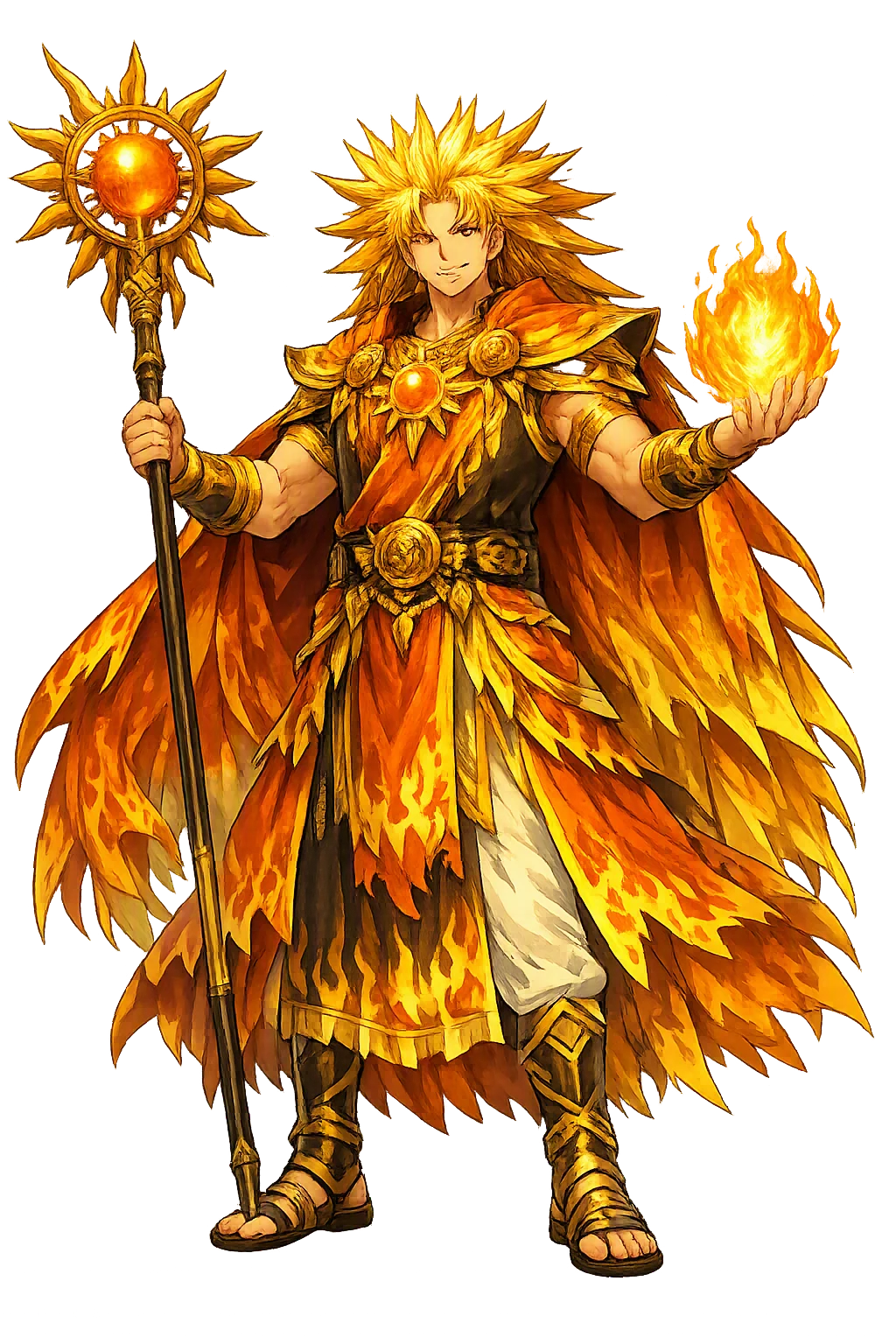
Stories of Beli
Beli has no adventure of his own: his story is his house. The Mabinogion knows him as the dead king whose four sons inherit Britain, France, and the quarrels of the next generation; the pedigrees know him as the root; and Geoffrey of Monmouth knows him as Heli, father of the builder of London.
The tale of Lludd and Llefelys opens with the settlement of the island: Beli the Great, son of Manogan, was king of this island, and he had three sons — Lludd, Caswallawn, and Nynniaw — and, as the story tells, a fourth son called Llefelys. When Beli died, the kingdom of the Island of Britain fell to Lludd as the eldest, and Lludd ruled it prosperously, rebuilding the walls of London and living there for most of the year. Llefelys, the youngest, went to France, won the love of the old king's only daughter, and inherited that kingdom in his turn.
What follows — the three plagues that fall on Britain, and Llefelys's counsel from the middle of the Channel — belongs to the sons' temples. Beli's part is finished in the opening lines, and that is precisely his function: he is the point from which legitimacy flows, the dead father whose reign makes his sons' divided world one family.
The Second Branch remembers Beli's house at the moment it takes the crown. While Brân the Blessed marched into Ireland to avenge Branwen, he left seven men as regents in Britain, his son Caradog at their head. Caswallawn son of Beli marched against them wearing a veil of illusion, so that no one could see him — only his sword killing. He slew the seven, and Caradog died of a broken heart at the sight of the slaughter and the knowledge of who held the island now.
Caswallawn son of Beli became king in London. The branch never explains or excuses the usurpation; it simply registers that while the children of Llŷr spent themselves overseas, the children of Beli took the island — the two great houses of Welsh tradition passing the crown between them without a battle anyone could see.
Outside the tales, the record that made Beli matter was parchment of a drier kind. The Harleian genealogies — the collection of Welsh royal pedigrees preserved in British Library, Harley MS 3859 (c. 1100) — carry the lines of the British kingdoms back generation by generation until they reach Beli mawr, who stands near the root of the trees. To claim a throne in early Wales was, in part, to publish a pedigree, and the pedigrees converge on him.
The convention was old and remarkably tenacious: centuries later, the genealogical tracts still counted descent from Beli the Great as the deepest legitimacy a Welsh royal house could print. He is the standing proof that in the British tradition, ancestry is not mere decoration on kingship — it is the thing itself.
Geoffrey of Monmouth's Historia Regum Britanniae (c. 1136) took the Welsh Beli into Latin and made him a chapter of world history. As Heli he reigns after King Cligueillus, a man of forty years' rule, and fathers three sons: Lud, Cassibelaunus, and Nennius. Lud succeeds him and rebuilds the city of Trinovantum with noble walls, surrounding it with countless towers and renaming it Kaerlud, Lud's City — whence, Geoffrey says, its later name London, and the memory of the king in the gate called Ludgate.
Through Geoffrey, Beli's house entered the bloodstream of European letters: the Historia was one of the most copied books of the Middle Ages, and the sons of Heli — Lud the city-builder, Cassibelaunus the enemy of Caesar — carried their father's ancestry wherever Latin was read.
Older than any Welsh manuscript is a continental witness the scholars keep setting beside Beli's name. Around the year 200, Tertullian lists the local gods of the provinces and gives the Noricans Belenus (Apologeticum 24); a generation later, Herodian tells how, at the siege of Aquileia in 238, the citizens credited their deliverance to Apollo, the god the people of that region worshipped under the name Belis. The altars agree: dedications Belino Augusto sacrum cluster at Aquileia and across the eastern Alpine provinces.
Whether the Welsh ancestor-king descends from this 'bright, shining' god is the standing question of Beli scholarship. The names are close, the traditional gloss fits, and a euhemerized god makes a plausible root for a genealogy — but no text performs the identification, and the honest verdict is the one the handbooks give: a venerable possibility, unproven. This temple holds the question open.
The Island of Britain, the Four Sons, and the Question of the Bright One
Beli mawr — Beli the Great, son of Manogan — is the deep ancestor of British kingship: the king of the Island of Britain whom the Mabinogion sets at the head of its dynasties, father of Lludd, Caswallawn, Nynniaw, and Llefelys, and the name to which the medieval Welsh royal pedigrees climb. Behind the king, scholarship has long glimpsed a god — the continental Belenos, the 'bright, shining' one — but the texts give us the ancestor, and the ancestor is what the record can defend.
Beli's realm in Lludd a Llefelys: the whole island, 'the crown of London' its seat — the deep past of a single British kingship.
Lludd, Caswallawn, Nynniaw — and, 'as the story tells', a fourth, Llefelys: the branches of the house the whole tradition descends from.
The Harleian genealogies carry the royal houses of Wales back to Beli Mawr — the name at the root of the British family trees.
The proposed god behind the king: Belenos, 'bright, shining' — the continental name Tertullian and the Aquileia altars attest, linked to Beli by a long scholarly tradition.
From the original script to the living URL
Beli
The name survives in scholarly transliteration. Beli is the standard Celtic romanisation, documented in academic sources — “Bright, shining”. Because the spelling uses only Latin letters, the form is the same in both ASCII and Unicode.
No indigenous writing system is securely attested for individual celtic names. The form shown is a modern scholarly transliteration.
beli
The plain beli form is identical to the Unicode restoration. Because this name is already written in Latin letters, no diacritics, stress, or script information were lost — only capitalization differs.
Beli
The Unicode restoration does not need to recover lost marks for Beli. Its value is canonical spelling and consistent cataloguing, not the reconstruction of erased orthography. The domain is readable as-is to both DNS and humanity.
Beli.com
This restoration is written entirely in ASCII letters — no Punycode encoding stands between Beli and the DNS. The domain reads identically to machines and to human eyes.
Owned, ideal, and ASCII forms of Beli
Beli
The full Unicode restoration. beli.com is not in the PuniCodex collection — it is watched for release; if it drops, this temple upgrades to an owned flagship.
How Beli was spoken
How Beli is preserved in writing
No indigenous writing system is securely attested for individual celtic names. The form shown is a modern scholarly transliteration.
Contribute scholarly provenance →The lore you have read is the living myth. Extended Lore opens the scholarly vault beneath it: the cult and its material remains, a history of the image, the name after antiquity, a meditation on what the name still means, and the full scholarly apparatus — etymology, orthography, sources.
Enter Extended Lore