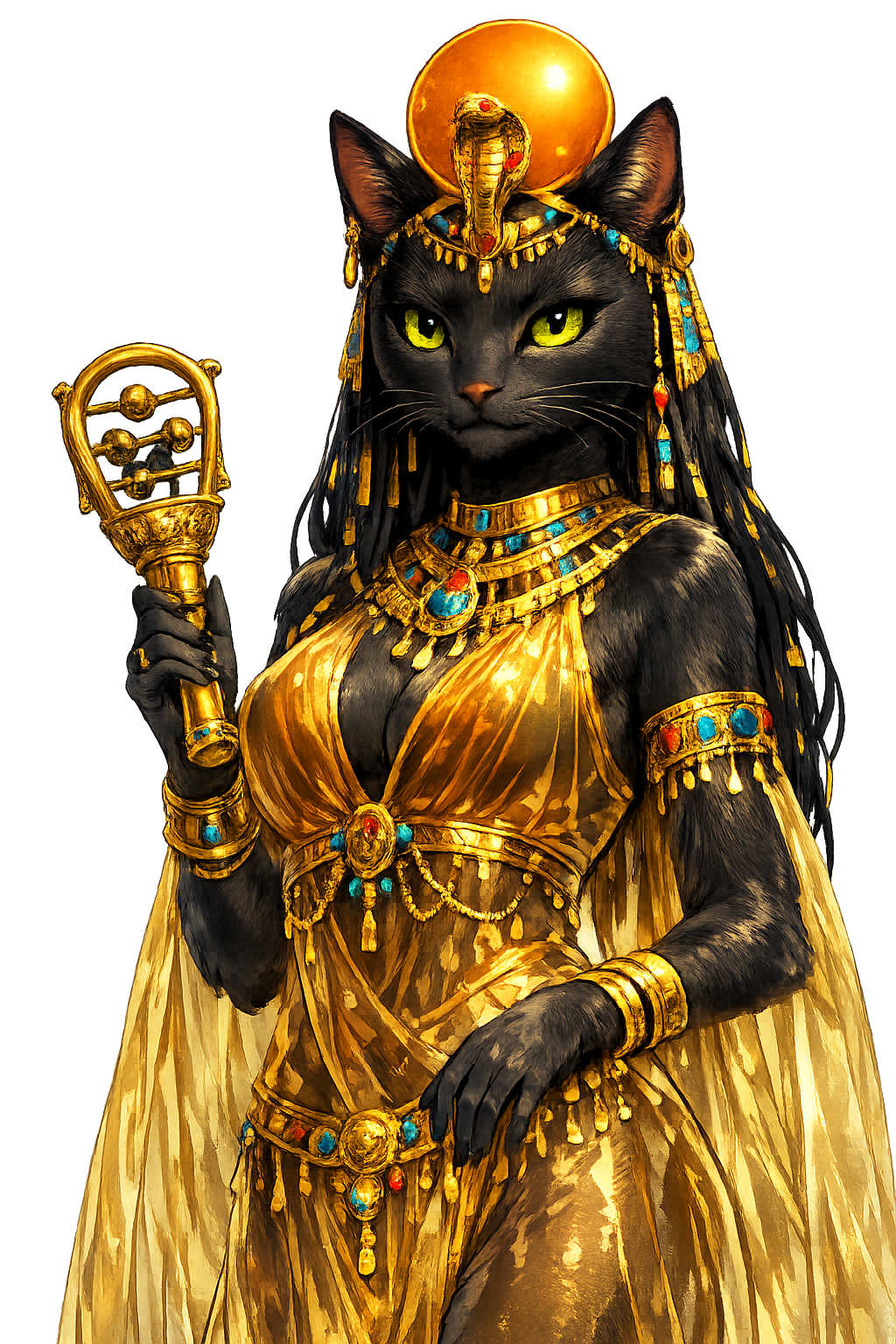
Stories of Bꜣstt
Bastet's myths are fewer and more fragmented than those of Isis or Horus — Egypt never wrote her a great cycle — but what survives is vivid: the wandering solar eye that must be talked home, the red beer that ends a massacre, and the festival that Herodotus judged the merriest in Egypt.
In the theology of the solar eye, the goddess who is Re's own eye grows angry and abandons Egypt for the Nubian desert, taking leonine form; the sun dims and the land withers behind her. The gods send the eloquent Thoth — disguised, in the Late Ptolemaic Papyrus Jumilhac, as a baboon — to coax her back with a flood of words and stories. When the eye returns she comes home in gentler form: the cat, Bastet, the pacified one, and the homecoming itself becomes festival. The same pattern, without her name, underlies the Book of the Heavenly Cow, where the eye must be retrieved before creation itself can be repaired. The Jumilhac account is late — a mythological manual of the Ptolemaic age — but the grammar it preserves is old: wrath departs south, eloquence retrieves it, and the returning goddess is gentler than the one who left. The myth reads Bastet's two bodies, lioness and cat, as a single biography — ferocity that has been talked home, and asked to stay.
When humanity plots against the aging Re, the sun-god sends his eye against them, and the eye — a lioness whom later tradition variously names Sekhmet or Bastet — falls upon mankind in a slaughter so complete that even the gods grow afraid the earth will be emptied. In the version painted on the royal tomb walls of the Book of the Heavenly Cow — Seti I (KV17), Ramesses VI (KV9), and the gilded shrines of Tutankhamun (KV62) — Re halts the carnage with a stratagem: the gods brew seven thousand jars of beer, dye them red with ochre, and flood the fields until the land lies red as blood. The eye, sworn to drink only blood, drinks, wakes drunk, wakes changed — and the text itself renames her Hathor, the rejoicing one, while her wrath keeps the name Sekhmet. The festival of drunkenness at Thebes kept this transformation liturgically alive. The myth's theology is precise and unnerving: divine violence is never defeated, only inebriated into harmlessness — and then commemorated, every year, with a hangover.
The fullest account of Bastet's worship was written by a Greek tourist. Herodotus (Histories 2.59–60) describes her annual festival at Boubastis as the most joyous in Egypt: some seven hundred thousand pilgrims — he says this without counting children — sailed the canals in crowded boats, men and women together, clapping castanets, shaking rattles, and playing flutes, while on the banks the townsfolk jeered at them with obscene gestures that the boaters cheerfully answered in kind. At the city they made great sacrifices — Herodotus remarks that more wine was drunk at this festival than in all the rest of Egypt's year — and the household cats of the honoured dead were mummified and carried to sacred ground at Bubastis (2.66–67). He also judged the temple of Bastet the loveliest in Egypt, with its grove of trees, its spring, and its lake (2.137–138). The historian's disapproval of animal veneration never quite hides his astonishment. What his account preserves is a goddess whose cult was defined by collective, licensed joy — religion as festival rather than fear — and an Egypt that laughed all the way upriver to her door.
Book of the Dead spell 17 preserves one of Egypt's strangest divine self-declarations: 'I am the cat beside whom the ished-tree was split, on the night when the enemies of the lord of all were destroyed.' The cat is the sun-god's own fighting form — the Great Cat, the text's glosses explain, a form of Re — who guards the solar barque through the underworld hours and beheads the chaos serpent at Heliopolis. Later tradition read Bastet herself into the passage, and the identification gave the house-cat a cosmic job description: the same animal that keeps granaries free of vermin keeps the universe free of Apep. Spell 17 is deliberately cryptic — a commentary text whose glosses multiply identities — and the cat passage sits among identifications of the deceased with Re, Atum, and Osiris, so the claim belongs to the whole company of the justified. But its instinct is Bastet's own: the watchful eye that never sleeps, small enough for a windowsill, large enough for the sky. The domestic and the cosmic are, for this goddess, the same work at different scales.
When Herodotus came to Bubastis in the fifth century BCE he needed a Greek face for the lioness-cat of Egypt, and he chose Artemis: he calls her temple 'the temple of Artemis' in Greek translation, and later Greek writers repeat the equation as if it were obvious. The resemblance is thin — Artemis the virgin huntress shares little theology with Bastet — but the comparison fixes something real: both goddesses hold the wild at the boundary of the city, tamed enough to protect, fierce enough to terrify. In Roman times the equation softened further; her name survived less in cult than in the calendar, in the Coptic month that kept her sound. What the Greek translation cannot carry is the domestic heart of Bastet: a goddess whose temple was praised as the most beautiful in Egypt, whose pilgrims drank the year's largest ration of wine, and whose cat guarded not the hunt but the house. The equation says more about Greek habits of translation than about the goddess herself — and what it mistranslated was her tenderness.
Cats, Childbirth, and Domestic Sanctity
Bꜣstt begins as a lioness and ends as a cat. In the Old Kingdom she is a fierce daughter of Re, one of the raging eyes of the sun; by the Late Period she has become the benevolent lady of the home, her round face and upright ears copied by millions of household cats. The transformation is not a decline but an expansion: she learns to keep watch at the cradle as well as at the battlefield — and to receive her pilgrims with music and wine.
Bastet's later animal form; the cat protects the home from vermin and evil, and embodies solar warmth.
Her older, fiercer aspect as a daughter of Re who fights the chaos serpent Apep.
Her festivals featured sistrums, drums, and dancing; she is a goddess of controlled revelry.
Amulets of Bastet protected women in childbirth and children against malign forces.
From the original script to the living URL
𓎯𓏏𓏏𓁐
The name in its original Egyptian form. Bꜣstt (𓎯𓏏𓏏𓁐) is attested in the source tradition — “She of the ointment jar (Egyptian bꜣstt)”. Its Egyptological ain and alef letters carry the full phonetic and orthographic weight of the source tradition.
bastet
Reduced to plain bastet, the name loses everything that made it specific: Egyptological ain and alef letters. What remains is an ASCII string that machines can parse but that no longer speaks with its original voice.
Bꜣstt
The Unicode restoration recovers what ASCII flattened. Bꜣstt restores Egyptological ain and alef letters, returning the name to its original written dignity. The domain encodes to Punycode, but the browser displays the truth.
Bꜣstt.com → xn--bstt-ge8o.com
The non-ASCII characters in Bꜣstt are encoded while the ASCII remains visible. To the DNS, it is Punycode. To humanity, it is Bꜣstt.
Owned, ideal, and ASCII forms of Bꜣstt
Bꜣstt
Restores 𓎯𓏏𓏏𓁐. The live temple domain — bꜣstt.com.
bastet
Flattens 𓎯𓏏𓏏𓁐. The plain ASCII fallback — what DNS and legacy systems see.
How Bꜣstt was spoken
How Bꜣstt travels from ancient script to the modern URL
Egyptian bꜣstt; the original vocalisation is unknown. The name is connected with the ointment jar (bꜣs) and the cat-goddess of Bubastis.
Home, Fertility, Cats
The Unicode restoration Bꜣstt uses Egyptological characters registrable in .com; hieroglyphs are outside the .com IDN table.
The lore you have read is the living myth. Extended Lore opens the scholarly vault beneath it: the cult and its material remains, a history of the image, the name after antiquity, a meditation on what the name still means, and the full scholarly apparatus — etymology, orthography, sources.
Enter Extended Lore