PuniCodex

Extended Lore

𓎯𓏏𓏏𓁐 Bꜣstt

Etymology · Orthography · Cultural Legacy · Reception · Primary Sources

Tier 1 Bꜣstt.com
Bꜣstt — Home, Fertility, Cats
01

Quick Facts

Essential information about Bꜣstt, Home, Fertility, Cats

Original Script𓎯𓏏𓏏𓁐
Unicode RestorationBꜣstt
Reconstructed Pronunciation/buˈʔistit/
PantheonEgyptian
DomainHome, Fertility, Cats
MeaningShe of the ointment jar (Egyptian bꜣstt)
ClassificationTier 1
Primary DomainBꜣstt.com
Sacred SymbolsCat, Lioness, Sistrum, Ointment jar, Ankh
02

Etymology & Word Family

From original script to Unicode restoration

Original Script 𓎯𓏏𓏏𓁐 Bꜣstt — "She of the ointment jar (Egyptian bꜣstt)"
Unicode Restoration Bꜣstt Restored stress, length, and script
Modern ASCII bastet Plain-ASCII fallback

The name Bꜣstt carries the orthographic signature of the egyptian tradition: 𓎯𓏏𓏏𓁐. Unicode restoration recovers what ASCII flattens.

03

Unicode Character Breakdown

Character-by-character philological analysis

CharacterUnicodeNameBlockPhonetic Role
BU+0042Latin Capital Letter BBasic LatinSame
U+A723Latin Small Letter Egyptological AlefLatin Extended-DAlef: glottal stop
sU+0073Latin Small Letter SBasic LatinSame
tU+0074Latin Small Letter TBasic LatinSame
N/ADropped characterEgyptian orthographyDropped: vowel not written
tU+0074Latin Small Letter TBasic LatinSame

The Tier 1 classification reflects how much of the original phonology this restoration preserves — stress and vowel length for Greek names, distinctive letters and diacritics for every other tradition.

04

Cultural Significance

From ancient cult to modern memory

Bꜣstt in Later Traditions

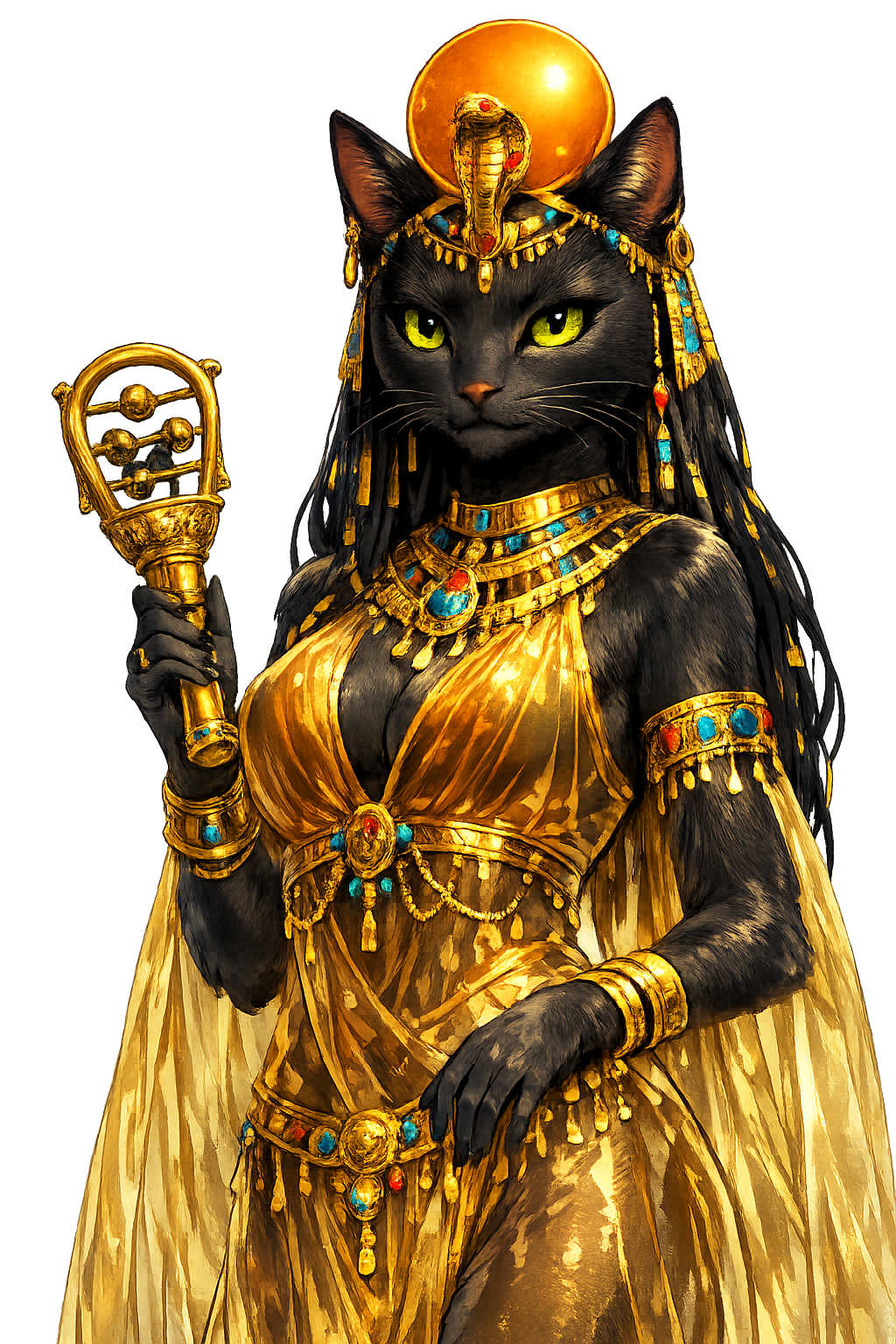
Bastet overlaps with Sekhmet as the pacified form of the solar eye; one text's destroyer is another's house-cat. She was also identified with Hathor in her musical and erotic aspects, and with Isis as protector of the child Horus. Greeks equated her with Artemis, another virgin huntress with a fierce streak, and sometimes with Aphrodite because of her festivals' sexual license. In Roman Egypt her cult spread alongside that of Isis, and her cat iconography influenced medieval European images of the cat as both demonic and protective. The Coptic name Oubaste preserves her sound long after her temples closed.

Modern Legacy

Bastet is the ancestor of every famous cat. Her image underlies the seated feline statuette, the 'cat lady' archetype, and the double reputation of cats as guardians and familiars; medieval Europe, forgetting her temples, made the cat ambiguous — demonic in one legend, protective in the next — precisely the double nature Bastet had refined two thousand years earlier. Modern Kemetic and Neopagan practice invokes her for home protection, fertility, and pleasure; her name brands cat sanctuaries, museum exhibitions, and a small industry of bronze reproductions. The excavations at Tell Basta continue to yield her votive cats and jewelry, studied as evidence of the ancient animal-cult economy and of some of history's earliest pet-keeping. Bastet endures because her theology never needed rescuing from metaphor: the divine can sit on a windowsill, purring, and still be a daughter of the sun.

In the Earth

The temple of Bastet at Tell Basta (Per-Bastet/Boubastis) has yielded statues, jewelry, and one of the largest animal cemeteries in Egypt: hundreds of thousands of mummified cats deposited as votives from the Late Period into Roman times. Bronze cat statuettes, often inlaid with gold earrings, are common in museum collections; examples come from Saqqara, Thebes, and Tanis. Reliefs in the Valley of the Kings show Bastet as a daughter of Re in the solar barque, and the temple foundations Herodotus praised (Histories 2.137–138) have been partially excavated at the modern tell.

05

The Meditation

What Bꜣstt means — beyond the dictionary

Bastet is the goddess of thresholds. She lives where the wild presses against the wall of the house: the cat who sleeps on the bed but still dreams of the hunt. Her mythology is the domestication of solar power — not its weakening, but its decision to protect something small.

There is a wisdom in her later form that the earlier lioness could not teach. To guard a child, to keep watch through the night, to turn a corner of the home into a sanctuary — these are not lesser magics than tearing apart chaos. They are the magics that make chaos worth defeating. Bastet asks us to honor the fierce thing that has chosen to be gentle, and to remember that the claw and the purr belong to the same creature.

06

Frequently Asked Questions

Common questions about Bꜣstt, Home, Fertility, Cats, and Unicode restoration

01How do you pronounce Bꜣstt?

In reconstructed pronunciation, Bꜣstt is /buˈʔistit/ — approximately 'boo-ISS-tee' — say 'boo', then a tiny catch before 'iss', ending with 'tee' (the final t is often silent).

02What does Bꜣstt mean?

Bꜣstt means She of the ointment jar (Egyptian bꜣstt) in the egyptian tradition.

03What are the symbols of Bꜣstt?

Bꜣstt is associated with Cat (Her later, domestic form; guardian of the home and hearth), Lioness (Her older solar-warrior aspect as an eye of Re), Sistrum (Music, trance, and the rattling sound that drives away evil), Ointment jar (Perfume, cosmetics, and the guarded substances of feminine space), Ankh (The life and fertility she grants to households).

04Why restore Bꜣstt in Unicode?

Plain ASCII bastet strips the stress, length, and script that make the name specific. Unicode restoration returns the name to its original written dignity.

05What is the most important myth about Bꜣstt?

“The Lioness Talked Home” — Bastet's myths are fewer and more fragmented than those of Isis or Horus — Egypt never wrote her a great cycle — but what survives is vivid: the wandering solar eye that must be talked home, the red beer that ends a massacre, and the festival that Herodotus judged the merriest in Egypt. The full telling lives on the lore page.

07

Scholarly Sources

The philological foundations of this restoration

Every claim on this page is grounded in established scholarship. The orthographic restorations follow disciplinary convention. The etymological chain follows the best available reference works. This is not invention — it is resurrection through scholarship.

Lexicography & Philology

  • Faulkner, R. O. A Concise Dictionary of Middle Egyptian. Oxford: Griffith Institute, 1962.
  • Wb

Primary Texts

  • Papyrus Jumilhac

Archaeology & Art History

  • Material evidence — iconography, inscriptions, and temple archaeology — for Bꜣstt and related cults.

Religious Studies

  • Allen, The Ancient Egyptian Language: A Historical Study (2013), p. 74
  • Faulkner, A Concise Dictionary of Middle Egyptian, s.v. bꜣstt
  • Herodotus, Histories 2.59–60, 66–67, 137–138
  • Book of the Heavenly Cow
  • Malek, The Cat in Ancient Egypt
Return

The Surface Awaits

You have traced the name from its earliest attestation to its Unicode restoration. Now return to the myth. The story is where the name lives.

Back to Lore
Bꜣstt mascot