The Living Myth
Sky Father, Creator · The eaglehawk father of southeast Australia
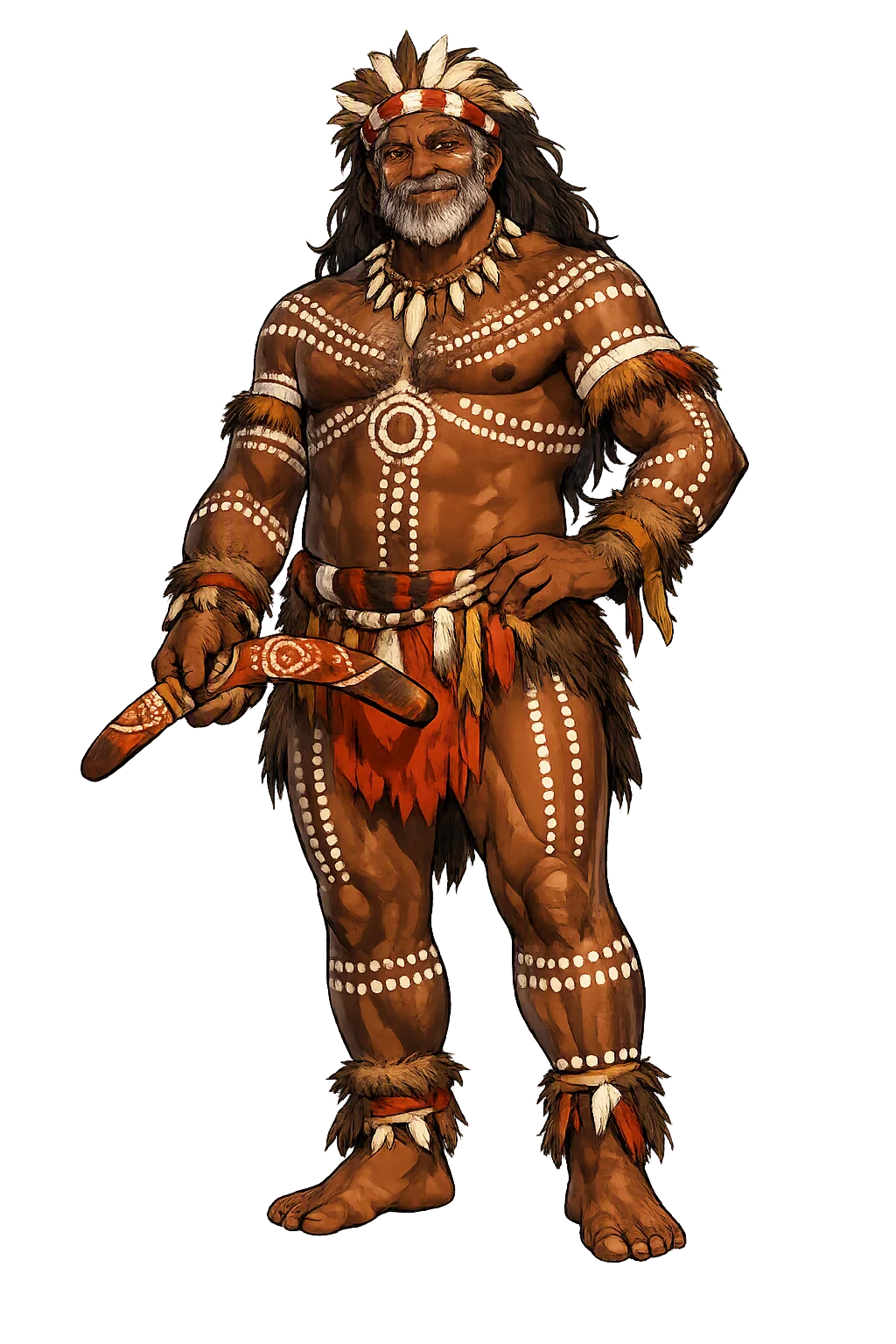
Stories of Baiame
Baiame's mythology is preserved in the oral traditions of the Wiradjuri, Gamilaraay, and neighbouring nations. The stories are not free-floating entertainment: they are title deeds to country, instruction manuals for law, and maps of the sky. What follows are widely reported themes; local elders hold the authoritative versions of each nation's stories.
In the beginning Baiame shaped the land. He formed the hills and rivers, planted the trees, and made the animals. Then he made the first people and gave them their languages, their countries, and the laws by which they should live — the earliest ethnographers of the Euahlayi, above all K. Langloh Parker in The Euahlayi Tribe (1905), record the Baayami of creation as the maker whose work is the country itself. Every mountain, waterhole, and plain became a reminder of his creative act, and every clan received the responsibility to care for the part of country made for it (Parker 1905; Berndt and Berndt 1964).
Creation here is not a finished product handed over but a continuing arrangement: the world is a country made by an ancestor and entrusted to his descendants, and the deed of trust is the story itself.
When the work of creation was finished, Baiame rose into the sky and made his camp there. From that distant place he watches over the world he made — remote, but not absent, his presence announced by the dark lanes of the Milky Way, which are said to be his camp or the tracks of the emu he placed there, and by the stars themselves, the campfires of the ancestors who went before. The early recorders of the southeast (Parker; Elkin 1938) heard the same withdrawal in many nations: the Sky Father who made the world does not govern it day by day, because the law he gave does that work for him.
The withdrawal is the gift: a maker who stayed would be a ruler, but a maker who leaves behind law becomes an ancestor. Distance is how the Sky Father turns creation into inheritance.
Baiame's son Daramulum moves between earth and sky as a messenger and teacher. Often associated with the rainbow and with thunder, Daramulum taught the people the secrets of initiation and the songs that must be sung at each stage of life; it is his voice that the bullroarer carries at the bora ground, and his figure that the initiated recognize in the images kept from the uninitiated. Through him, Baiame's law is passed on without the Sky Father needing to descend himself (Parker 1905; Elkin 1938).
The arrangement is precise: the father's law, the son's voice. A law that can only be delivered by the lawgiver in person would die with him; a law carried by a messenger becomes a tradition.
The dark shape of the emu stretches across the Milky Way — the great bird read not from stars but from the dust lanes between them, its head in the Coalsack, its body along the galactic plane. It is both a constellation and a story: the emu in the sky tells the people when to collect emu eggs, when to hold ceremonies, and how to read the seasons, and Aboriginal astronomers and their collaborators have shown the reading is practical — the constellation's turning marks the breeding season of the emu on the ground. Baiame placed it there as a calendar and a memory, so that the connection between sky and country would never be lost (cf. Fuller, Harney and Norris on Aboriginal astronomy).
The bird above and the bird below are one fact in two places: the sky is not a separate world but the same country seen at night, and the calendar is written in darkness rather than light.
Creator, Law-Giver, and Ancestor
Baiame is the great creator and Sky Father of several Aboriginal nations of south-eastern Australia, above all the Wiradjuri and the Gamilaraay/Euahlayi. He made the land, the animals, and the people, and then gave them the laws, kinship systems, and initiation ceremonies by which they still live. After the work of creation he withdrew to the sky, where he remains as a remote but watchful ancestor, his presence felt in the Milky Way, in the flight of the emu, and in the sound of the bullroarer at initiation.
Baiame shaped the mountains, rivers, and plains, and made the first people and animals. Creation is not a single event but an ongoing relationship with country.
After creation Baiame returned to the sky. His camp is sometimes identified with the dark patches and stars of the Milky Way, especially the Emu in the Sky.
He gave the first laws, the kinship rules, and the initiation ceremonies that turn boys into men. The bullroarer is sounded in his name.
Baiame is not worshipped in the everyday sense; he is remembered as the founding ancestor whose actions set the moral and social order of the world.
From the original script to the living URL
Baiame
The name survives in scholarly transliteration. Baiame is the standard Aboriginal romanisation, documented in academic sources — “The maker”. Because the spelling uses only Latin letters, the form is the same in both ASCII and Unicode.
No indigenous writing system is securely attested for individual aboriginal names. The form shown is a modern scholarly transliteration.
baiame
The plain baiame form is identical to the Unicode restoration. Because this name is already written in Latin letters, no diacritics, stress, or script information were lost — only capitalization differs.
Baiame
The Unicode restoration does not need to recover lost marks for Baiame. Its value is canonical spelling and consistent cataloguing, not the reconstruction of erased orthography. The domain is readable as-is to both DNS and humanity.
Baiame.com
This restoration is written entirely in ASCII letters — no Punycode encoding stands between Baiame and the DNS. The domain reads identically to machines and to human eyes.
Owned, ideal, and ASCII forms of Baiame
Baiame
The full Unicode restoration. baiame.com is not in the PuniCodex collection — it is watched for release; if it drops, this temple upgrades to an owned flagship.
How Baiame was spoken
How Baiame is preserved in writing
No indigenous writing system is securely attested for individual aboriginal names. The form shown is a modern scholarly transliteration.
Contribute scholarly provenance →The lore you have read is the living myth. Extended Lore opens the scholarly vault beneath it: the cult and its material remains, a history of the image, the name after antiquity, a meditation on what the name still means, and the full scholarly apparatus — etymology, orthography, sources.
Enter Extended Lore