PuniCodex

Extended Lore

Baiame

Etymology · Phonology · Orthography · Cultural Legacy · Primary Sources

Tier 2 Baiame
Baiame — Sky Father, Creator
01

Quick Facts

Essential information about Baiame, Sky Father, Creator

Scholarly TransliterationBaiame
Unicode RestorationBaiame
Reconstructed Pronunciation/ˈbajaˌmi/
PantheonAboriginal
DomainSky Father, Creator
MeaningThe maker
ClassificationTier 2
Primary DomainBaiame
Sacred SymbolsThe Emu in the Sky, Bullroarer, Stone arrangements and bora rings, Stone axes
02

Etymology & Word Family

From original script to Unicode restoration

Scholarly Transliteration Baiame Baiame — "The maker"
Unicode Restoration Baiame Restored stress, length, and script
Modern ASCII baiame Plain-ASCII fallback

The name Baiame is a romanization of an oral tradition; no single original script exists. PuniCodex renders it as Baiame, capitalizing the conventional scholarly citation form. Because the restoration does not add a diacritic or distinctive letter absent from the ASCII form, the name is Tier 2. The spoken name and the mythic role remain intact; the ASCII string is a DNS convenience, not an ancient spelling.

03

Unicode Character Breakdown

Character-by-character philological analysis

CharacterUnicodeNameBlockPhonetic Role
BU+0042Latin Capital Letter BBasic LatinSame, capitalized
aU+0061Latin Small Letter ABasic LatinSame
iU+0069Latin Small Letter IBasic LatinSame
aU+0061Latin Small Letter ABasic LatinSame
mU+006DLatin Small Letter MBasic LatinSame
eU+0065Latin Small Letter EBasic LatinSame

The Tier 2 classification reflects how much of the original phonology this restoration preserves — stress and vowel length for Greek names, distinctive letters and diacritics for every other tradition.

04

Cultural Significance

From ancient cult to modern Unicode

Ancient Domain

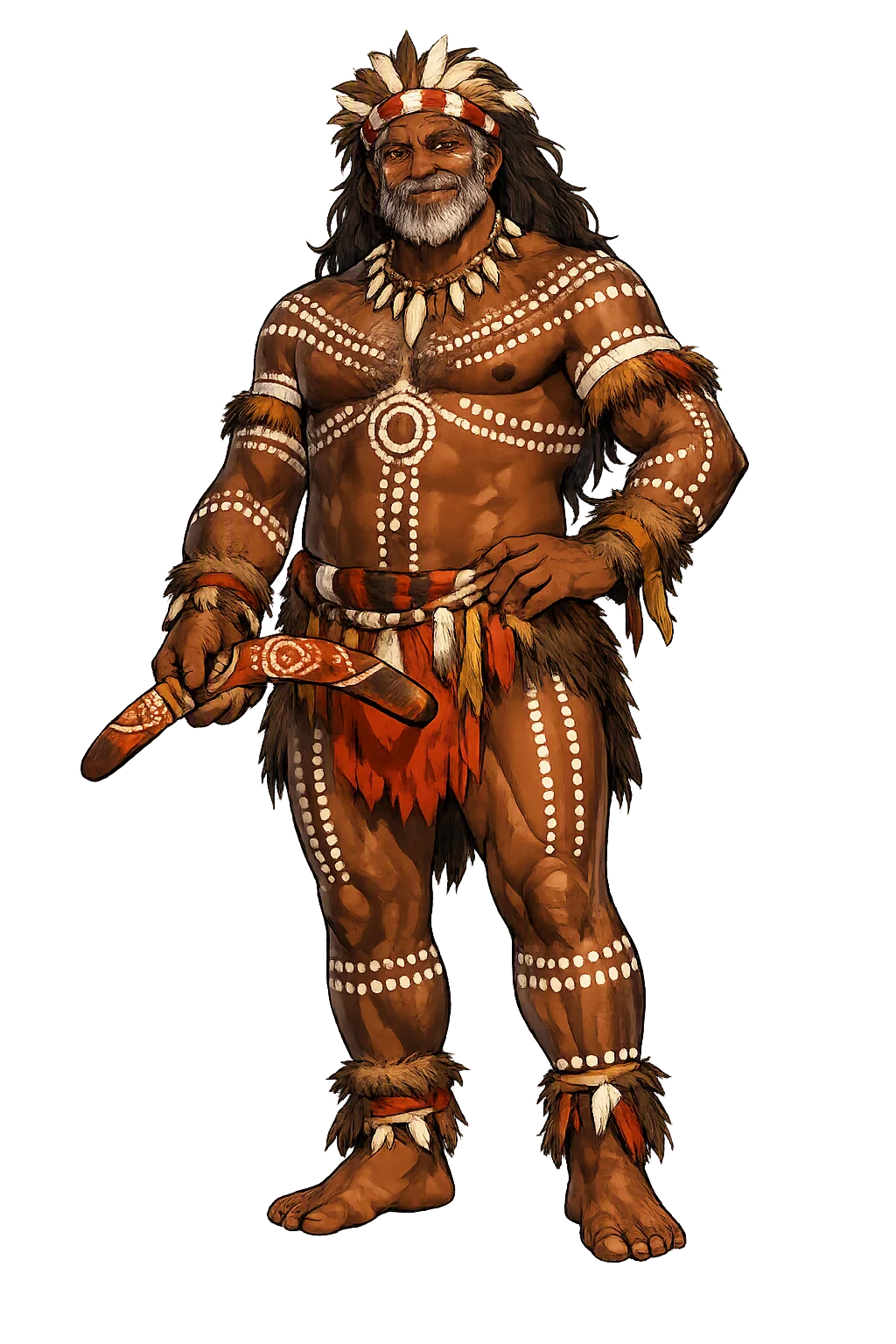
Baiame is the great creator and Sky Father of several Aboriginal nations of south-eastern Australia, above all the Wiradjuri and the Gamilaraay/Euahlayi. He made the land, the animals, and the people, and then gave them the laws, kinship systems, and initiation ceremonies by which they still live. After the work of creation he withdrew to the sky, where he remains as a remote but watchful ancestor, his presence felt in the Milky Way, in the flight of the emu, and in the sound of the bullroarer at initiation.

Baiame in Later Traditions

Early colonial observers sometimes compared Baiame to the Christian God, and some recorded traditions show signs of post-contact reinterpretation. Modern scholarship, led by Berndt and Berndt and by AIATSIS, treats Baiame as a specifically Aboriginal Sky Father whose identity is tied to country, kinship, and initiation rather than to any universal deity. He is not interchangeable with the biblical creator, and each nation retains its own protocols for how his name and stories may be used.

Modern Legacy

Baiame remains a powerful symbol of Aboriginal sovereignty over country and culture. His name appears in place names, in rock art and stencil sites, and in contemporary Aboriginal art and literature. The Emu in the Sky is now widely recognised as one of the best-known Aboriginal astronomical traditions. At the same time, Aboriginal custodians have rightly insisted that Baiame's sacred aspects — especially those connected with men's law and initiation — are not open-source material for casual adaptation. PuniCodex presents only the publicly documented, scholarly record and directs readers to AIATSIS and to the relevant Aboriginal communities for authoritative teachings.

Unicode Restoration as Cultural Act

Restoring Baiame in a domain name is more than orthographic accuracy. It is a statement that the internet should recognize the full range of human writing — not only the ASCII keyboard.

05

Frequently Asked Questions

Common questions about Baiame, Sky Father, Creator, and Unicode restoration

01How do you pronounce Baiame?

In reconstructed pronunciation, Baiame is /ˈbajaˌmi/ — approximately 'BYE-ah-meh' — stress the first syllable, keep the vowels open, and avoid turning the final vowel into a long English 'ee'..

02What does Baiame mean?

Baiame means The maker in the aboriginal tradition.

03What are the symbols of Baiame?

Baiame is associated with The Emu in the Sky (The dark constellation of the Milky Way, a celestial marker of Baiame's camp and of the emu he created), Bullroarer (A sacred sound-maker used in men's initiation; its voice is associated with Baiame and his son Daramulum), Stone arrangements and bora rings (Earth-and-stone ceremonial sites where initiation and law are enacted under Baiame's authority), Stone axes (Often linked to Baiame as tools of creation and as sacred objects exchanged across southeast Australia).

04Why restore Baiame in Unicode?

Plain ASCII baiame strips the stress, length, and script that make the name specific. Unicode restoration returns the name to its original written dignity.

05What is the most important myth about Baiame?

In the beginning Baiame shaped the land. He formed the hills and rivers, planted the trees, and made the animals. Then he made the first people and gave them their languages, their countries, and the laws by which they should live. Every mountain, waterhole, and plain became a reminder of his creative act, and every clan received the responsibility to care for the part of country made for them.

06

Scholarly Sources

The philological foundations of this restoration

Every claim on this page is grounded in established scholarship. The orthographic restorations follow disciplinary convention. The etymological chain follows the best available reference works. This is not invention — it is resurrection through scholarship.

Lexicography & Philology

  • AIATSIS
  • Parker

Primary Texts

  • Primary sources in the aboriginal tradition for Baiame.

Archaeology & Art History

  • Material evidence — iconography, inscriptions, and temple archaeology — for Baiame and related cults.
  • The material record of Baiame-related belief includes stone arrangements, bora (initiation) grounds, rock engravings, and rock shelters across the Wiradjuri and Gamilaraay countries of New South Wales. Notable sites include Baiame Cave near Milbrodale in the Hunter Valley, which contains a large painted figure sometimes identified with Baiame, and numerous carved and painted emus that reference the Emu in the Sky. These sites are protected under Aboriginal cultural-heritage law and are best understood in consultation with the traditional custodians.

Religious Studies

  • AIATSIS (Australian Institute of Aboriginal and Torres Strait Islander Studies)
  • K. Langloh Parker, The Euahlayi Tribe: A Study of Aboriginal Life in Australia, 1905
  • Ronald M. Berndt and Catherine H. Berndt, The World of the First Australians, 1964
  • A. P. Elkin, The Australian Aborigines: How to Understand Them, 1938; later editions
  • T. G. H. Strehlow, Aranda Traditions, 1947 (comparative southeastern Australian creator/sky-being context)
Return

The Surface Awaits

You have traced the name from its earliest attestation to its Unicode restoration. Now return to the myth. The story is where the name lives.

Back to Lore
Baiame mascot