
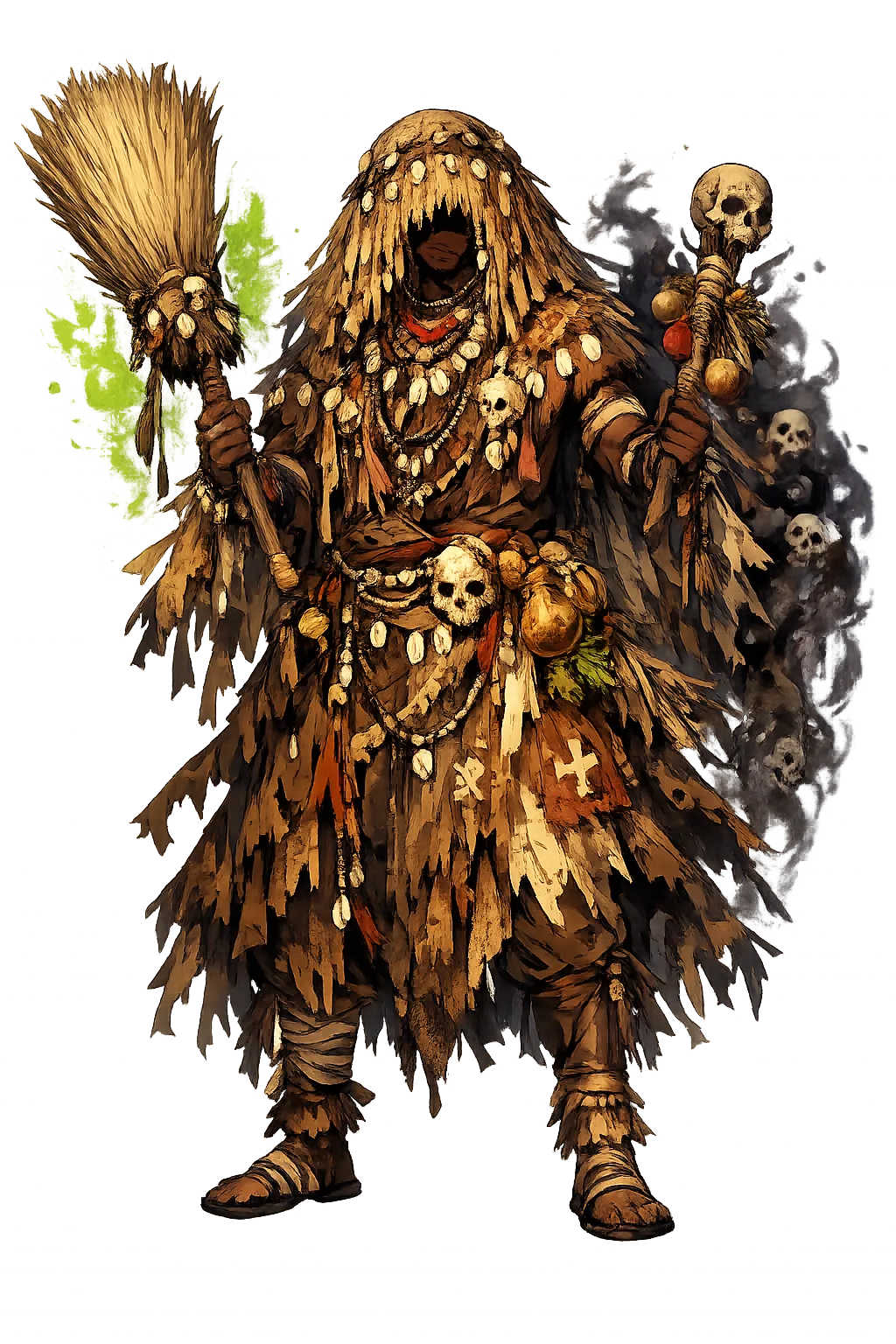
The provenance file on Ọbalúayé
Catalogue entry — Ọbalúayé. Every claim below carries its chain of custody.
Provenance
1. The attestation. —, from the tradition's own record. On record: Idowu, Olódùmarè: God in Yoruba Belief (1962), Bascom, Ifá Divination: Communication Between Gods and Men in West Africa (1969), Mason, Four New World Yoruba Rituals (1992), Murphy, Santería: African Spirits in America (1988).
2. The preserved evidence. l → ú (Acute on u); y → é (Acute on e) — absent from the ASCII form babaluaye, present in the restoration, verifiable against the sources above.
3. The narrative record. The King Cast Down — In the most widely told patakís of the Cuban canon, Babalú-Ayé was not always a beggar. He was a king — some say the proudest of the orixás — who grew contemptuous of the sick, or hoarded the secrets of healing, until Olodumare's judgment fell on him: sores from the soles of his feet to the crown of his head, and exile from every door. The Dogs and the Hidden Path — Dogs belong to Ọbalúayé on both continents because they live at the boundary he owns — between the village and the bush, the healthy and the sick, the living and the earth that takes them. In Yoruba teaching the dog runs ahead on paths men cannot see; in diaspora patakís it is the dog who leads the sufferer to the stream where the healing leaves grow, or who carries the message between the sick person's door and the orixá's.
4. The physical record. Ọbalúayé left no inscriptions and no ancient monuments — his material culture is the living altar. In Cuba, the casa-templo and the home altar keep his figure: the old man in burlap on crutches, flanked by dogs, ringed with gourds of grain and bundles of his herbs; the great pilgrimage church of San Lázaro at El Rincón, Santiago de las Vegas, receives his votive offerings by the thousand each December. In Bahia, Candomblé ilé shrines preserve the cowrie strings, earth-colored beads, and consecrated brooms of Obaluaiê, documented by ethnographers since the nineteenth century and by Verger's surveys. Behind the diaspora altar stands the West African substrate: the shrines and guarded groves of the smallpox deity described by Idowu and Bascom, suppressed under colonial medicine, surviving in the secrecy his theology always claimed as its own. His oldest 'excavation site' is the epidemic graveyard itself.
5. The current holding. The temple at /babaluaye/, classified Tier 1. What survives here cannot be shown in ASCII: a feature of the original that the fallback alphabet flattens. That is the Tier-1 test, and this name passes it without argument.
6. The documented resonances. Healthcare, Pharma & Medicine, Disaster Resilience & Recovery, Faith & Spiritual Organizations — seats argued and weighted in the pattern atlas, read through the myths in this temple's Resonance File.
7. The primary sources. Nigerian Studies — The Orisha Myths — the library this file answers to, open at the Sacred Texts collection.
8. The continuing record. Ọbalúayé's legacy is the theology of illness. In Yoruba and Afro-Atlantic thought, sickness is not mere biological accident; it is a message, a punishment, or a calling, and those who survive smallpox — or the modern afflictions that have inherited his domain — often dedicate their survival to him.
At a Glance
- Restored name: Ọbalúayé
- ASCII form: babaluaye
- Meaning: "Father of the world"
- Domain of influence: Disease, Healing, Earth
- Pantheon: Yoruba
- Classification: Tier 1
- Original script: —
- Series: The Restoration Files, No. 73 of 546
The File Continues
Read the founding dispatch for the name's full story, the Resonance File for the archetype at work — or the whole archive in one sitting.
Continue the series — previous file: Baꜥal (read it here) · next file: Badb (read it here).
The Restoration Files are written from the same canonical record as the temples themselves: the lexicon, the lore catalog, the pattern atlas, and the cited scholarly sources. If a file ever disagrees with its temple, the temple is right — tell us, and the file will be corrected.