The Living Myth
Storm God, Lord of the Heavens · Rider of the Clouds · Lord of the Storm
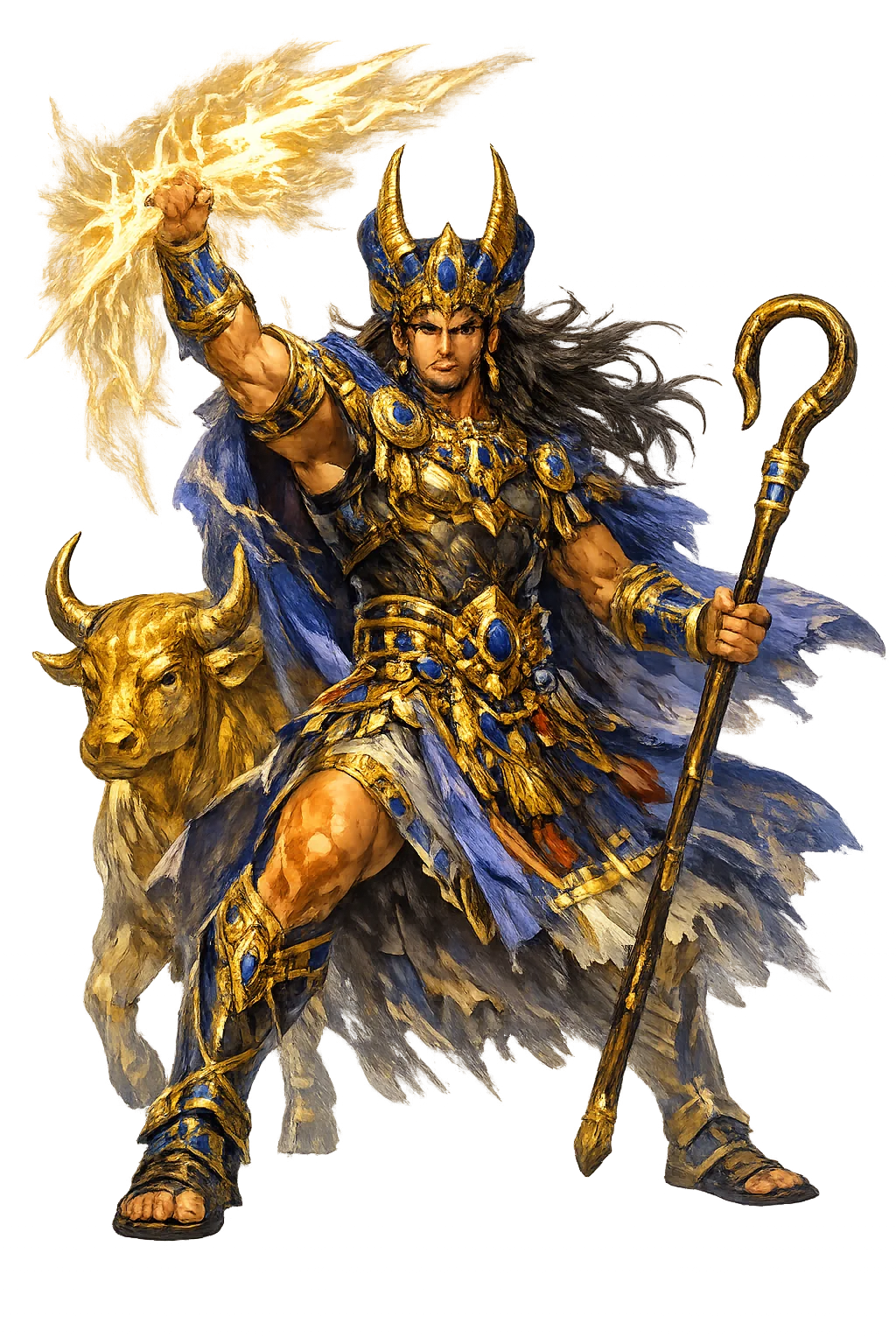
Stories of Baꜥal
The Ugaritic Baꜥal Cycle (KTU 1.1–1.6) is the central myth of Canaanite religion. It tells how Baꜥal wins kingship from the chaotic Sea, builds his palace, confronts Death, and returns to bring back the rains. The cycle is a seasonal drama of drought and renewal, but also a political statement about divine legitimacy.
Before Baꜥal could rule, the Sea had to be beaten. In the opening tablets of the cycle (KTU 1.1–1.2), Ēl grants kingship to Yamm, the deified ocean, whose emissaries stride into the divine assembly and demand that Baꜥal himself be delivered as a captive. Baꜥal longs to strike the envoys down, but Kothar-wa-Ḫasīs restrains him: to kill the messengers would break the protocol of the gods. Instead the craftsman forges two maces and names them Yagrush, 'Chaser', and Ayamur, 'Driver.' With them Baꜥal strikes Yamm in the skull and between the eyes; the Sea falls, 'scattered' across the floor of the assembly, and the gods at last seat Baꜥal at the feast he was denied (KTU 1.2 iv). The combat is the Levant's great chaoskampf: kingship is legitimate only once the primordial deep has been driven back beyond the harbor wall — a myth of order founded not on creation but on conquest of the waters.
Victory leaves Baꜥal homeless: a king without a palace is a king without a throne. He sends ꜥAnat to plead before Ēl, but it is Asherah — the diplomatic wife of the old god — who finally secures the decree (KTU 1.4 iv–v). Kothar-wa-Ḫasīs raises a cedar palace on Mount Zaphon, the cosmic north mountain, and Baꜥal hosts the banquet of the gods. One decision troubles him: Kothar urges him to cut a window in the palace wall, and Baꜥal hesitates — the window will let his thunder out to the world, but it may also let something in. When at last he opens it, he cries aloud through it, and his voice rolls from the heavens to the deeps (KTU 1.4 vii). Read as theology in architecture, the palace myth says that divine rule needs a fixed cosmic center: the voice that brings rain must have a gate through which to go — and a house worth defending when Death comes calling.
When the palace is finished, Death itself sends an invitation. Mōt — whose throat is a lion's and whose gullet is a whale's — demands that Baꜥal come down into the realm of dust and drought (KTU 1.5 i). Baꜥal obeys: he takes his clouds, winds, and rains with him, and the earth dries behind him. Ēl mourns on the ground, gashing himself with a stone knife; ꜥAnat searches the world for her brother, finds him dead, and buries him on Zaphon. Then she turns on Mot and takes him apart: 'with a sword she splits him, with a sieve she winnows him, with fire she burns him, with millstones she grinds him, in the field she scatters him' (KTU 1.6 ii 30–35). Baꜥal returns, and the rains return with him. The myth refuses to treat death as an ending: it is a season with a boundary, and grief armed becomes the force that pushes the boundary back.
Baꜥal was not only the hero of cosmic myth; the people of Ugarit prayed to him at their own walls. A ritual text from the royal archives (KTU 1.119), composed for a time of military danger, invokes Baꜥal to expel the besieger from 'your city Ugarit' and to drive the enemy from its gates. The storm god who had conquered the Sea was the natural patron of a maritime city: votive anchors and figurines from his temple at Ras Shamra show sailors entrusting themselves to the power that had once subdued Yamm. This is liturgy rather than narrative — the cycle's cosmic drama compressed into one urgent civic prayer — and it shows that for Ugarit the battle against chaos was never finished. It returned each season, each siege, and had to be won again by sacrifice and song. The temple and the city wall stood as two faces of one theology: order, once won, must be defended every day.
Storm, Fertility, and Divine Kingship
Baꜥal is the storm made king. In a land where rain is life and drought is death, he is the deity who rides the clouds, shatters the sea-monster, and opens his palace windows so that the rains may fall. He is young, vigorous, and hungry for a throne — yet even his kingship depends on the older god Ēl. The Baꜥal Cycle is the great myth of his rise, death, and return.
His voice is thunder, his weapon lightning; he gathers clouds, wind, and rain around his chariot.
His cedar palace stands on the mountain of the north, the axis mundi from which he governs the cosmos.
When he lives, bread, wine, and oil abound; when he descends to Mot, the land withers.
He defeats Yamm, the primordial Sea, and shatters the seven-headed serpent Lotan.
From the original script to the living URL
𐎁𐎓𐎍
The name in its original Canaanite form. Baꜥal (𐎁𐎓𐎍) is attested in the source tradition — “Canaanite storm and fertility god; the title "Lord" (baʿlu) was also applied to local deities”. Its Egyptological ain and alef letters carry the full phonetic and orthographic weight of the source tradition.
baal
Reduced to plain baal, the name loses everything that made it specific: Egyptological ain and alef letters. What remains is an ASCII string that machines can parse but that no longer speaks with its original voice.
Baꜥal
The Unicode restoration recovers what ASCII flattened. Baꜥal restores Egyptological ain and alef letters, returning the name to its original written dignity. The domain encodes to Punycode, but the browser displays the truth.
Baꜥal.com → xn--baal-re8o.com
The non-ASCII characters in Baꜥal are encoded while the ASCII remains visible. To the DNS, it is Punycode. To humanity, it is Baꜥal.
Owned, ideal, and ASCII forms of Baꜥal
Baꜥal
Restores 𐎁𐎓𐎍. The live temple domain — baꜥal.com.
Baʿal
Restores 𐎁𐎓𐎍. Ugaritic/Phoenician ʿayin (ʿ) is the ideal consonant, but is rejected by the DNS root zone. Not in the PuniCodex collection.
baal
Flattens 𐎁𐎓𐎍. The plain ASCII fallback — what DNS and legacy systems see.
How Baꜥal was spoken
How Baꜥal travels from ancient script to the modern URL
Ugaritic bʿl simply means “lord, master"; as a divine title it was applied to the storm-god Hadad and to local manifestations of deity.
Storm God, Lord of the Heavens
The Unicode restoration Baꜥal uses registrable Latin diacritics; the Ugaritic form is not registrable in .com.
The lore you have read is the living myth. Extended Lore opens the scholarly vault beneath it: the cult and its material remains, a history of the image, the name after antiquity, a meditation on what the name still means, and the full scholarly apparatus — etymology, orthography, sources.
Enter Extended Lore