PuniCodex

Extended Lore

𐎁𐎓𐎍 Baꜥal

Etymology · Orthography · Cult · Iconography · Reception · Sources

Tier 1 Baꜥal.com
Baꜥal — Storm God, Lord of the Heavens
01

Quick Facts

Essential information about Baꜥal, Storm God, Lord of the Heavens

Original Script𐎁𐎓𐎍
Unicode RestorationBaꜥal
Reconstructed Pronunciation/baʕ.al/
PantheonCanaanite
DomainStorm God, Lord of the Heavens
MeaningCanaanite storm and fertility god; the title "Lord" (baʿlu) was also applied to local deities
ClassificationTier 1
Primary DomainBaꜥal.com
Sacred SymbolsBull, Lightning club, Window, Cloud chariot
02

Etymology & Word Family

From original script to Unicode restoration

Proto-afro-asiatic *baʿl- lord, owner, husband
Original Script 𐎁𐎓𐎍 Baꜥal — "Canaanite storm and fertility god; the title "Lord" (baʿlu) was also applied to local deities"
Unicode Restoration Baꜥal Restored stress, length, and script
Modern ASCII baal Plain-ASCII fallback

From Common Semitic baʿlu, "lord"; the pharyngeal is written with Egyptian Ain (ꜥ) as the only registrable Unicode workaround

03

Unicode Character Breakdown

Character-by-character philological analysis

CharacterUnicodeNameBlockPhonetic Role
BU+0042Latin Capital Letter BBasic LatinCapital beta
aU+0061Latin Small Letter ABasic LatinSame
ꜥaU+A725Character U+A725Latin Extended-DEgyptian Ain (ꜥ) used as the only DNS-registrable stand-in for Semitic ʿayin, followed by the vowel present in the Unicode restoration
lU+006CLatin Small Letter LBasic LatinSame

The Tier 1 classification reflects how much of the original phonology this restoration preserves — stress and vowel length for Greek names, distinctive letters and diacritics for every other tradition.

04

Cult & Worship

How the sacred was kept — rites, sanctuaries, remains

The Cult

Baʿal’s cult was anchored in storm-theology and kingship. At Ugarit, the Temple of Baal excavated by Claude Schaeffer produced stelae, votive anchors, and the tablets of the Baʿal Cycle, while the Karatepe bilingual invoked Baʿal alongside King Azatiwada in Phoenician and Luwian. In Syria, the great Temple of Baal-Shamin dominated Palmyra; in North Africa, Baʿal-Hammon received child sacrifice in the tophet sanctuaries of Carthage and its western colonies. Biblical tradition remembers contests at Mount Carmel and shrines at Hazor and Megiddo. No priestly hierarchy is preserved in detail, but royal dedications and treaty oaths show that Baʿal was a guarantor of dynastic legitimacy across the Levant. Modern veneration is absent; the name survives mainly in academic and polemical discourse.

In the Earth

The Temple of Baal at Ugarit, excavated by Claude Schaeffer, yielded stelae, votive anchors, and the Baʿal Cycle tablets (KTU 1.1–1.6). The Karatepe bilingual pairs Baʿal with King Azatiwada in Phoenician and Luwian. At Palmyra the great Temple of Baal-Shamin dominated the city; at Carthage, Baʿal-Hammon received child sacrifice in the tophet sanctuary. Hazor, Megiddo, and Mount Carmel provide Levantine cultic contexts attacked by biblical polemic.

05

Iconography

How Baꜥal was imaged across the ages

The Image

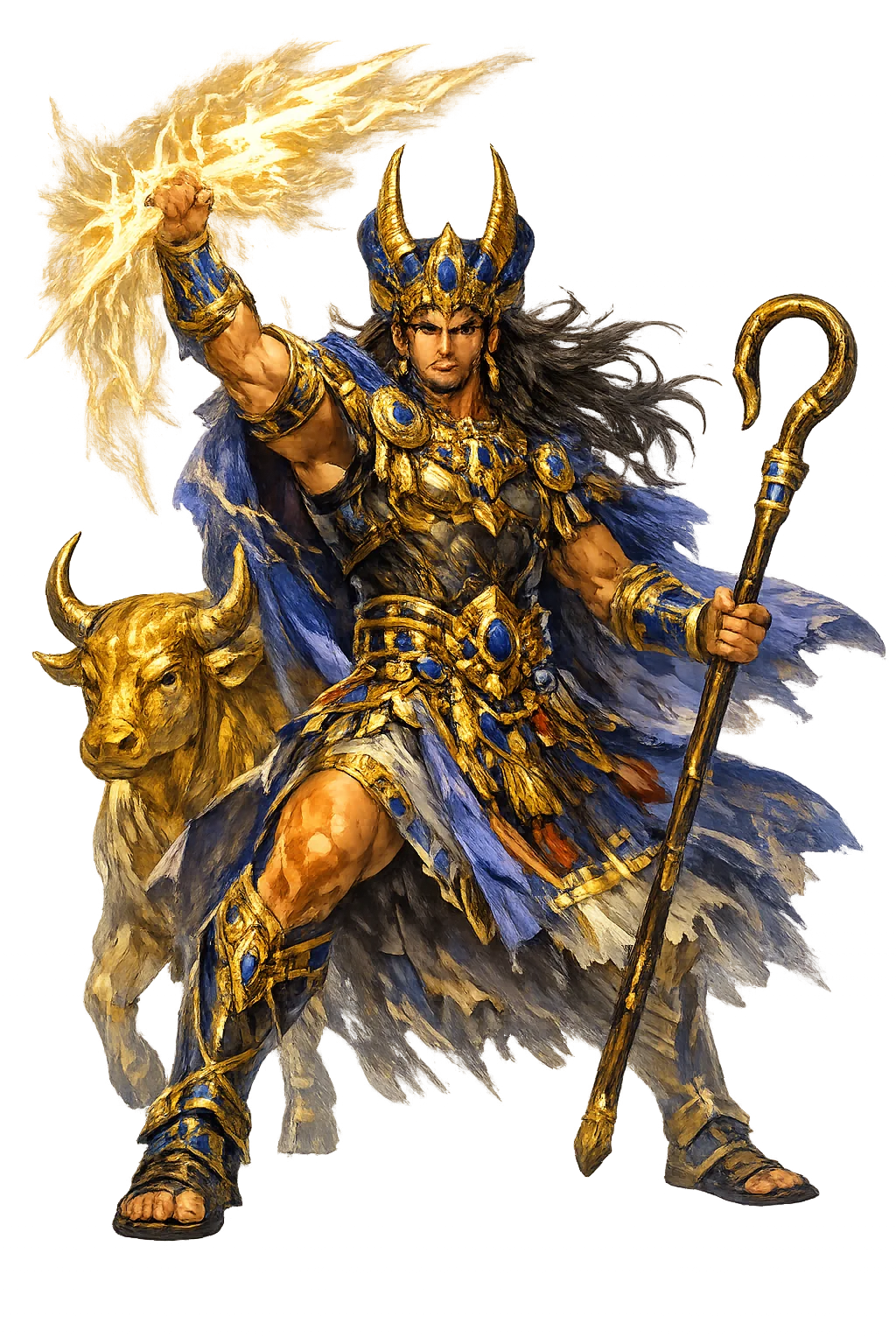
Baʿal was imaged as a storm-king: the famous Ugarit stele shows him striding with a mace or spear in one hand and vegetal thunderbolt in the other, wearing the horned crown of divinity and a short Syrian kilt. The bull—symbol of fertility and thunder—accompanies him on seals and stelae across the Levant. At Palmyra, Baal-Shamin appears in relief as a bearded sovereign framed by eagles and the zodiac. In Carthage, Baʿal-Hammon is represented by a stern enthroned figure, often with a wheat-sheaf or raised hand, rather than by storm imagery. No painted vase cycle survives from Canaan itself, and manuscript illumination is lacking, but bronze figurines and coin types from Phoenician mints kept the armed, striding god recognizable across the Mediterranean.

06

Reception & Transformation

The name after its own age — transmission, translation, survival

Afterlives

The title Baʿal outlived its cults through translation and polemic. In the Hebrew Bible, Baʿal became the paradigmatic foreign god, and Phoenician Baʿal-Zebub was later demonized as Beelzebub in Jewish and Christian tradition; Byzantine hagiography and Syriac monastic texts kept the name alive as a label for paganism and heresy. Early Islam knew the name through Quranic and Syriac polemics against pre-Islamic Arabian deities, while medieval European grimoires carried Beelzebub into demonological lore. The actual temples at Ugarit and Palmyra were buried and forgotten until French and German excavations in the twentieth century, when the Baʿal Cycle transformed understanding of Canaanite religion. Nineteenth-century Romantic and occult writers revived Baʿal as an exotic deity, but scholarly reception dominates today: he is now a standard case study in Semitic linguistics, ancient Near Eastern storm-god typology, and the archaeology of child sacrifice.

Identifications Across Traditions

Baꜥal is inseparable from the older West Semitic storm god Hadad/Haddu; in texts and inscriptions the two names are often combined as Baꜥal-Haddu. In Mesopotamia he was equated with Adad (dIM), and in Egypt he influenced the Levantine storm god imported during the New Kingdom. The Greeks saw in him a Near Eastern Zeus, a sky-storm king, though they did not directly worship him. In the Hebrew Bible, Baꜥal became the archetype of apostasy, the 'false god' opposed by Elijah on Mount Carmel. Later Jewish and Christian tradition demonized the name, turning 'Baal' into a byword for idolatry and, in medieval occultism, for a class of demons.

Modern Legacy

No Canaanite name was more reviled or more enduring than Baꜥal. The prophets of Israel spent generations attacking his cult, yet his imagery — the storm god who rides the clouds, defeats the sea, and sends rain — was quietly absorbed into the figure of Yahweh. In the New Testament, Beelzebub ('Lord of the Flies,' probably a distortion of Baꜥal-Zebul, 'Prince Baꜥal') becomes a name for Satan. In modern fantasy and occult literature, Baal persists as a demon-king. But beneath the polemic remains the old Levantine truth: a god of storm and fertility whose absence means drought and whose return means life.

07

The Meditation

What Baꜥal means — beyond the dictionary

Baꜥal is the god of the necessary storm. He does not create the world; he saves it from chaos, builds a house for his voice, and dies so that the cycle of rain may continue. His mythology is not about transcendence but about recurrence — the eternal return of the waters that make civilization possible.

In a warming world, Baꜥal's story takes on new weight. The storm is no longer merely symbolic; it is the weather that either nourishes or destroys. To remember Baꜥal is to remember that divine kingship, in the ancient imagination, was bound to the rains. The health of the cosmos and the legitimacy of the king rose and fell together. That is a theology we have not outgrown, however much we have renamed it.

08

Frequently Asked Questions

Common questions about Baꜥal, Storm God, Lord of the Heavens, and Unicode restoration

01How do you pronounce Baꜥal?

In reconstructed pronunciation, Baꜥal is /baʕ.al/ — approximately 'BAH-ahl' — the middle consonant is a deep, throaty 'ʿ' (like Arabic ع), not a glottal stop or silent letter.

02What does Baꜥal mean?

Baꜥal means Canaanite storm and fertility god; the title "Lord" (baʿlu) was also applied to local deities in the canaanite tradition.

03What are the symbols of Baꜥal?

Baꜥal is associated with Bull (His own victorious animal — he is acclaimed the 'bull' of the divine assembly — and the storm's fertile strength in one image), Lightning club (Yagrush and Ayamur, the twin maces Kothar-wa-Ḫasīs forged and named to shatter Yamm (KTU 1.2 iv)), Window (The palace window Baꜥal hesitated to cut; through it his thunder goes forth to the world (KTU 1.4 vii)), Cloud chariot (The storm cloud itself, his vehicle — 'Rider on the Clouds' (rkb ʿrpt) is his oldest epithet).

04Why are there different spellings of Baꜥal?

Each form is a historically attested restoration rather than a mistake: Baʿal is the ideal form (Ugaritic/Phoenician ʿayin (ʿ) is the ideal consonant, but is rejected by the DNS root zone); baꜥal is the owned form (Lowercase owned form); Baál is the alt form (Stress-only alternate transliteration (previous Phoenician entry)). PUNICODEX registers the full set so the tradition is preserved under every defensible spelling.

05Why restore Baꜥal in Unicode?

Plain ASCII baal strips the stress, length, and script that make the name specific. Unicode restoration returns the name to its original written dignity.

06What is the most important myth about Baꜥal?

“Against Prince Yamm” — the The Combat story that anchors the mythology of Baꜥal, told in full on the lore page.

09

Scholarly Sources

The philological foundations of this restoration

Every claim on this page is grounded in established scholarship. The orthographic restorations follow disciplinary convention. The etymological chain follows the best available reference works. This is not invention — it is resurrection through scholarship.

◈

Lexicography & Philology

  • Ugaritic texts
  • CIS
  • Coogan
  • Smith
  • De Moor
◎

Primary Texts

  • KTU
  • KTU (Ugaritic texts)
  • Smith, The Ugaritic Baal Cycle
  • KTU 1.1–1.6 (Ugaritic Baal Cycle)
  • Karatepe bilingual inscription (Phoenician Baal and Azatiwada)
  • Hebrew Bible, Psalm 29 (storm theophany over the waters)
  • Hebrew Bible, 1 Kings 18 (Elijah and the prophets of Baal on Carmel)
◉

Archaeology & Art History

  • Material evidence — iconography, inscriptions, and temple archaeology — for Baꜥal and related cults.
✦

Religious Studies

  • CIS
  • Coogan, Stories from Ancient Canaan
  • De Moor, The Seasonal Pattern in the Ugaritic Myth of Baʿlu
  • Wyatt, Religious Texts from Ugarit
Return

The Surface Awaits

You have traced the name from its earliest attestation to its Unicode restoration. Now return to the myth. The story is where the name lives.

Back to Lore
Baꜥal mascot