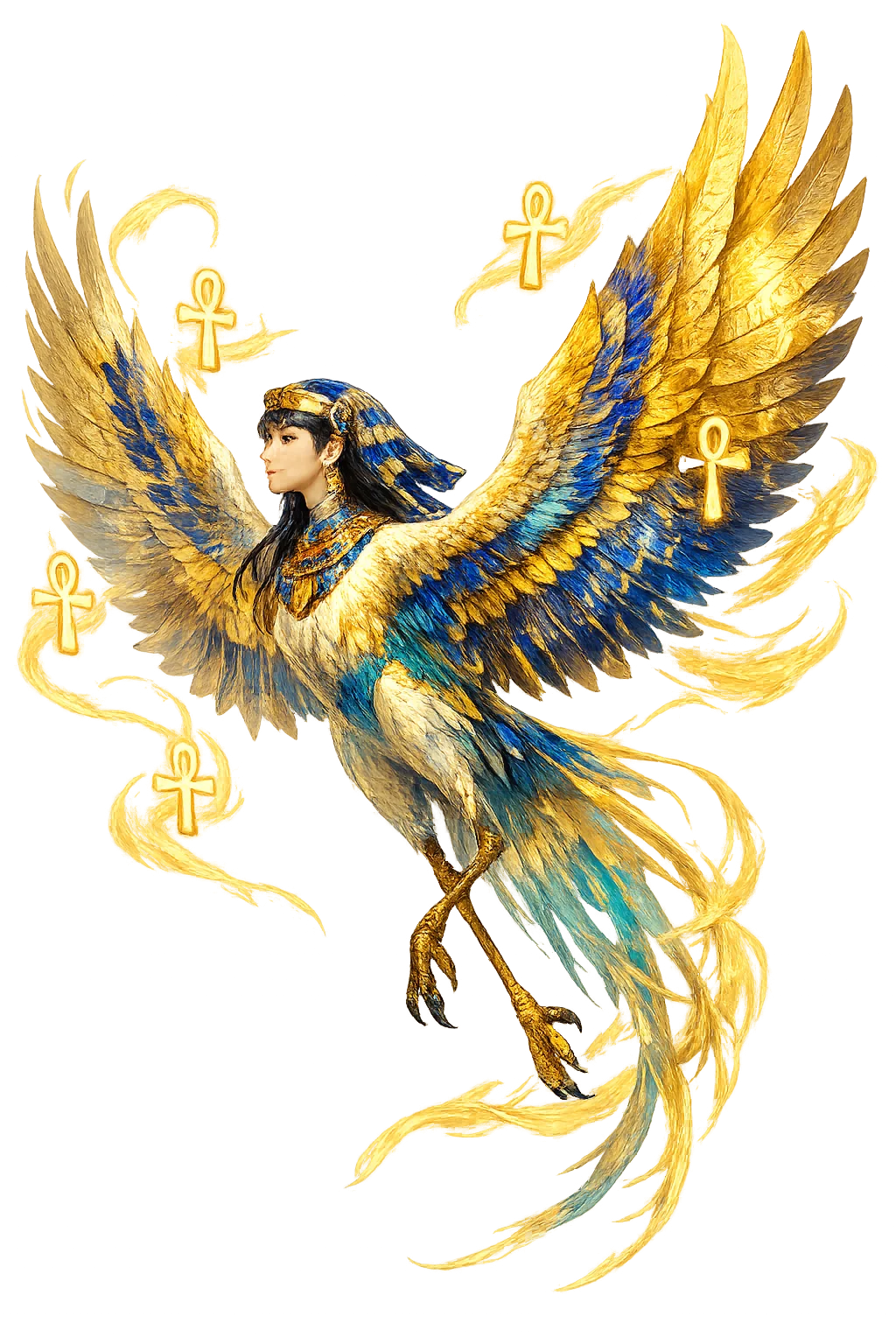
Stories of Bꜣ
The bꜣ enters literature as a fully formed theological concept in the Pyramid Texts and remains central through the Coffin Texts and the Book of the Dead. Its mythology is not a single story but a set of possibilities: the ba may ascend, return, lament, or be transformed, depending on the rites performed for it — and on the verdict of the scales.
Egyptian anthropology is relational and composite. The most widely cited scheme names five components: the ka (vital double, life-force sustained by offerings), the ba (mobile personality), the akh (transfigured effective spirit achieved after judgment), the ren (name, the marker of identity), and the shut (shadow, the protective silhouette). To these some sources add the ib (heart), the seat of thought and the record of a life's deeds. None of these map neatly onto a single Western 'soul'; together they form a networked self sustained by ritual, memory, and ma'at. The scheme was not a dogma but a working theology, its lists varying from text to text across two millennia. The ba is the network's traveller — the one component whose nature is motion between the stations of body, tomb, sky, and hall of judgment.
The Middle Kingdom text known as the Dialogue of a Man with His Ba is one of the most intimate documents in Egyptian literature. A man, despairing of life in a corrupt age, longs for death; his ba resists the death-wish, warning that to die without rites and remembrance is to cease entirely, then relents and promises to remain with him. The ba speaks as a separate, wiser self — proof that the Egyptians experienced personality not as a unity but as a conversation between aspects that could disagree. The text ends with the man reconciled to life and preparing the rites that will let his ba prosper after him. No other ancient literature gives the soul a speaking part against its owner; the dialogue remains a startlingly modern document about despair, companionship, and the will to live.
Book of the Dead spells assure the deceased that their ba will leave the tomb at will, 'go forth by day', and join the sun-god Re in his bark. Pyramid Texts describe the king's ba ascending to the circumpolar stars, that imperishable region beyond the turning of the night sky. This mobility is the ba's defining privilege: unlike the ka, which is tied to the corpse and the offering table, the ba is free to travel the cosmos. But the freedom is secured by magic, not taken for granted — Coffin Texts and Book of the Dead spells 38A exist precisely to prevent the ba from being seized or barred in the necropolis, and spells 26–30 guard the heart on which the ba's wanderings ultimately depend. The Egyptian afterlife was not a release; it was a maintained condition, paid for in rites and vigilance.
Book of the Dead Spell 125 places the ba's future in the scales. In the Hall of the Two Truths the heart (ib) of the deceased — 'my heart of my mother, my heart of my mother, my heart-case of my coming into being' — is weighed against the feather of Ma'at, while Anubis tends the balance and Thoth records the result. The dead must recite the negative confession, the declarations of innocence before the forty-two assessor gods. If the heart outweighs the feather, it is given to Ammit, the devourer who waits beside the scales, and the person dies the second death, from which there is no return — no ba, no akh, no name spoken. If the scales hold level, the deceased is declared 'true of voice' (mꜣꜥ-ḫrw) and joins the company of the gods. The theology is uncompromising: the ba flies only as far as the heart's truth allows. Mobility — the ba's glory — is the wage of a life in balance.
Personality · Manifestation · Presence
The bꜣ is not the Egyptian word for 'soul' in the modern, singular sense. It is the mobile, recognisable aspect of a person — the part that leaves the body at death, flies above the marshes, boards the sun-bark, and returns to the tomb. In life it is personality; in death it becomes the self that moves between worlds. Where the ka stays with the corpse and eats the offerings, the ba is the one who goes abroad.
The distinct presence that makes a person recognisable — 'what shows forth' of the self.
The ba appears — to gods, to the dead, and even to the living in dreams — as a visible sign of the person.
Depicted as a human-headed bird, the ba can leave the tomb, fly through the sky, and travel the Duat.
If the ba and ka reunite after judgment, the deceased becomes an akh — an effective, transfigured spirit.
From the original script to the living URL
𓅡𓏤
The name in its original Egyptian form. Bꜣ (𓅡𓏤) is attested in the source tradition — “The soul, personality, or manifestation of a person. One of the five components of the Egyptian soul.”. Its Egyptological ain and alef letters carry the full phonetic and orthographic weight of the source tradition.
ba
Reduced to plain ba, the name loses everything that made it specific: Egyptological ain and alef letters. What remains is an ASCII string that machines can parse but that no longer speaks with its original voice.
Bꜣ
The Unicode restoration recovers what ASCII flattened. Bꜣ restores Egyptological ain and alef letters, returning the name to its original written dignity. The domain encodes to Punycode, but the browser displays the truth.
Bꜣ.com → xn--b-yw3e.com
The non-ASCII characters in Bꜣ are encoded while the ASCII remains visible. To the DNS, it is Punycode. To humanity, it is Bꜣ.
Owned, ideal, and ASCII forms of Bꜣ
Bꜣ
Restores 𓅡𓏤. The live temple domain — bꜣ.com.
ba
Flattens 𓅡𓏤. The plain ASCII fallback — what DNS and legacy systems see.
How Bꜣ was spoken
How Bꜣ travels from ancient script to the modern URL
Egyptian bꜣ “soul, manifestation"; the mobile aspect of the personality, often depicted as a human-headed bird.
Soul, Personality, Manifestation
The Unicode restoration Bꜣ uses Egyptological characters registrable in .com; hieroglyphs are outside the .com IDN table.
The lore you have read is the living myth. Extended Lore opens the scholarly vault beneath it: the cult and its material remains, a history of the image, the name after antiquity, a meditation on what the name still means, and the full scholarly apparatus — etymology, orthography, sources.
Enter Extended Lore