PuniCodex

Extended Lore

𓅡𓏤 Bꜣ

Etymology · Orthography · Cult · Iconography · Reception · Sources

Tier 1 Bꜣ.com
Bꜣ — Soul, Personality, Manifestation
01

Quick Facts

Essential information about Bꜣ, Soul, Personality, Manifestation

Original Script𓅡𓏤
Unicode RestorationBꜣ
Reconstructed Pronunciation/baːʕ/
PantheonEgyptian
DomainSoul, Personality, Manifestation
MeaningThe soul, personality, or manifestation of a person. One of the five components of the Egyptian soul.
ClassificationTier 1
Primary DomainBꜣ.com
Sacred SymbolsHuman-headed bird, Ba-bird, Heart scarab, Sun-bark, Cartouche
02

Etymology & Word Family

From original script to Unicode restoration

Original Script 𓅡𓏤 Bꜣ — "The soul, personality, or manifestation of a person. One of the five components of the Egyptian soul."
Unicode Restoration Bꜣ Restored stress, length, and script
Modern ASCII ba Plain-ASCII fallback

From Egyptian bꜣ, written b-aleph, denoting the mobile aspect of the soul or personality; the original vocalization is unknown.

03

Unicode Character Breakdown

Character-by-character philological analysis

CharacterUnicodeNameBlockPhonetic Role
BU+0042Latin Capital Letter BBasic LatinSame, capitalized
ꜣU+A723Latin Small Letter Egyptological AlefLatin Extended-DEgyptological aleph — glottal stop or specific vocalic quality

The Tier 1 classification reflects how much of the original phonology this restoration preserves — stress and vowel length for Greek names, distinctive letters and diacritics for every other tradition.

04

Cult & Worship

How the sacred was kept — rites, sanctuaries, remains

The Cult

The ba was not a god with public temples but a recipient of mortuary cult. Its welfare depended on continued offerings at the tomb, the Opening of the Mouth ritual, and the recitation of Book of the Dead spells that allowed it to leave the burial chamber by day and rejoin the mummy at night. New Kingdom tomb paintings at Deir el-Medina and in the Valley of the Kings, including the tomb of Sennedjem, show the ba-bird hovering over the mummy or traveling through the underworld. Gold-leaf ba-amulets and wooden ba-bird figures placed on Twenty-first-Dynasty Theban coffins were votive provisions for this journey. Papyri such as the Book of the Dead of Ani in the British Museum preserve the textual machinery of the cult. No festival calendar or priesthood belonged to the ba itself; its “cult” was the family mortuary cult of every Egyptian.

In the Earth

The human-headed ba-bird is attested in tomb paintings from Deir el-Medina and the Valley of the Kings, notably in the tomb of Sennedjem (TT1) and on the papyrus of Ani. Gold-leaf ba-amulets and wooden ba-bird figures have been recovered from Twenty-first-Dynasty coffins at Thebes. Stelae and Book of the Dead papyri in the British Museum and the Egyptian Museum, Cairo, depict the ba leaving the tomb by day and returning to the mummy.

05

Iconography

How Bꜣ was imaged across the ages

The Image

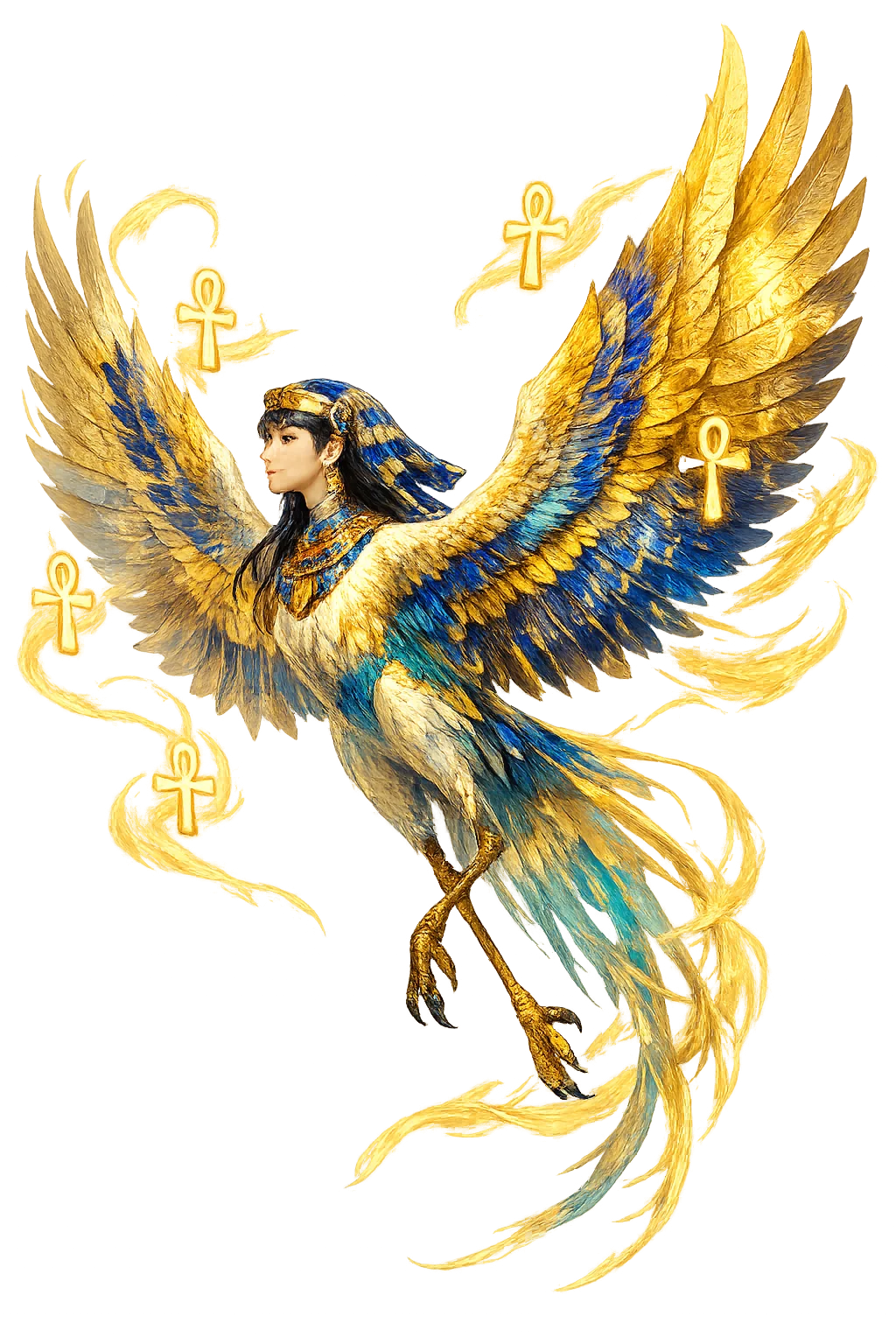
The canonical image of the ba is the human-headed bird, usually a jabiru or heron with a bearded male head, arms folded across the chest, and sometimes extended wings. This form dominates tomb paintings from Deir el-Medina and the Valley of the Kings, most famously in the papyrus of Ani now in the British Museum, where the ba hovers above the mummy or stands before Osiris. Gold-leaf amulets and small wooden ba-birds from Twenty-first-Dynasty Theban coffins render the same icon in three dimensions, intended as provisions rather than cult statues. The hieroglyph itself uses the jabiru bird as a phonogram, so text and image are inseparable. Later Coptic and medieval Arabic grave imagery occasionally borrowed the hovering-soul motif, but the specific Egyptian ba-bird disappears after pharaonic religion ends.

06

Reception & Transformation

The name after its own age — transmission, translation, survival

Afterlives

After pharaonic religion, the ba survived as a concept only in fragments. Coptic Christians reinterpreted the soul through biblical categories, though funerary art kept the hovering-bird motif for a few centuries. Greek and Roman writers such as Herodotus and Plutarch discussed Egyptian soul-divisions in ethnographic terms, but the ba had no direct Greek equivalent and was usually flattened into psyche. Medieval Arabic scholars preserved little of this vocabulary; real transmission resumed in the nineteenth century when Champollion’s decipherment allowed Egyptologists to read Book of the Dead papyri in the British Museum and Cairo. The ba then entered modern comparative religion and psychoanalytic metaphor—Jungians sometimes likened it to the mobile, outward-facing aspect of the soul—while museum displays of Ani’s papyrus turned it into one of the most recognizable afterlife images in global visual culture.

Identifications Across Traditions

Later Egyptian texts sometimes speak of the ba of gods — Re travels the underworld as a ram-headed ba, and Banebdjedet of Mendes is identified with the ba of Osiris. In Greco-Roman Egypt, the ba was partially mapped onto the Greek psyche, though the Greek concept lacks the ba's specifically mobile, bird-shaped iconography. Coptic Christianity inherited the word as bē, now meaning 'soul' in a more unitary sense, smoothing away the older plurality. Through Theosophy and modern Kemetic revival, the ba has returned as a term for the traversable, dream-capable aspect of the self.

Modern Legacy

The idea that the self has more than one component — that part of us stays with the body while another part flies free — is one of Egypt's most enduring gifts to the imagination. Medieval alchemy, Renaissance hermeticism, and modern psychology all found in the ba a precedent for divided or layered personhood. Today the ba appears in fantasy fiction, in role-playing games, and in contemporary pagan practice as the 'astral body' or 'travelling soul'. The human-headed bird remains one of the most recognisable images of the afterlife, a visual shorthand for the conviction that we are not finished when the body stops breathing.

07

The Meditation

What Bꜣ means — beyond the dictionary

To think about the ba is to think about what in us is portable. The Egyptians did not believe that a person simply survived death; they believed that a person survived in several different modes at once. The corpse stayed in the tomb, the life-force fed at the offering table, the name waited to be spoken, and the ba — the ba went out into the light. This is not confusion. It is a more honest anthropology than the single, disembodied soul that later traditions inherited.

The ba asks us to recognise that identity is not a substance but a relationship: between body and image, memory and presence, the one who stays and the one who goes. When we say of someone that they 'live on in memory', we are speaking the language of the ba. When we feel our own personality leave a room and travel elsewhere in a dream, we are touching what the Egyptians named. The ba is the part of us that is visible to others even when the body is absent — the manifest self, still in motion.

08

Frequently Asked Questions

Common questions about Bꜣ, Soul, Personality, Manifestation, and Unicode restoration

01How do you pronounce Bꜣ?

In reconstructed pronunciation, Bꜣ is /baːʕ/ — approximately 'BAH-ah' — but close the final syllable with a soft catch in the throat, as if the name itself were a wing-beat.

02What does Bꜣ mean?

Bꜣ means The soul, personality, or manifestation of a person. One of the five components of the Egyptian soul. in the egyptian tradition.

03What are the symbols of Bꜣ?

Bꜣ is associated with Human-headed bird (The union of human identity with avian mobility; the ba in its standard iconographic form), Ba-bird (A small falcon or sparrowhawk body bearing the face of the deceased), Heart scarab (The heart (ib) is weighed; the ba depends on the heart's truth for its continued freedom), Sun-bark (The vessel on which the ba journeys with Re across the day and night skies), Cartouche (The ren (name) must survive for the ba to be remembered and effective).

04Why restore Bꜣ in Unicode?

Plain ASCII ba strips the stress, length, and script that make the name specific. Unicode restoration returns the name to its original written dignity.

05What is the most important myth about Bꜣ?

“The Components of the Egyptian Person” — the The Fivefold Self story that anchors the mythology of Bꜣ, told in full on the lore page.

09

Scholarly Sources

The philological foundations of this restoration

Every claim on this page is grounded in established scholarship. The orthographic restorations follow disciplinary convention. The etymological chain follows the best available reference works. This is not invention — it is resurrection through scholarship.

◈

Lexicography & Philology

  • Faulkner, R. O. A Concise Dictionary of Middle Egyptian. Oxford: Griffith Institute, 1962.
  • Gardiner
  • Allen
◎

Primary Texts

  • Pyramid Texts
  • Coffin Texts
  • Book of the Dead, Spells 17, 26–30, 38A, 125
◉

Archaeology & Art History

  • Material evidence — iconography, inscriptions, and temple archaeology — for Bꜣ and related cults.
✦

Religious Studies

  • Faulkner, A Concise Dictionary of Middle Egyptian
  • Wörterbuch der ägyptischen Sprache (Wb), bꜣ
  • Gardiner, Egyptian Grammar
  • Allen, Middle Egyptian
  • Dialogue of a Man with His Ba (Papyrus Berlin 3024)
  • Crum, A Coptic Dictionary, s.v. ⲃⲁⲓ
Return

The Surface Awaits

You have traced the name from its earliest attestation to its Unicode restoration. Now return to the myth. The story is where the name lives.

Back to Lore
Bꜣ mascot