PuniCodex

Extended Lore

Auðhumla — The Deeper Record

Etymology · Orthography · Cult · Iconography · Reception · Sources

Preserves distinctive letters Auðhumla.com
Auðhumla — Primeval Cow, Nourisher of Creation
01

At a Glance

Auðhumla — every fact links to its home

PantheonNorse
DomainPrimeval Cow, Nourisher of Creation
Primary Sources2 cited →
02

Etymology & Word Family

From original script to Unicode restoration — the full etymology page →

Original Script ᛅᚢᚦᚢᛘᛚᛅ Auðhumla — "Wealth-humla (primeval cow)"
Unicode Restoration Auðhumla Restored stress, length, and script
Modern ASCII audhumla Plain-ASCII fallback

Old Norse Auðhumla, the primeval cow that licked the salt blocks and revealed Búri, ancestor of the gods.

03

Unicode Character Breakdown

Character-by-character philological analysis

CharacterUnicodeNameBlockPhonetic Role
AU+0041Latin Capital Letter ABasic LatinSame, capitalized
uU+0075Latin Small Letter UBasic LatinSame
ðU+00F0Latin Small Letter EthLatin-1 SupplementEth: voiced dental fricative
hU+0068Latin Small Letter HBasic LatinSame
uU+0075Latin Small Letter UBasic LatinSame
mU+006DLatin Small Letter MBasic LatinSame
lU+006CLatin Small Letter LBasic LatinSame
aU+0061Latin Small Letter ABasic LatinSame

The restoration of Auðhumla preserves what it can of the original phonology — stress and vowel length for Greek names, distinctive letters and diacritics for every other tradition.

04

Cult & Worship

How the sacred was kept — rites, sanctuaries, remains

The Cult

No pre-modern cult of Auðhumla is attested, and honesty forbids inventing one: the entire ancient dossier is a single chapter of Snorri's Prose Edda (Gylfaginning 5), in which she gives milk and licks rime. She receives no sacrifice, temple, festival, or priesthood, and no skaldic poem or runestone invokes her. Norse religion is otherwise well documented, so the silence is meaningful: she is a cosmogonic actor, not a goddess with a congregation. What we can say is functional rather than liturgical — she stands at the head of every genealogy, the shared nurse of gods and giants, and Icelandic tradition kept her name alive in dictionaries and glosses long after any worship could have existed. Modern Norse-pagan movements honor her today as the first mother; that veneration is a revival, not a survival, and should be counted as new cult rather than ancient evidence.

In the Earth

Auðhumla is an entirely textual figure. No runestone, image, or place-name can be securely identified with her. Her witness is the manuscript tradition of Snorri's Prose Edda — Codex Regius (GKS 2367 4to), Codex Wormianus, Codex Trajectinus, and the Uppsala Edda — which preserve Gylfaginning 5. The scene has, however, left a strong trace in later Scandinavian folk art and modern Norse-revival iconography.

05

Iconography

How Auðhumla was imaged across the ages

The Image

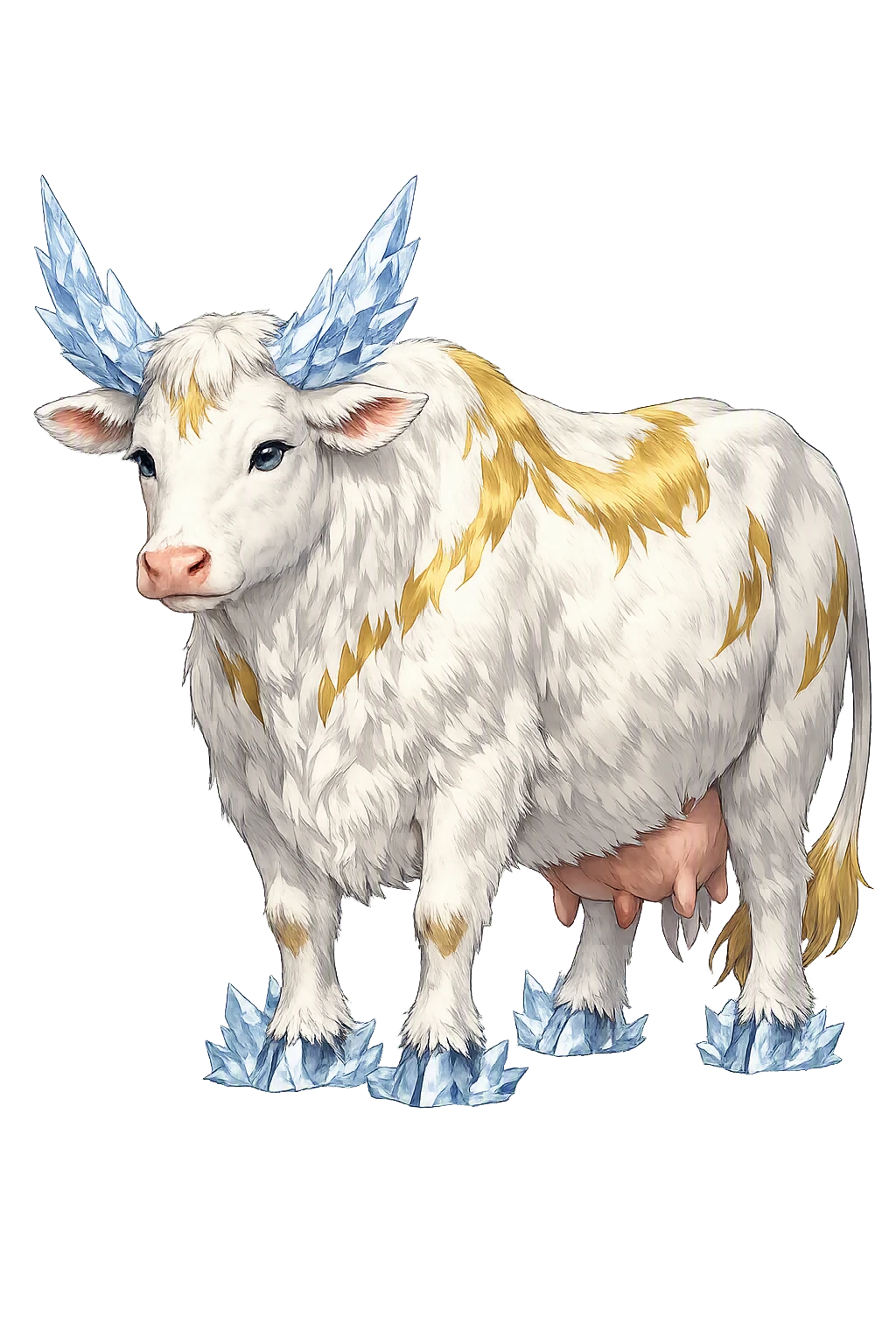
Auðhumla was never imaged in the Viking Age: no picture stone, carving, or metalwork shows her, and the texts give attributes, not a portrait — a cow standing in the void between ice and fire, four rivers of milk, a tongue patient enough to free a god from stone. The image tradition begins with paper. Eighteenth-century Icelandic scribes, among them Jakob Sigurðsson, illustrated manuscripts of Snorri's Edda that fixed her visual type: the massive cow, the giant at her udder, the block of rime under her tongue. The type's masterpiece is Danish: Nicolai Abildgaard's Ymir Suckling the Cow Auðhumla (c. 1777, National Gallery of Denmark), where her warm breath melts the stone that yields Búri. Nearly every modern illustration of the Norse creation descends from these two sources — a provincial manuscript habit and one Neoclassical canvas.

06

Reception & Transformation

The name after its own age — transmission, translation, survival

Afterlives

A one-chapter figure entered world culture on the back of Snorri's manuscripts. Her medieval afterlife is simply survival: the Edda codices kept the scene intact while the rest of Europe forgot it, and when the Prose Edda first reached print in Peder Resen's 1665 Copenhagen edition — with a Latin translation — Auðhumla went abroad. Eighteenth-century antiquarians relished the image; nineteenth-century scholarship canonized it. Jacob Grimm's Deutsche Mythologie (1835) exhibited the ice-licks as a standard case of comparative myth, and the great Victorian Eddas, the translations that carried Snorri into English drawing rooms, repeated her scene as the North's creation parable. Twentieth-century philology did its quiet work: Cleasby–Vigfússon and Zoëga parsed a name whose second element has never been fully explained, and modern handbooks (de Vries, Simek, Lindow) transmit her with honest footnotes. Her fame now vastly exceeds her sources — one vivid paragraph, endlessly reprinted.

Identifications Across Traditions

Auðhumla has no direct foreign counterpart, but she belongs to a broad Indo-European motif: the primeval bovine whose milk or body nourishes the world. The Vedic cow Surabhi yields the ocean of milk; the Iranian Gōšūrun and the bovid figure of the Zoroastrian creation myth play analogous roles; and the Egyptian cow-goddess Hathor and Greek Io have sometimes been compared, though these are typological, not genealogical, parallels. Within Norse studies she is read as the female counterpart to Ymir — the nourishing body that balances his monstrous growth.

Modern Legacy

Auðhumla survives in every retelling of the Norse creation myth, from the Victorian Eddas to contemporary comics, games, and Heathen cosmology. Her image — a cow standing in the void, licking the first god out of ice — is one of the most vivid in the Norse corpus. Modern Ásatrú and Norse-pagan reconstruction often honor her as the first mother, the abundance that precedes every order. Restoring Auðhumla preserves the eth and diphthong that make her name sound like the cold, rich world she inhabits.

08

The Original Script Note

What the written record preserves — and what it does not

Original Script

Auðhumla exists only in Snorri's telling: the primeval cow whose milk fed the giant Ymir and whose tongue licked Búri from the rime. Her name's first element is auðr 'riches, prosperity'; the second is opaque — usually connected with humla 'hop-plant' or taken as 'hornless', but no consensus holds. She is a manuscript figure with no runic inscription and no cult-trace. A normalized Younger Futhark rendering would be ᛅᚢᚦᚢᛘᛚᛅ. The restored form carries the ð (eth), the voiced fricative between the diphthong and the m — the one distinctive feature ASCII flattens to d. The registrable form is auðhumla.com (punycode xn--auhumla-xza.com), held in the PuniCodex collection.

09

The Meditation

What Auðhumla means — beyond the dictionary

Auðhumla is patience made flesh. She does not speak, she does not fight, she does not scheme; she simply gives milk and licks stone. Out of that patient repetition the whole world arrives: the giant fed, the god freed, the genealogies that will end in fire. She is the first example of Norse wisdom — that power often looks like persistence.

Her name carries wealth, and her body is abundance, but her real gift is attention. She notices the rime, she returns to it, and on the third day a man stands free. In a culture that values eloquence and violence, Auðhumla is the silent one who makes both possible.

10

Frequently Asked Questions

Deep-dives into the cult, attestation, reception, and sources of Auðhumla

01How do we know how Auðhumla was worshipped?

Auðhumla is an entirely textual figure. The full cult record →

02Where do the earliest attestations of Auðhumla come from?

The record rests on Snorri Sturluson, Prose Edda: Gylfaginning 5 (the primeval cow, Ymir, and the emergence of Búri), Cleasby–Vigfusson, An Icelandic-English Dictionary, s.v. auðr, Auðhumla, Zoëga, A Concise Dictionary of Old Icelandic, s.v. Auðhumla, among 5 cited works. The full source apparatus →

03How did later traditions reinterpret Auðhumla?

A one-chapter figure entered world culture on the back of Snorri's manuscripts. Reception & transformation →

04What do the surviving images of Auðhumla actually show?

Auðhumla was never imaged in the Viking Age: no picture stone, carving, or metalwork shows her, and the texts give attributes, not a portrait — a cow standing in the void between ice and fire, four rivers of milk, a tongue patient enough to free a god from stone. The iconography →

05What does the written record of Auðhumla actually preserve?

Auðhumla exists only in Snorri's telling: the primeval cow whose milk fed the giant Ymir and whose tongue licked Búri from the rime. The Original Script note →

11

Scholarly Sources

The philological foundations of this restoration

Every claim on this page is grounded in established scholarship. The orthographic restorations follow disciplinary convention. The etymological chain follows the best available reference works. This is not invention — it is resurrection through scholarship.

◈

Lexicography & Philology

  • Cleasby-Vigfusson
  • Zoëga
◎

Primary Texts

  • Prose Edda
  • Snorri Sturluson, Prose Edda: Gylfaginning 5 (the primeval cow, Ymir, and the emergence of Búri)
◉

Archaeology & Art History

  • Foote, P., & Wilson, D. M. The Viking Achievement; Graham-Campbell, J. Viking Art.
✦

Religious Studies

  • Cleasby–Vigfusson, An Icelandic-English Dictionary, s.v. auðr, Auðhumla
  • Zoëga, A Concise Dictionary of Old Icelandic, s.v. Auðhumla
  • Simek, Dictionary of Northern Mythology, s.v. Auðhumla
  • Lindow, Norse Mythology: A Guide, s.v. Auðhumla
Return

The Surface Awaits

You have traced the name from its earliest attestation to its Unicode restoration. Now return to the myth. The story is where the name lives.

Back to Lore
Auðhumla mascot