The Living Myth
Primeval Cow, Nourisher of Creation · The cow who licked the first god from ice
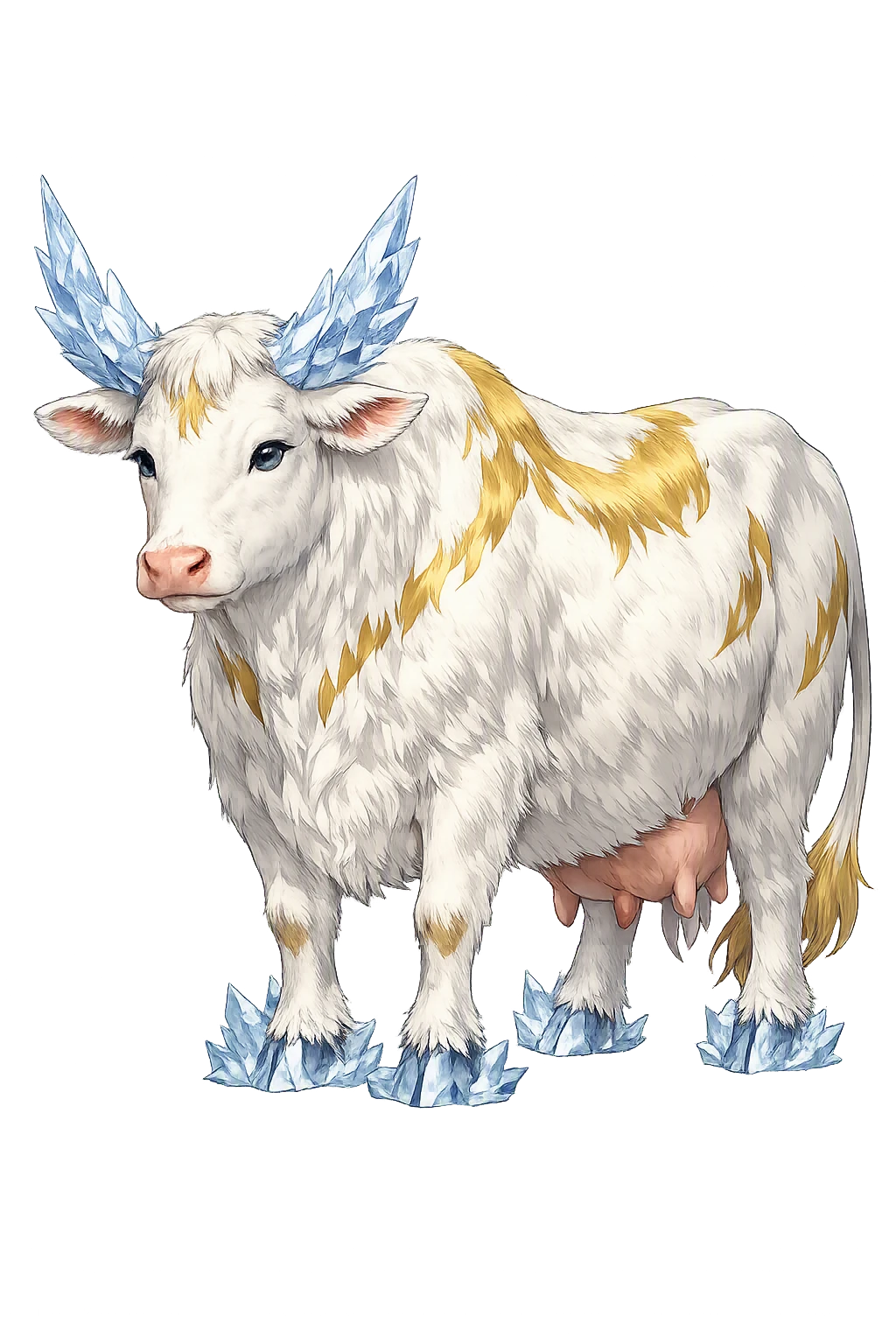
Stories of Auðhumla
Auðhumla has only one extended scene in Norse mythology, preserved in a single chapter of Snorri's Prose Edda — but it is the scene from which everything else follows: the void's first feast, and the patient tongue that frees the first god.
Snorri Sturluson tells how the rivers of Élivágar, flowing out of Niflheim, hardened into ice in the void of Ginnungagap, while sparks and molten blasts blew over it from Múspell to the south. Where the heat met the ice it melted and dripped; from the living drips in the north came Ymir, the first frost giant, and he was not alone: a second dripping formed the cow Auðhumla, her udders flowing with four rivers of milk. Ymir fed on her through the long night of the world's beginning, and she in turn fed by licking the salty stones, hoar-frosted, that stood from the rime. It is a creation with no maker — only flow, freeze, melt, and lick. The myth insists that the cosmos begins not with a word or a war but with nourishment: before anything can fight or speak, something must be fed, and before anything can be fed, something must give.
On the first day that Auðhumla licked the rime-stones, hair came forth from the stone by evening; on the second day, a head; on the third day, the whole man stood free. His name was Búri — 'the producer' — and he was tall and beautiful. Búri's son Borr married Bestla, daughter of the giant Bǫlþorn, and she bore Óðinn, Vili, and Vé. Snorri's genealogy is deliberate: the highest god of the North is the grandson of a woman of giant stock and the great-grandson of a cow's patient tongue. No sword struck here and no word was spoken; the first god entered the world through an animal's persistence, three days of licking repeated until stone became man. The myth quietly demotes every later account of power: at the very root of the Æsir lies not force but patience, the kind that returns to the same stone every morning.
Auðhumla stands at the branching point of the Norse cosmos — a nurse shared by the two enemies of the world's last day. Ymir, fed on her milk, slept and sweated out the race of frost giants, male and female, who will ride against the gods at Ragnarǫk; Búri, freed by her licking, begins the line that runs through Borr and Bestla to Óðinn, Vili, and Vé — the three who will dismember Ymir and build the world from him. The mythology never resolves this kinship of opposites, and appears not to want to: when Óðinn's brothers kill the sleeping giant, they are killing the brother of their own nurse's first charge. Norse cosmology begins, then, with a divided inheritance from a single body — plenty itself, the auðr in her name, feeding the giants it will destroy and releasing the gods who will do it. The first being in the world is a mother; the first crime in the world is committed by her foster-sons against her other children.
Honesty about the sources deepens rather than diminishes her. Auðhumla is known from a single chapter — Gylfaginning 5 — of a single work, Snorri Sturluson's Prose Edda (c. 1220); the Poetic Edda's parallel account of Ymir's origin, in Vafþrúðnismál, knows the venom-drops and the giant but never mentions the cow, and no skald calls on her name. Her entire witness is the manuscript tradition of Gylfaginning: Codex Regius (GKS 2367 4to), Codex Wormianus, Codex Trajectinus, and the Uppsala Edda. After freeing Búri she simply leaves the story — she is not killed, not honored, not even dismissed; the myth has no further use for the nurse once the nursed can stand. Modern scholarship reads in that silence something the Norse themselves may have felt: that the world's first mother belongs to a stage before narrative, when there was no one yet to tell about her.
Nourisher of Ymir and Mother of Búri
Auðhumla is the first being with a body of plenty in the Norse cosmos. While the frost giant Ymir feeds from her four streams of milk, she licks the salty rime-stones of Ginnungagap and frees Búri, the first of the gods. She is not a goddess in the usual sense but the living source from which the two lineages of the world — giant and god — draw their beginning.
From her udders flow four rivers of milk that nourish the primeval giant Ymir through the long winter of Ginnungagap.
On the first day she licks the rime, a man's hair appears; by the third day, Búri stands whole, tall, and beautiful.
She exists in the gap between Niflheim's ice and Múspell's fire, where the first life takes shape from melting rime.
Her name means "wealth-humla"; she is the cow whose body is the first feast, feeding giant-kind while releasing god-kind.
From the original script to the living URL
ᛅᚢᚦᚢᛘᛚᛅ
The name in its original Norse form. Auðhumla (ᛅᚢᚦᚢᛘᛚᛅ) is attested in the source tradition — “Wealth-humla (primeval cow)”. Its original diacritics and script distinctions carry the full phonetic and orthographic weight of the source tradition.
audhumla
Reduced to plain audhumla, the name loses everything that made it specific: original diacritics and script distinctions. What remains is an ASCII string that machines can parse but that no longer speaks with its original voice.
Auðhumla
The Unicode restoration recovers what ASCII flattened. Auðhumla restores original diacritics and script distinctions, returning the name to its original written dignity. The domain encodes to Punycode, but the browser displays the truth.
Auðhumla.com → xn--auhumla-xza.com
The non-ASCII characters in Auðhumla are encoded while the ASCII remains visible. To the DNS, it is Punycode. To humanity, it is Auðhumla.
Owned, ideal, and ASCII forms of Auðhumla
Auðhumla
Restores ᛅᚢᚦᚢᛘᛚᛅ. The live temple domain — auðhumla.com.
audhumla
Flattens ᛅᚢᚦᚢᛘᛚᛅ. The plain ASCII fallback — what DNS and legacy systems see.
How Auðhumla was spoken
How Auðhumla travels from ancient script to the modern URL
The lore you have read is the living myth. Extended Lore opens the scholarly vault beneath it: the cult and its material remains, a history of the image, the name after antiquity, a meditation on what the name still means, and the full scholarly apparatus — etymology, orthography, sources.
Enter Extended Lore