The Living Myth
Lost Island, Legendary Realm, Sea · Daughter of Atlas; the legendary lost island civilization
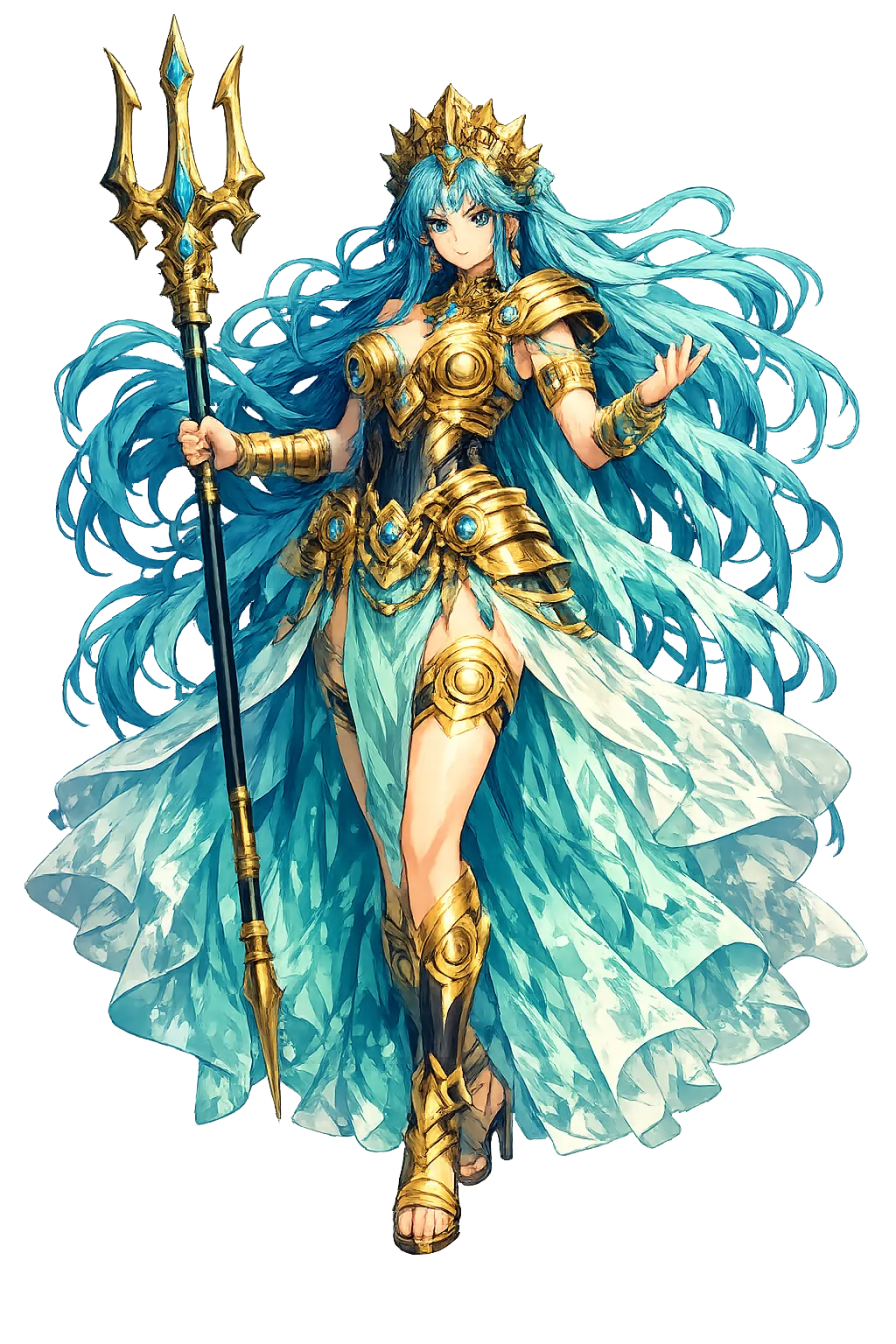
Stories of Atlantís
Atlantís is Plato's story, whether invented or adapted from older traditions. It serves as a philosophical allegory about the corruption of power and the fragility of civilization.
The story reaches us nested three layers deep. Solon, the Athenian lawmaker, visits Saïs in Egypt, and the priests there show him how young Greece's memory is: floods repeatedly wipe out the Greeks' records, while the Nile preserves Egypt's. One priest then produces a marvel: nine thousand years before Solon — a deliberate impossibility, before Athens itself existed — the city of Athens led the resistance against a great Atlantic power that had enslaved the Mediterranean as far as Egypt and Tyrrhenia, and drove it back in a single victorious stroke (Plato, Timaeus 25b–c). Atlantis, the priest says, lay beyond the Pillars of Herakles, 'larger than Libya and Asia together'. Kritias heard the tale from his grandfather, who heard it from Solon himself; Socrates, hearing it retold, is asked to imagine Athens' ancient constitution in action against the island's might.
The frame is the point: Plato hides an invented world inside a claimed memory, and dares his readers to ask which of their own certainties are merely the oldest surviving copy.
The Critias supplies what the Timaeus only sketches. Poseidon receives the island, falls in love with the mortal Kleitō, and carves the hill around her dwelling into concentric rings of land and sea — two of earth and three of water — spanned by bridges and girdled with a wall of orichalcum. Their five pairs of twin sons rule the ten kingdoms, the eldest named Atlas, who gives the island and the ocean their names. Behind the capital stretches a plain divided by a grid of canals; on the hilltop stands the temple of Poseidon and Kleitō, walled in orichalcum, roofed in ivory, and filled with gold — and inside, a gold statue of the god in a chariot drawn by six winged horses stands so tall 'his head touched the roof' (Critias 116e–117a).
For generations the kings keep the divine portion of their law inscribed on the temple's orichalcum pillars; then the admixture of mortality thickens, and the very wealth Plato has just finished cataloguing begins to rot the virtue that built it.
The decline takes one generation past the tipping point: the kings of Atlantis, 'filled with lawless ambition and power', resolve to enslave the whole Mediterranean, the Greeks included. Zeus, 'god of gods, who rules by law', convenes the divine council, and in a speech unique in Plato — the supreme god speaking like a lawgiver — he rehearses the case against the island: 'when the divine part in them became enfeebled and the human got the upper hand, they could no longer bear their good fortune' (Critias 121a–b). Then the sentence falls, as the Timaeus (25c–d) records it: 'there were earthquakes and floods of extraordinary violence, and in a single dreadful day and night all your fighting men were swallowed up by the earth, and the island of Atlantis was similarly swallowed up by the sea and vanished.'
Only a shoal of mud marked the sea where an empire had been. The myth's terror is its brevity: a civilization ends inside one sentence, in one day, leaving shoals through which no ship could pass.
The Critias stops mid-sentence. Zeus has risen to pronounce judgment, 'wishing to punish them and so bring them to their senses' — and the manuscript simply ends, whether Plato abandoned the dialogue or it was lost. Antiquity felt the truncation: Strabo (2.3.6) records the skeptical tradition that Plato invented the tale as a lesson and reports Aristotle's quip — the man who dreamed it up also sank it. Theopompos of Chios answered Plato with deliberate parody within a generation: his Meropis, preserved by Aelian (Varia Historia 3.18), describes a continent beyond the ocean whose people live twice as long as we do and where a great war nearly crossed the sea — Atlantis told as satire, barely after Plato's death.
The unfinished ending became the story's engine: every age since has tried to complete the sentence, and none has managed it — which may be exactly the lesson Plato intended.
Atlantís is the legendary island civilization described by Plato, a powerful naval empire that angered the gods and sank beneath the waves in a single day and night. It is the archetype of the golden age destroyed by its own ambition.
A ringed island beyond the Pillars of Herakles, rich in metals, timber, and fertile soil.
Its fleet dominated the Mediterranean until Athens led a resistance of free Greeks.
Its kings grew greedy and impious; Zeus punished them with earthquakes and floods.
Sank beneath the Atlantic, becoming the template for every lost-civilization legend.
From the original script to the living URL
Ἀτλαντίς
The name in its original Greek form. Atlantís (Ἀτλαντίς) is attested in the source tradition — “Daughter of Atlas; the legendary lost island civilization”. Its acute accents carry the full phonetic and orthographic weight of the source tradition.
atlantis
Reduced to plain atlantis, the name loses everything that made it specific: acute accents. What remains is an ASCII string that machines can parse but that no longer speaks with its original voice.
Atlantís
The Unicode restoration recovers what ASCII flattened. Atlantís restores acute accents, returning the name to its original written dignity. The domain encodes to Punycode, but the browser displays the truth.
Atlantís.com → xn--atlants-dza.com
The non-ASCII characters in Atlantís are encoded while the ASCII remains visible. To the DNS, it is Punycode. To humanity, it is Atlantís.
Owned, ideal, and ASCII forms of Atlantís
Atlantís
Restores Ἀτλαντίς. The live temple domain — atlantís.com.
atlantis
Flattens Ἀτλαντίς. The plain ASCII fallback — what DNS and legacy systems see.
How Atlantís was spoken
How Atlantís is preserved in writing
A bespoke provenance study for Atlantís is being prepared by the PUNICODEX scholarly team.
Contribute scholarly provenance →The lore you have read is the living myth. Extended Lore opens the scholarly vault beneath it: the cult and its material remains, a history of the image, the name after antiquity, a meditation on what the name still means, and the full scholarly apparatus — etymology, orthography, sources.
Enter Extended Lore