The Living Myth
Wisdom, War Strategy, Crafts · The Grey-Eyed Strategist · Patron of Athens
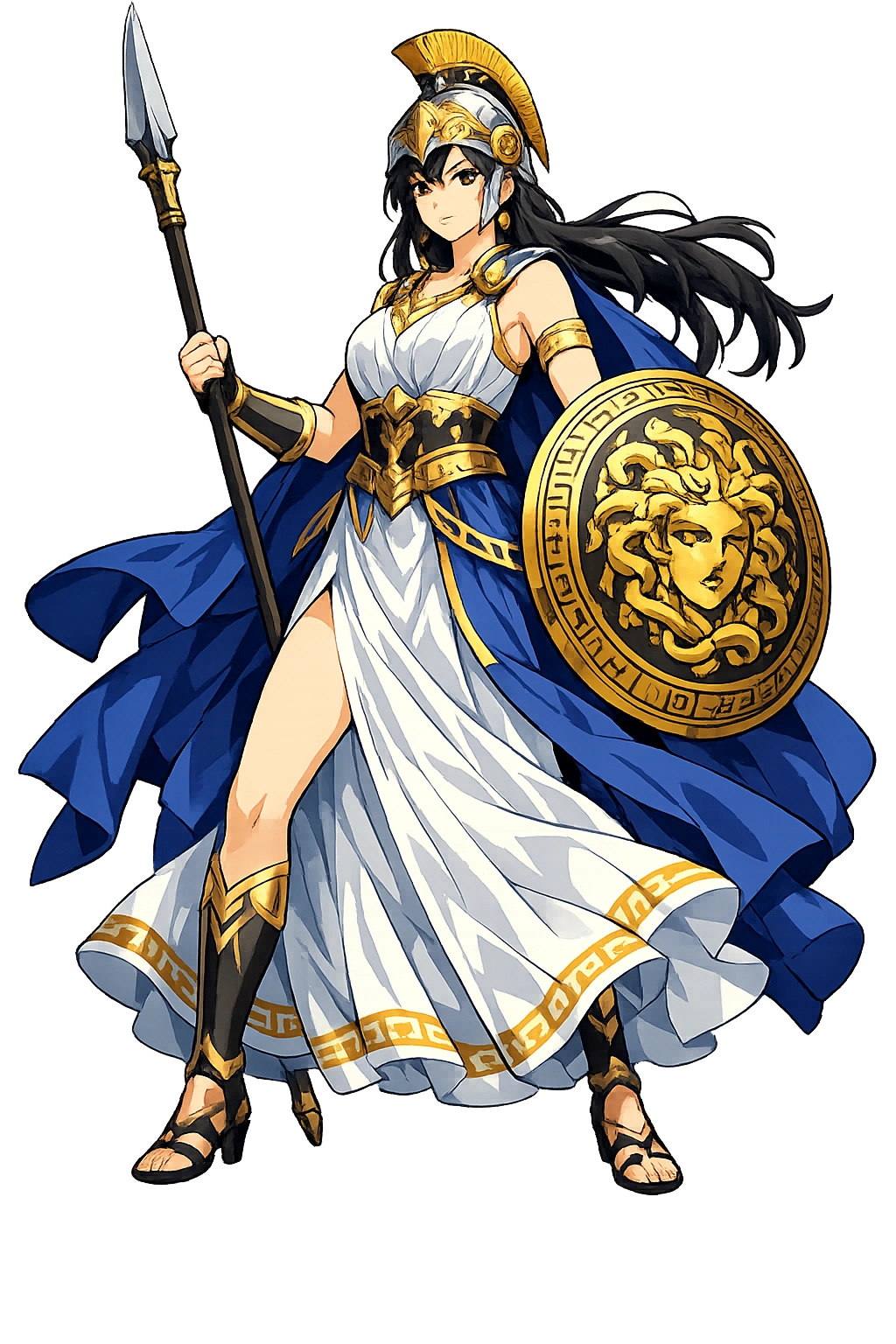
Stories of Athēnâ
Athénā's myths center on intelligence overcoming force. She is born from Zeus's head fully armed, defeats Poseidôn by gift rather than combat, and guides the heroes who win by cunning. Wherever she appears, calculation replaces rage.
Zeus, warned by Earth and starry Heaven that a son born to his first wife Mêtis — 'wisest among gods and mortal men' — would overthrow him, swallowed the pregnant goddess whole, a solution Hesiod calls Zeus's equal in cunning (Theogony 886–900, 924–929). The child, however, was a daughter. One day Zeus suffered a splitting headache, and the craftsman god — later sources name Hephaistos, some say Prometheus, the axe-stroke varies in the telling — cleft his skull, and Athena sprang forth 'from his immortal head,' fully armed, shaking a sharp spear, her cry so mighty that all heaven trembled (Theogony 924ff.; cf. Pindar, Olympian 7.35ff.; Homeric Hymn 28). She is thus the only Olympian with no mother in the ordinary sense: intelligence born directly from the sovereign mind, carrying both his cunning and the aegis that is his own. The myth makes her genesis an allegory — wisdom is what sovereignty produces when it swallows its own rival.
Poseidon and Athena contested the land of Attica, and each gave the city a token: the sea god struck the rock of the Acropolis with his trident and a salt spring gushed forth (the mark was still shown in the Erechtheion in Pausanias's day); Athena planted the first olive tree, and Cecrops, the earth-born first king, judged her gift the better — food, oil, and firewood where the spring gave only brine (Pseudo-Apollodorus, Bibliotheca 3.14.1; Herodotus 8.55; Pausanias 1.24.5). Poseidon raged and flooded the Thriasian plain until the Athenians appeased him with honors — the joint shrine in the Erechtheion enshrines both tokens under one roof, a treaty in architecture. The Athenians told the story as their civic charter: the city chose the useful, the cultivated, the peaceable gift over the display of raw power. Civilization is the prize of a contest decided by judgment, not force.
The mortal girl Arachnê of Colophon — Ovid is our fullest teller, drawing on Greek sources now lost — was so fine a weaver that nymphs came to watch her, and when Athena herself descended in the guise of an old woman to warn her against rivaling the gods, Arachnê challenged the goddess outright. The contest they wove on adjacent looms is described in matching tapestries: Athena depicted the gods enthroned in glory and, in the corners, mortals struck down for hubris; Arachnê depicted the gods' own scandals — Zeus as a bull, as a shower of gold, as a swan — flawless work, and impious (Ovid, Metamorphoses 6.5–145). Three times Athena struck the web; then Arachnê, in shame, hanged herself, and the goddess in reluctant pity transformed her into the spider, weaver forever. The myth's edge is exact: skill without reverence is hubris, and hubris is punished even when it wins.
Athena's favorite mortal is the man 'of many turns,' and their partnership spans the Odyssey from beginning to end. She champions his return in the divine council (Odyssey 1.44–62), guides his steps invisibly, disguises him as a beggar on Ithaca, stands by his side through the slaughter of the suitors, and finally reconciles him to his people when vengeance threatens civil war (Odyssey 24.472–548). The pattern holds in the Iliad: it is Athena who restrains Achilles' hand and later drives his spear home against Hector, and who guides Diomedes' aristeia until the hero wounds Aphrodite and Ares themselves (Iliad 5.1–143, 846–909). Her bond with Odysseus is the closest thing in Greek myth to a partnership between human and divine intelligence — she loves him, the poem says, because 'he is so like-minded' with her. Wisdom does not replace effort; it steadies and crowns it.
When Polydectes of Seriphos demanded the head of Medousa as a gift, Athena herself equipped the young Perseus for the impossible task, directing him to the Graiai and arming him with the polished shield in which he could watch the Gorgon's reflection without turning to stone (Pseudo-Apollodorus, Bibliotheca 2.4.2–3; Hesiod, Theogony 280 names Athena as guide of the hand that struck). From Medousa's severed neck sprang the winged horse Pegasos and the giant Chrysaor; Athena received the Gorgon's head and set it on her aegis, where its petrifying stare became the guardian of cities and the terror of Troy's fields. The motif recurs across her mythology: she arms the mortal, lends the shield, dictates the tactic — Perseus slays, Bellerophon rides, Heracles finishes the Hydra — but the plan is hers. Athena's warfare is the intelligence that makes force unnecessary, then supervises it anyway.
Wisdom, Warcraft, Crafts, and Civilization
Athénā is unique among the Olympians: a warrior who fights only for just causes, a virgin goddess who needs no consort to validate her power, and the patron of the practical arts that make city life possible. She is intelligence made divine.
She favors counsel, discipline, and defensive battle over the berserk fury of Árēs; heroes like Odysseus and Diomedes fight under her sign.
The mind that sees all sides; her advice is practical, ethical, and far-sighted.
Patron of weaving, pottery, carpentry, and olive cultivation — the technologies that sustain the polis.
Polias and Poliouchos: the goddess who protects the citadel and whose olive tree marks the land.
From the original script to the living URL
Ἀθηνᾶ
The name in its original Greek form. Athēnâ (Ἀθηνᾶ) is attested in the source tradition — “Unknown; possibly pre-Greek”. Its aspirated consonants, long vowels, and acute accents carry the full phonetic and orthographic weight of the source tradition.
athena
Reduced to plain athena, the name loses everything that made it specific: aspirated consonants, long vowels, and acute accents. What remains is an ASCII string that machines can parse but that no longer speaks with its original voice.
Athēnâ
The Unicode restoration recovers what ASCII flattened. Athēnâ restores aspirated consonants, long vowels, and acute accents, returning the name to its original written dignity. The domain encodes to Punycode, but the browser displays the truth.
Athēnâ.com → xn--athn-eoa60a.com
The non-ASCII characters in Athēnâ are encoded while the ASCII remains visible. To the DNS, it is Punycode. To humanity, it is Athēnâ.
Owned, ideal, and ASCII forms of Athēnâ
Athēnâ
Restores Ἀθηνᾶ. The live temple domain — athēnâ.com.
Athēnā
Restores Ἀθηνᾶ. A second live spelling — athēnā.com.
athénā
Restores Ἀθηνᾶ. A second live spelling — athénā.com.
athena
Flattens Ἀθηνᾶ. The plain ASCII fallback — what DNS and legacy systems see.
How Athēnâ was spoken
How Athēnâ travels from ancient script to the modern URL
Greek Ἀθήνα; the etymology is unknown and possibly pre-Greek. A traditional folk-etymology connects it with Ἀθήνη “mind, craft".
Wisdom, War Strategy, Crafts
The Unicode restoration Athénā preserves Greek stress and length; the ASCII form athena loses these features.
The lore you have read is the living myth. Extended Lore opens the scholarly vault beneath it: the cult and its material remains, a history of the image, the name after antiquity, a meditation on what the name still means, and the full scholarly apparatus — etymology, orthography, sources.
Enter Extended Lore