PuniCodex

Extended Lore

Ἀθηνᾶ Athēnâ

Etymology · Orthography · Cult · Iconography · Reception · Sources

Tier 1 Athēnâ.com · Athēnā.com · athénā.com
Athēnâ — Wisdom, War Strategy, Crafts
01

Quick Facts

Essential information about Athēnâ, Wisdom, War Strategy, Crafts

Original ScriptἈθηνᾶ
Unicode RestorationAthēnâ
Reconstructed Pronunciation/a.tʰɛː́.naː/
PantheonGreek
DomainWisdom, War Strategy, Crafts
MeaningUnknown; possibly pre-Greek
ClassificationTier 1
Primary DomainAthēnâ.com
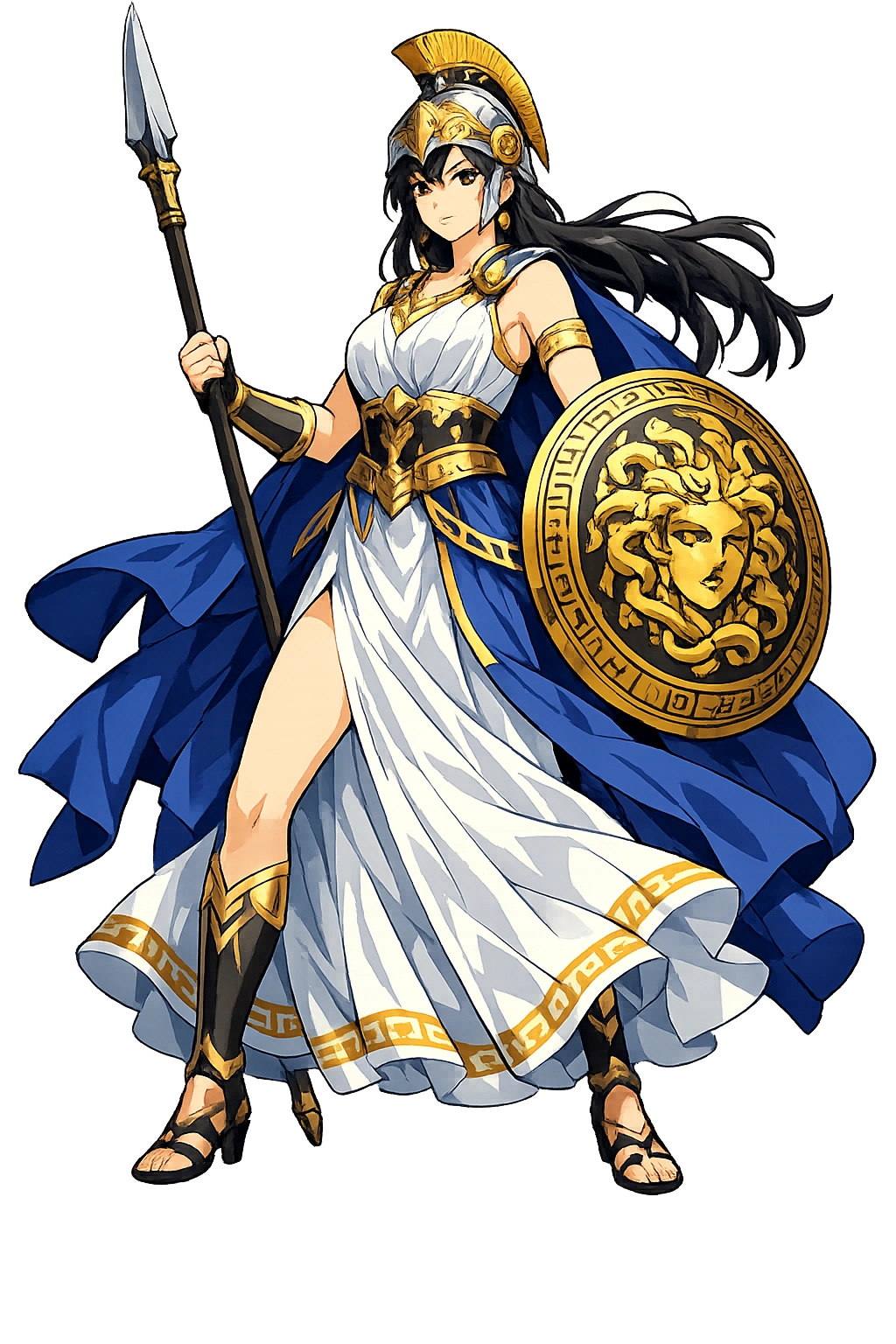
Sacred SymbolsOwl, Olive tree, Aegis, Helmet and spear, Gorgoneion
02

Etymology & Word Family

From original script to Unicode restoration

Proto-indo-european *h₂erǵ- to shine, white, silver
Original Script Ἀθηνᾶ Athēnâ — "Unknown; possibly pre-Greek"
Unicode Restoration Athēnâ Restored stress, length, and script
Modern ASCII athena Plain-ASCII fallback

Pre-Greek or from Ἀθήνη; possibly from *h₂erǵ- "shining" or Luwian deity. The owl goddess.

03

Unicode Character Breakdown

Character-by-character philological analysis

CharacterUnicodeNameBlockPhonetic Role
AU+0041Latin Capital Letter ABasic LatinSame, capitalized
tU+0074Latin Small Letter TBasic LatinSame
hU+0068Latin Small Letter HBasic LatinSame
ēU+0113Latin Small Letter E with MacronLatin Extended-AMacron: long eta
nU+006ELatin Small Letter NBasic LatinSame
âU+00E2Latin Small Letter A with CircumflexLatin-1 SupplementCircumflex: stress + length on the contracted final alpha (Ἀθηνᾶ)

The Tier 1 classification reflects how much of the original phonology this restoration preserves — stress and vowel length for Greek names, distinctive letters and diacritics for every other tradition.

04

Cult & Worship

How the sacred was kept — rites, sanctuaries, remains

The Cult

Athens was her city and the Acropolis her house. The Erechtheion sheltered the archaic olive-wood xoanon of Athena Polias, the city's ancient palladium; every fourth year the Great Panathenaea clothed it in a new peplos woven under the goddess's own roof and carried it in procession past the Parthenon — the frieze shows the gods receiving it. Her calendar ran all year: the Chalkeia opened the weaving, the Plynteria washed the old statue, and the Lesser Panathenaea repeated the games annually. Two young arrēphoroi served her in rites kept secret, and her priestess of Polias held one of Athens's most prestigious religious offices for life. Beyond Attica her cult filled Lindos, Sparta's bronze-house Chalkioikos, Priene, and Ilion, and the Panathenaic prize amphorae bearing her armed figure reached every Greek shore.

In the Earth

The Athenian Acropolis is her monument: the Parthenon (447–432 BCE) housed Phidias's colossal chryselephantine Athena Parthenos, known to us through ancient descriptions and the Varvakeion statuette copy; the Erechtheion preserved her olive tree, Poseidon's salt spring mark, and the archaic xoanon of Athena Polias dressed in the peplos; the little Ionic temple of Athena Nike guarded the citadel's approach. Phidias's bronze Athena Promachos stood between Propylaia and Parthenon for a thousand years. Every Panathenaic year, the prize amphorae of olive oil carried her armed image to victors across the Greek world — thousands survive. Beyond Athens, the temple of Athena Alea at Tegea (with pediments by Scopas), the archaic sanctuary at Lindos on Rhodes, and the great Hellenistic temples at Priene and Syracuse attest a civic cult older than the polis itself.

05

Iconography

How Athēnâ was imaged across the ages

The Image

The Greeks never doubted how to recognize Athena: helmet, snake-fringed aegis centered by a gorgoneion, spear, shield, and the owl at her side. Her two monumental types came from one artist. Phidias's gold-and-ivory Parthenos (438 BCE) stood nearly twelve meters tall, Nike in her palm, a serpent at her spear; the Varvakeion statuette in Athens and Roman copies carry the type today. His bronze Promachos towered between Propylaia and Parthenon for a thousand years, a landmark for sailors rounding Cape Sounion. Earlier, the Promachos of coins strides with brandished spear; in later Hellenistic and Roman art she rests on her spear and leans, pensive — the Giustiniani type in the Vatican. Her birth survives at full height in the east pediment of the Parthenon (British Museum).

06

Reception & Transformation

The name after its own age — transmission, translation, survival

Afterlives

Athena's journey ran through Rome and Byzantium side by side. As Minerva she entered the Capitoline triad; Martianus Capella's fifth-century De nuptiis made her divine wisdom for a thousand years of medieval schools, and Fulgentius and the Vatican Mythographers passed her story into the Latin Middle Ages. The Renaissance recovered her in the round — Botticelli's Minerva and the Centaur (Uffizi) re-staged her legend — and iconographers from Ripa to Cartari fixed her attributes for courtly emblem books. Scholarship then made and remade her image: Furtwängler's Athena Lemnia attribution (1891) turned connoisseurship into a modern discipline, and the Parthenon marbles, removed to London by Elgin from 1801, became the contested centerpiece of Western museums. The epic character behind her survives in the tenth-century Venetus A and other Byzantine codices of Homer, and her name never stopped working in Greek — Athēnē, the city Athens, and the proverbial 'owls to Athens' keep her present in the language.

Identifications Across Traditions

The Romans identified Athénā with Minerva, a goddess already associated with crafts and strategy, so the equation was unusually smooth; Minerva's temple on the Capitoline housed the guilds of artisans. In Egypt she was equated with Neith, the warrior-weaver goddess of Sais — Plato's Socrates remarks on the coincidence (Timaeus 21e) — and Hellenistic Jews identified her with Sophia, divine Wisdom. During the Renaissance she became the emblem of rational virtue and of learned institutions; in modern Athens she remains the namesake and symbol of the city, her helmeted head on coins and seals. The Parthenon, her temple, is the canonical image of Classical Greece and of ordered reason everywhere.

Modern Legacy

Athénā is the divine patron of everything the Greeks most valued in civic life: wisdom, craft, disciplined courage, and strategic thought. The Athenian democracy claimed her protection; the Panathenaea, her great festival, processed the new peplos woven for her statue through the city, and the Parthenon frieze still shows it. In philosophy she became the emblem of reason; in art the model of dignified female power. Her owl, her olive, and her helmet remain instantly recognizable symbols of classical civilization, and her name crowns universities, academies, and a capital city. Restoring Athénā preserves the name under which the world's first democracy invoked its guiding intelligence.

07

The Meditation

What Athēnâ means — beyond the dictionary

Athénā is the goddess of the well-aimed blow — not merely in war, but in speech, craft, and thought. She does not rage; she calculates. She does not seduce; she advises. Her virginity is not a lack but a statement: her power is complete in itself, needing no alliance with masculinity to be effective.

In an age that often confuses intelligence with cleverness and power with dominance, Athénā offers a different model. She is strong because she is skilled, just because she is wise, and feared because she is right. The restoration of her name in Unicode is a small act of recognition: that wisdom, no less than beauty or wrath, deserves its original voice.

08

Screen & Culture

Where Athēnâ echoes through film, television, and games — and how

09

Frequently Asked Questions

Common questions about Athēnâ, Wisdom, War Strategy, Crafts, and Unicode restoration

01How do you pronounce Athēnâ?

In reconstructed pronunciation, Athēnâ is /a.tʰɛː́.naː/ — approximately 'ah-THAY-na' — the second syllable is pitched higher and drawn out; the final 'a' is long and pure.

02What does Athēnâ mean?

Athēnâ means Unknown; possibly pre-Greek in the greek tradition.

03What are the symbols of Athēnâ?

Athēnâ is associated with Owl (The night-eyed bird that sees through darkness — wisdom watching over the city; 'owl to Athens' was proverbial for something native and abundant), Olive tree (Her victory over Poseidon in the contest for Attica: food, oil, and wood in a single plant; the 'contest olive' on the Acropolis was shown to visitors into late antiquity), Aegis (The goatskin fringed with serpents and bearing the Gorgoneion, worn by Zeus and lent to Athena; at Troy it routs armies (Iliad 2.446–449)), Helmet and spear (Her warrior identity — always disciplined, defensive, and allied with just causes, never berserk), Gorgoneion (The apotropaic head of Medousa on her breastplate or aegis; the dead face that turns enemies to stone).

04Why are there different spellings of Athēnâ?

Each form is a historically attested restoration rather than a mistake: Athēnā is the macron-only form (LSJ convention: length only, no acute on epsilon). PUNICODEX registers the full set so the tradition is preserved under every defensible spelling.

05Why restore Athēnâ in Unicode?

Plain ASCII athena strips the stress, length, and script that make the name specific. Unicode restoration returns the name to its original written dignity.

06What is the most important myth about Athēnâ?

“Born from the Head of Zeús” — the The Birth story that anchors the mythology of Athēnâ, told in full on the lore page.

10

Scholarly Sources

The philological foundations of this restoration

Every claim on this page is grounded in established scholarship. The orthographic restorations follow disciplinary convention. The etymological chain follows the best available reference works. This is not invention — it is resurrection through scholarship.

◈

Lexicography & Philology

  • Liddell, H. G., Scott, R., & Jones, H. S. A Greek-English Lexicon. Oxford: Clarendon Press, 9th ed. 1996.
  • Pape, W., & Benseler, G. E. Wörterbuch der griechischen Eigennamen. Braunschweig: Vieweg, 1884.
  • Beekes, R. S. P. Etymological Dictionary of Greek. Leiden: Brill, 2010.
◎

Primary Texts

  • Hesiod, Theogony 886–929
  • Homer, Iliad 5; Odyssey 1 and 24
  • Ovid, Metamorphoses 6.5–145
  • Pseudo-Apollodorus, Bibliotheca 2.4 and 3.14
  • Pausanias, Description of Greece 1.24
  • Pindar, Olympian 7.35ff.
◉

Archaeology & Art History

  • Material evidence — iconography, inscriptions, and temple archaeology — for Athēnâ and related cults.
✦

Religious Studies

  • Comparative studies of greek religion and the place of Athēnâ within it.
Return

The Surface Awaits

You have traced the name from its earliest attestation to its Unicode restoration. Now return to the myth. The story is where the name lives.

Back to Lore
Athēnâ mascot