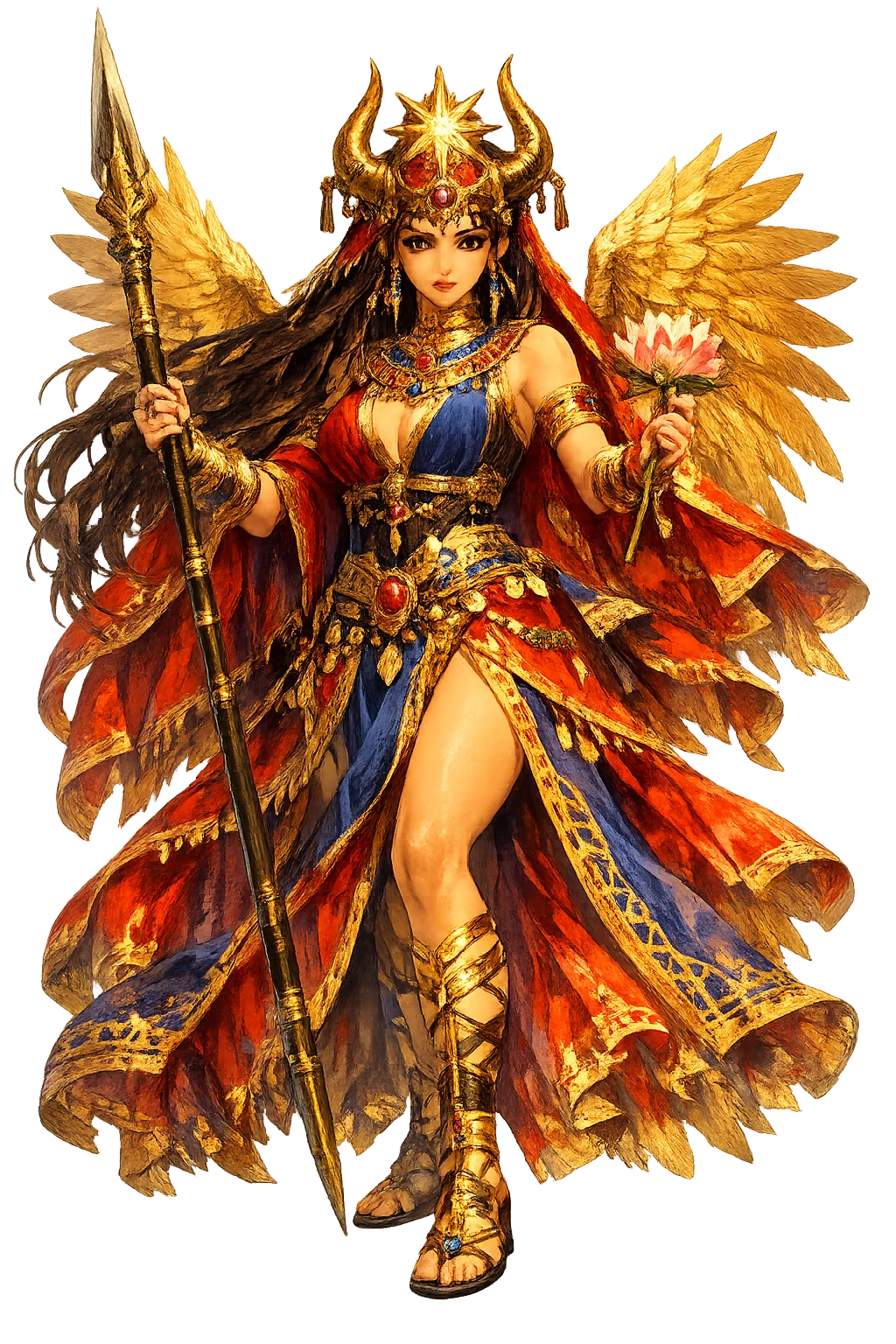
Stories of Aštart
Aštart's mythology is more dispersed than centralized. She appears in Ugaritic texts as a huntress and member of Ēl's household, but her full fame comes from Phoenician, Egyptian, and later Greco-Roman cult. She is the goddess who crosses borders as easily as the Phoenician ships that carried her.
KTU 1.92 is the only Ugaritic literary text in which Aštart is the protagonist, and it is short and partly broken. The goddess arms herself and goes out into the šd, the open country, where she hunts and fells game; she then returns to serve the meat at the table of her father Ēl and of Yarikh, the moon god. Johannes de Moor's edition titled it Athtartu the Huntress, and it remains the clearest window on her Ugaritic personality — not yet the queen of a great city cult, as she would become at Sidon, but a divine huntress of the wilderness, a goddess of the between places where game runs and boundaries blur. The text has been connected with the ritual hunt known from Emar on the Euphrates, suggesting a seasonal rite lay behind the poem. Even in fragments the figure is vivid: the armed maiden of the steppe, bringing home the kill for the high god's table.
In KTU 1.114 — the tale of Ēl's drunken banquet — Aštart appears at the high god's table alongside ꜥAnat, her constant companion in the Ugaritic sources. The two goddesses are the most animated members of Ēl's household: they feast, they stagger home with the incapacitated father of gods, and they share his appetite and his lack of ceremony. The scene is comic, but the pairing is theologically pointed. Where later traditions split the dangerous feminine into separate deities — a love goddess here, a war goddess there — Ugarit kept Aštart and ꜥAnat together as sister powers, appetite and ferocity dining at the same table. Both are called btlt, 'maiden'; both refuse the settled roles of wife and mother. The household of Ēl — the Bible's arch-foe — is here simply a family: loud, tipsy, and fond of its unruly daughters.
Aštart's Phoenician career turned her into a civic sovereign. At Sidon she presided over one of the Levant's greatest sanctuaries, honored in royal inscriptions from the ninth century onward; at Tyre she stood beside Melqart as the city's divine pair. Her title Queen of Heaven — mlkt šmym — became so beloved that it outlived her cult: in Jeremiah 44, Jewish refugees in Egypt tell the prophet to his face that their wives, daughters, and they themselves have kept baking cakes for the Queen of Heaven, 'as we and our ancestors... did in the towns of Judah.' Farther west, the gold tablets of Pyrgi record a joint dedication of the Caeretan sanctuary to Uni — usually identified with Aštart — and the local king. Her cult traveled Phoenician trade routes from Carthage to Kition to Sicily, making her one of the most widely worshipped goddesses of the first millennium BCE.
New Kingdom Egypt adopted the Levantine goddess with enthusiasm. From the reign of Amenhotep II onward, Aštart — ꜥa-set-ir-ti — appears as a goddess of horses and chariotry, shown with the naked body, Hathoric wig, and raised scimitar of the Asiatic war goddess, protecting the pharaoh in his chariot and trampling his enemies. At Tanis and Memphis her cult flourished; Ramesside tradition could identify her with the leonine Sakhmet, and her image spreads across Delta scarabs and temple reliefs. A late Egyptian tale — the so-called Astarte Papyrus, its leading women nameless in what survives — dramatizes the Sea's demand for tribute from the gods, a plot scholars have long compared with the Ugaritic Baꜥal Cycle; whether Aštart stood at its center is debated. Either way, the papyrus shows how deeply her mythic world had been naturalized on the Nile by the end of the Bronze Age.
Love, War, Fertility, and the Morning Star
Aštart is the Phoenician Venus — a goddess in whom love and war are not opposites but twin faces of the same radiant power. She is 'she of the womb,' the planet Venus as deity, and the Queen of Heaven invoked by women across the Levant. In Ugarit she stands just behind ꜥAnat in the warrior-huntress pair; in Phoenicia and Egypt she becomes one of the most widely traveled goddesses of antiquity.
The morning and evening star; her celestial body marks the boundaries between day and night, human and divine.
She governs sexual attraction, fertility, and the life-giving power of the womb; her cult emphasized renewal.
KTU 1.92 casts her as a huntress in the wilderness; in Egypt she rides chariots and battles enemies beside the king.
The title invoked by Jewish women in Egypt (Jeremiah 44) and by Phoenician devotees across the Mediterranean.
From the original script to the living URL
𐤏𐤔𐤕𐤓𐤕
The name in its original Phoenician form. Aštart (𐤏𐤔𐤕𐤓𐤕) is attested in the source tradition — “She of the womb. The planet Venus as deity. Queen of heaven.”. Its original diacritics and script distinctions carry the full phonetic and orthographic weight of the source tradition.
astart
Reduced to plain astart, the name loses everything that made it specific: original diacritics and script distinctions. What remains is an ASCII string that machines can parse but that no longer speaks with its original voice.
Aštart
The Unicode restoration recovers what ASCII flattened. Aštart restores original diacritics and script distinctions, returning the name to its original written dignity. The domain encodes to Punycode, but the browser displays the truth.
Aštart.com → xn--atart-vdb.com
The non-ASCII characters in Aštart are encoded while the ASCII remains visible. To the DNS, it is Punycode. To humanity, it is Aštart.
Owned, ideal, and ASCII forms of Aštart
Aštart
Restores 𐤏𐤔𐤕𐤓𐤕. The live temple domain — aštart.com.
astart
Flattens 𐤏𐤔𐤕𐤓𐤕. The plain ASCII fallback — what DNS and legacy systems see.
How Aštart was spoken
How Aštart travels from ancient script to the modern URL
Phoenician ʿAštart is the Venus-goddess and queen of heaven; the name is related to Akkadian Ištar and South Arabian ʿAttar.
Love, War, Fertility, Venus
The Unicode restoration Aštart supplies registrable vowel diacritics; the Phoenician consonantal form is not registrable in .com.
The lore you have read is the living myth. Extended Lore opens the scholarly vault beneath it: the cult and its material remains, a history of the image, the name after antiquity, a meditation on what the name still means, and the full scholarly apparatus — etymology, orthography, sources.
Enter Extended Lore