PuniCodex

Extended Lore

𐤏𐤔𐤕𐤓𐤕 Aštart

Etymology · Orthography · Cult · Iconography · Reception · Sources

Tier 1 Aštart.com
Aštart — Love, War, Fertility, Venus
01

Quick Facts

Essential information about Aštart, Love, War, Fertility, Venus

Original Script𐤏𐤔𐤕𐤓𐤕
Unicode RestorationAštart
Reconstructed Pronunciation/ʔaʃ.taːrt/
PantheonPhoenician
DomainLove, War, Fertility, Venus
MeaningShe of the womb. The planet Venus as deity. Queen of heaven.
ClassificationTier 1
Primary DomainAštart.com
Sacred SymbolsDove, Lion, Horse and chariot, Pomegranate
02

Etymology & Word Family

From original script to Unicode restoration

Proto-semitic *ʿaṯtart- goddess of love, war, Venus
Original Script 𐤏𐤔𐤕𐤓𐤕 Aštart — "She of the womb. The planet Venus as deity. Queen of heaven."
Unicode Restoration Aštart Restored stress, length, and script
Modern ASCII astart Plain-ASCII fallback

The Phoenician theonym continues Common Semitic *ʿAṯtart-, reflected in Ugaritic ʿAṯrt, Akkadian Ištar, and Hebrew ʿAštōreṯ; it is associated with the planet Venus.

03

Unicode Character Breakdown

Character-by-character philological analysis

CharacterUnicodeNameBlockPhonetic Role
AU+0041Latin Capital Letter ABasic LatinSame, capitalized
šU+0161Latin Small Letter S with CaronLatin Extended-ACaron marks voiceless postalveolar fricative /ʃ/
tU+0074Latin Small Letter TBasic LatinSame
aU+0061Latin Small Letter ABasic LatinSame
rU+0072Latin Small Letter RBasic LatinSame
tU+0074Latin Small Letter TBasic LatinSame

The Tier 1 classification reflects how much of the original phonology this restoration preserves — stress and vowel length for Greek names, distinctive letters and diacritics for every other tradition.

04

Cult & Worship

How the sacred was kept — rites, sanctuaries, remains

The Cult

Aštart received civic and funerary cult across the Phoenician Mediterranean. Sidon, Tyre, and Kition left dedicatory inscriptions naming her as queen of heaven, while the Carthage tophet preserves the ash-and-urn context in which she was invoked alongside child-vow rituals. In Egypt she was worshipped as a chariot warrior and horse goddess from the New Kingdom onward, attested in reliefs and bronze statuettes from Tanis, Memphis, and Pi-Ramesses. The Pyrgi gold tablets record a joint dedication to Uni-Aštart at Caere’s port sanctuary, binding Etruscan and Punic cult calendars. Ugaritic KTU 1.92 casts her as a divine huntress, but no standing temple at Ugarit has been securely identified as hers. No continuous modern pilgrimage exists, though her Punic and Etruscan junctions are studied as evidence of inter-city religion.

In the Earth

Ugaritic KTU 1.92 casts her as a huntress in alphabetic cuneiform, while Phoenician inscriptions from Sidon, Tyre, Kition, and the Carthage tophet invoke her as a civic and funerary goddess. In Egypt, New Kingdom reliefs and statuettes from Tanis, Memphis, and Pi-Ramesses present her as a chariot warrior and horse goddess. The Pyrgi gold tablets record a joint dedication to Uni/Aštart, and the Karatepe bilingual names her alongside Baʿal.

05

Iconography

How Aštart was imaged across the ages

The Image

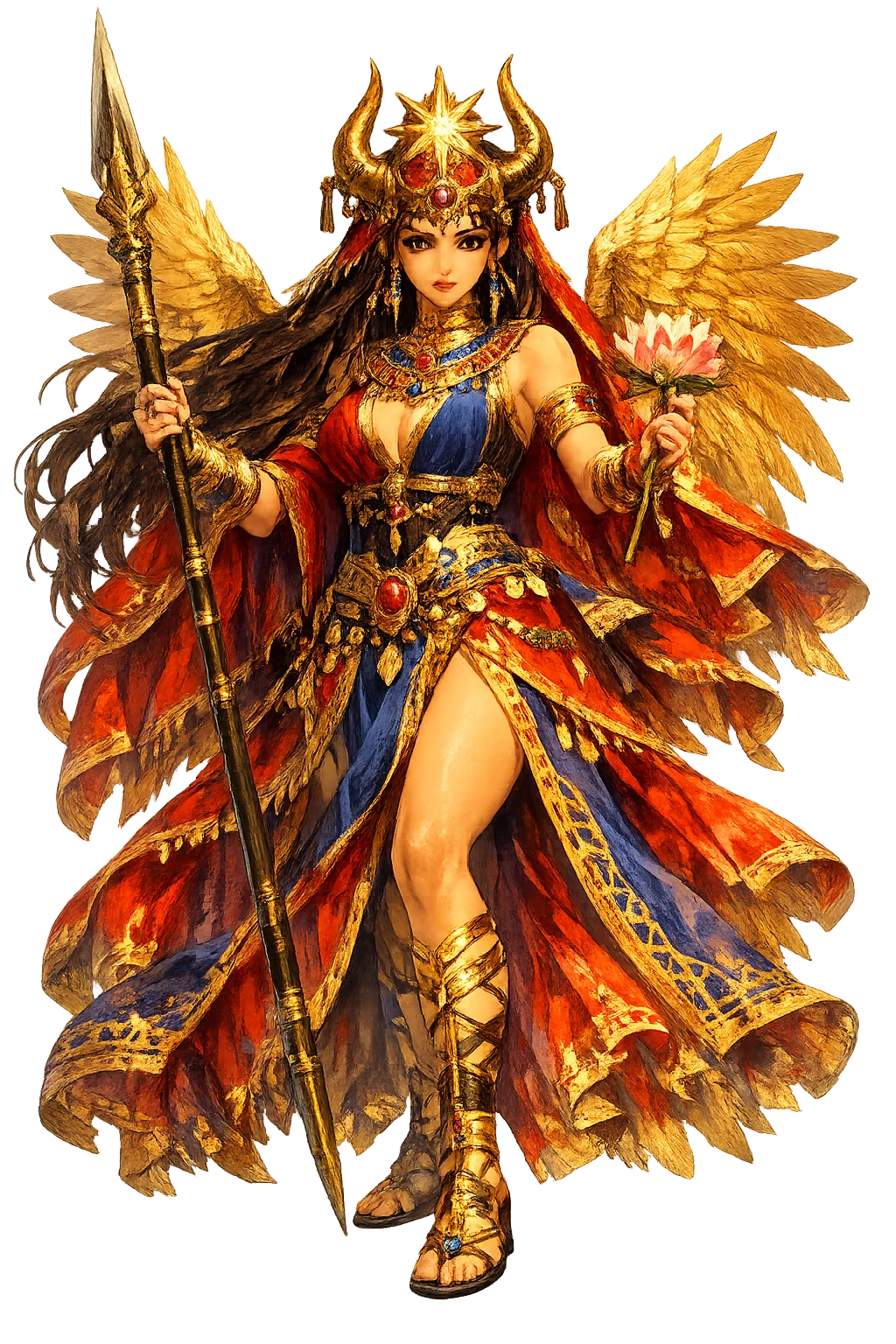
Aštart’s imaging shifts between Levantine, Egyptian, and Punic conventions. In Phoenicia she appears as a nude or robed goddess, sometimes framed by Hathoric curling wigs and lotus flowers, on terracotta plaques and ivory inlays from Sidon and Tyre. Egyptian artists rendered her as a chariot-warrior in bronze and faience, often armed with bow and shield, or as a horse goddess crowned with the Atef plumes borrowed from Osiris. Coins of Kition and other Cypriot mints show her standing beside a palladion or holding a flower, signaling her assimilation to Aphrodite. No comprehensive ancient statue cycle survives, and medieval illumination is absent, but modern Levantine nationalist art has revived her as a symbol of Phoenician identity.

06

Reception & Transformation

The name after its own age — transmission, translation, survival

Afterlives

The name Aštart traveled westward as Astarte, carried by Phoenician colonies and Greek translators into the Hellenistic Mediterranean. Greek writers from the fifth century BCE onward identified her with Aphrodite and Artemis, while the Hebrew Bible condemned her as Ashtoreth, a foreign rival to Yahweh, ensuring her survival in Jewish, Christian, and Islamic exegetical memory. Roman North Africa kept her Punic epithets on stelae until late antiquity, after which her temples were either reused for church building or quarried. Renaissance scholars rediscovered her through Pyrgi and Karatepe inscriptions only in the modern era; nineteenth-century philology and art—most influentially in the French Orientalist revival—recast her as a voluptuous eastern goddess. Today she surfaces in Levantine cultural nationalism, neopagan goddess movements, and scholarship on gender in ancient Near Eastern religion, while her Ugaritic name has become a standard test case in Semitic linguistics and digital-humanities encoding debates.

Identifications Across Traditions

Aštart is the West Semitic face of the older Mesopotamian Ištar, and the two names almost certainly share a common ancestor, though the exact historical path is debated. The Greeks identified her with Aphrodítē in matters of love and with Ártemis in matters of hunting; the Romans made her their Venus. In Egypt she merged with Sakhmet and Hathor. Some scholars trace her imagery forward into the figure of the Virgin Mary (the Queen of Heaven) and even into the Christian iconography of the dove. She is, in short, one of the great transformers of ancient Mediterranean religion.

Modern Legacy

Aštart's name survives in the biblical ʿAštōreth — deliberately vocalized to echo bōšet, 'shame' — and her title Queen of Heaven echoes whenever Jeremiah's refugees are read aloud. The oft-repeated claim that the Christian feast of Easter took its name from her has no scholarly standing: Bede himself derives English Ēostre from a Germanic dawn goddess, and the Romance languages name the feast from Hebrew Pesaḥ (Pâques, Pascua). What is certain is that Aštart was among the most widely worshipped goddesses of the first millennium BCE, carried by Phoenician ships from Carthage to Cyprus to Sicily; her temples, doves, lions, and naked-warrior image long outlived the city-states that raised them. In modern Neopaganism she returns as a goddess of sacred sexuality, warriorship, and the morning star.

07

The Meditation

What Aštart means — beyond the dictionary

Aštart refuses to be one thing. She is the morning star and the evening star, the womb and the battlefield, the naked goddess and the armored charioteer. Where later traditions split these powers among separate deities, she held them together, and her very multiplicity made her portable across cultures.

To sit with Aštart is to sit with the ancient intuition that creation and destruction are not enemies. The same desire that brings lovers together can drive armies apart; the same planet that heralds dawn also marks the threshold of night. She is the goddess of thresholds, and her cult was always strongest wherever two worlds met — sea and land, East and West, mortal and divine.

08

Frequently Asked Questions

Common questions about Aštart, Love, War, Fertility, Venus, and Unicode restoration

01How do you pronounce Aštart?

In reconstructed pronunciation, Aštart is /ʔaʃ.taːrt/ — approximately 'ash-TART' or 'ASH-tart' — with a crisp 'sh' and a drawn-out second syllable; the final t is pronounced.

02What does Aštart mean?

Aštart means She of the womb. The planet Venus as deity. Queen of heaven. in the phoenician tradition.

03What are the symbols of Aštart?

Aštart is associated with Dove (The bird of love and the soul, companion of her Venus aspect — carried west by Phoenician ships), Lion (Her war aspect's ferocity; she shares the leonine grammar of Ishtar and the Qudshu plaques), Horse and chariot (Her Egyptian persona — the naked, scimitar-bearing goddess of the war-chariot), Pomegranate ('She of the womb' — fertility, blood, and renewal gathered in one fruit).

04Why are there different spellings of Aštart?

Each form is a historically attested restoration rather than a mistake: Ashtart is the alt form (Hebraic/Biblical form); Astarte is the alt form (Greek-influenced form (Astarte)). PUNICODEX registers the full set so the tradition is preserved under every defensible spelling.

05Why restore Aštart in Unicode?

Plain ASCII astart strips the stress, length, and script that make the name specific. Unicode restoration returns the name to its original written dignity.

06What is the most important myth about Aštart?

“Aštart the Huntress” — the Ugarit story that anchors the mythology of Aštart, told in full on the lore page.

09

Scholarly Sources

The philological foundations of this restoration

Every claim on this page is grounded in established scholarship. The orthographic restorations follow disciplinary convention. The etymological chain follows the best available reference works. This is not invention — it is resurrection through scholarship.

◈

Lexicography & Philology

  • Ugaritic texts
  • CIS
  • KAI
◎

Primary Texts

  • KTU (Ugaritic texts)
  • De Moor, 'Athtartu the Huntress (KTU 1.92)'
◉

Archaeology & Art History

  • Material evidence — iconography, inscriptions, and temple archaeology — for Aštart and related cults.
✦

Religious Studies

  • CIS
  • KAI
  • Pardee, Ritual and Cult at Ugarit
  • Budin, Aphrodite
Return

The Surface Awaits

You have traced the name from its earliest attestation to its Unicode restoration. Now return to the myth. The story is where the name lives.

Back to Lore
Aštart mascot