PuniCodex

Extended Lore

Ἀσκληπιός Asklēpiós

Etymology · Orthography · Cult · Iconography · Reception · Sources

Tier 1 Asklēpiós.com
Asklēpiós — Medicine, Healing, Renewal
01

Quick Facts

Essential information about Asklēpiós, Medicine, Healing, Renewal

Original ScriptἈσκληπιός
Unicode RestorationAsklēpiós
Reconstructed Pronunciation/a.skliː.pi.ós/
PantheonGreek
DomainMedicine, Healing, Renewal
MeaningUncertain; possibly related to ἀσκαλαβώτης (lizard) or a pre-Greek healing root
ClassificationTier 1
Primary DomainAsklēpiós.com
Sacred SymbolsThe serpent, The staff, The dog, The cock
02

Etymology & Word Family

From original script to Unicode restoration

Original Script Ἀσκληπιός Asklēpiós — "Uncertain; possibly related to ἀσκαλαβώτης (lizard) or a pre-Greek healing root"
Unicode Restoration Asklēpiós Restored stress, length, and script
Modern ASCII asklepios Plain-ASCII fallback

The name Asklēpiós carries the orthographic signature of the greek tradition: Ἀσκληπιός. Unicode restoration recovers what ASCII flattens.

03

Unicode Character Breakdown

Character-by-character philological analysis

CharacterUnicodeNameBlockPhonetic Role
AU+0041Latin Capital Letter ABasic LatinSame letter
sU+0073Latin Small Letter SBasic LatinSame letter
kU+006BLatin Small Letter KBasic LatinSame letter
lU+006CLatin Small Letter LBasic LatinSame letter
ēU+0113Latin Small Letter E with MacronLatin Extended-AMacron marks the long vowel
pU+0070Latin Small Letter PBasic LatinSame letter
iU+0069Latin Small Letter IBasic LatinSame letter
óU+00F3Latin Small Letter O with AcuteLatin-1 SupplementStress mark (acute/tone)
sU+0073Latin Small Letter SBasic LatinSame letter

The Tier 1 classification reflects how much of the original phonology this restoration preserves — stress and vowel length for Greek names, distinctive letters and diacritics for every other tradition.

04

Cult & Worship

How the sacred was kept — rites, sanctuaries, remains

The Cult

No pagan god left a richer paper trail of worship. The cult was a network: Epidaurus the head, Kos and Pergamon close behind, some three hundred sanctuaries across the Greek world, and Rome's Tiber Island temple from 293 BCE (Livy 10.47). The rite was incubation — purification, a fee, a night in the abaton — and the institution kept its own records: the iamata stelai at Epidaurus publish the god's cures like case notes. Priests managed each sanctuary, while the healing guilds of Kos and Rhodes, the Asklēpiadai, claimed descent from the god himself. The calendar gave him festivals — the Asklepieia at Epidaurus with games and musical contests, and at Athens the Epidauria, added late to the Eleusinian Mysteries to mark his arrival from the Peloponnese. Votive anatomical terracottas, clay eyes and limbs and breasts, still hang in museum cases as the patient's half of the contract. Galen served his cult at Pergamon; the healer's Oath swears by him second, after Apóllōn. The Christian centuries closed the sanctuaries, but the hospital — as institution and as word — is his continuation.

In the Earth

Epidaurus is the crown: a UNESCO World Heritage sanctuary preserving the abaton, the great theatre, and the circular tholos — the labyrinthine building Pausanias (2.27.3) attributes to Polykleitos the Younger, possibly the god’s ritual ‘dance floor’. The iamata stelai (IG IV² 1, 121–124) are the largest surviving archive of ancient patient testimony. At Kos the terraced Asklepieion climbs the hill behind the plane tree said to shade Hippocrates; at Pergamon, Galen’s home sanctuary, the great altar overlooked the healing terraces. In Rome the Tiber Island temple is gone, but its memory is carved in travertine: the island’s embankment still wears the relief prow of the ship that brought the god. Across all his shrines, the humblest artifacts speak loudest — thousands of terracotta votives shaped like the body parts the god had healed, hung on his walls like a catalogue of gratitude in clay.

05

Iconography

How Asklēpiós was imaged across the ages

The Image

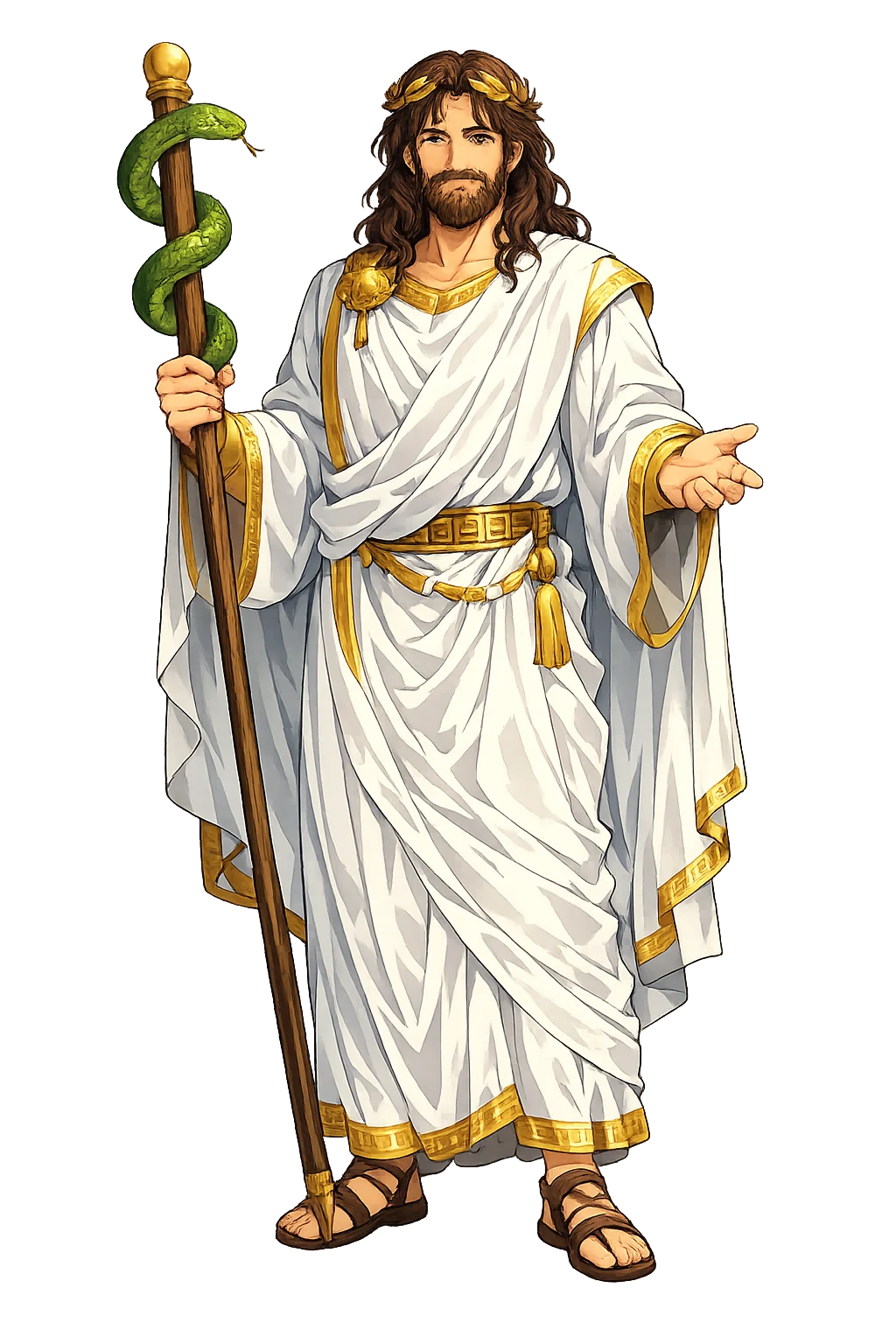
Recognize him by the company he keeps: a staff, a single serpent, a dog at his feet. The type is mature by the late fifth century BCE, when Attic red-figure painters already show the bearded, himation-clad healer leaning on his staff. Pausanias (2.27.2) describes the cult image at Epidaurus: gold and ivory, seated, wrought by Thrasymēdēs of Paros — the sanctuary's own masterpiece, known now from its inscribed base and its echoes. Roman copies carried the face everywhere: the Asklēpios of Milos in the Louvre and the Giustiniani type in the Vatican both descend from fourth-century originals. The serpent is the signature — one snake on one staff, a badge distinct from Hermês' paired caduceus — and the wound-licking dog appears in the visual record as early as the vases. On later gems and coins the god shrinks to an emblem: staff and snake alone.

06

Reception & Transformation

The name after its own age — transmission, translation, survival

Afterlives

He outlasted every other pagan god's working cult. Incubation sanctuaries ran into the third century CE, and Christian Rome did not so much destroy him as reassign him: healing incubation passed to Saints Cosmas and Damian, whose shrine received the same night-vigil patients, and the cock of the Phaedo became Sócrates' pious classroom anecdote. The name survived in the profession's charter — the Hippocratic Oath opens with him — and in Latin letters through Ovid's retelling of the snake's voyage (Metamorphoses 15) and Isidore's encyclopedia. Humanists rebuilt him from the sources: Pausanias was read anew, with his quotation of a cure inscription, and Renaissance medals and emblem books restored the rod-and-serpent as the learned sign of the physician. The nineteenth century dug him up — Kavvadias's excavations at Epidaurus from 1881 uncovered the sanctuary, the theatre, and the cure-inscriptions, turning temple medicine into a documented chapter of medical history; Edelstein's two-volume collection of the testimonies (1945) remains the field's foundation. From incubation ward to case-record to clinical trial, the institution he founded kept its first archive.

Identifications Across Traditions

Rome imported him wholesale during the plague of 293 BCE: the Sibylline Books prescribed his cult, an embassy sailed to Epidaurus, and the god came as a snake — boarding the Roman ship at Antium, coiling on the mast, and gliding ashore on the Tiber Island, where his temple rose within the year in the shape of a ship (Livy 10.47; Ovid, Metamorphoses 15.622–744, makes the snake’s journey the centrepiece of his Roman aetiology). The identification stuck for a millennium: the island still serves the sick. In Egypt the traffic ran the other way — Greeks identified the deified vizier Imhotep, whose healing cult flourished at Saqqāra and Memphis, as ‘the Egyptian Asklēpiós’, and Ptolemaic pilgrims left Greek dedications in his galleries. Through every translation the god kept his instrument: the single snake on the single staff, medicine’s signature in two civilizations.

Modern Legacy

His Rod — one snake, one staff — is the emblem of the World Health Organization, the American Medical Association, and thousands of medical schools, endlessly confused with the two-snaked caduceus of Hermês, a confusion institutionalized when the United States Army Medical Corps adopted the wrong staff in 1902. His sanctuary line ran unbroken into medicine’s institutions: the Hippocratic school grew up inside his temple at Kos, Galen served his cult at Pergamon before writing the ancient world’s greatest medical corpus, and the Hippocratic Oath itself opens by swearing ‘by Apóllōn the physician and Asklēpiós’ — the healer’s name is the second word of the profession’s oldest contract. His name still titles hospitals, journals, and medical software the world over. If any pagan god can be said never to have died, it is the son of Apóllōn: every pharmacy sign on earth is his votive offering, renewed nightly in neon.

07

The Meditation

What Asklēpiós means — beyond the dictionary

Asklēpiós is the god of the second opinion. He stands at the exact border between what may be cured and what must be accepted, and the thunderbolt that killed him marks medicine’s eternal question — not whether we can, but whether we should. Every healer who has ever weighed a risk against a hope has stood inside his sanctuary; every patient who has slept waiting for an answer has kept the old vigil under other names.

His instruments are modest for a deity: a stick, a snake, a dog, a dream. No lightning, no trident — the tools of walking, shedding, watching, sleeping, the four ordinary miracles on which all healing secretly depends. The iamata taught the ancient world to record outcomes; the cock teaches the modern one that gratitude has a price, small and exact, and that it should be paid.

08

Frequently Asked Questions

Common questions about Asklēpiós, Medicine, Healing, Renewal, and Unicode restoration

01How do you pronounce Asklēpiós?

In reconstructed pronunciation, Asklēpiós is /a.skliː.pi.ós/ — approximately ah-SKLAY-pee-OSS, with the stress on the ultima and a long ē.

02What does Asklēpiós mean?

Asklēpiós means Uncertain; possibly related to ἀσκαλαβώτης (lizard) or a pre-Greek healing root in the greek tradition.

03What are the symbols of Asklēpiós?

Asklēpiós is associated with The serpent (Renewal through the shed skin; the chthonic knowledge of roots and venoms), The staff (The physician's walking stick; authority without weaponry), The dog (The wound-licking guardian of the sanctuary floor), The cock (The vigil-bird sacrificed to him — Sócrates' famous last debt).

04Why are there different spellings of Asklēpiós?

Each form is a historically attested restoration rather than a mistake: Asklēpios is the macron-only form (LSJ convention: length only, no stress mark). PUNICODEX registers the full set so the tradition is preserved under every defensible spelling.

05Why restore Asklēpiós in Unicode?

Plain ASCII asklepios strips the stress, length, and script that make the name specific. Unicode restoration returns the name to its original written dignity.

06What is the most important myth about Asklēpiós?

“The Child of the Pyre” — the The Birth story that anchors the mythology of Asklēpiós, told in full on the lore page.

09

Scholarly Sources

The philological foundations of this restoration

Every claim on this page is grounded in established scholarship. The orthographic restorations follow disciplinary convention. The etymological chain follows the best available reference works. This is not invention — it is resurrection through scholarship.

◈

Lexicography & Philology

  • Liddell, H. G., Scott, R., & Jones, H. S. A Greek-English Lexicon. Oxford: Clarendon Press, 9th ed. 1996.
◎

Primary Texts

  • Homeric Hymns
  • Pausanias
  • Pindar, Pythian 3
  • Pausanias 2.26–27
  • Plato, Phaedo 118a
  • Apollodorus 3.10.3–4; Diodorus 4.71
◉

Archaeology & Art History

  • Material evidence — iconography, inscriptions, and temple archaeology — for Asklēpiós and related cults.
✦

Religious Studies

  • Edelstein, Asclepius: Collection and Interpretation of the Testimonies (1945)
Return

The Surface Awaits

You have traced the name from its earliest attestation to its Unicode restoration. Now return to the myth. The story is where the name lives.

Back to Lore
Asklēpiós mascot