PuniCodex

Extended Lore

𐬀𐬴𐬀 𐬬𐬀𐬵𐬌𐬱𐬙𐬀 Ašavahišta

Etymology · Orthography · Cult · Iconography · Reception · Sources

Tier 1 Ašavahišta.com
Ašavahišta — Truth, Righteousness, Fire
01

Quick Facts

Essential information about Ašavahišta, Truth, Righteousness, Fire

Original Script𐬀𐬴𐬀 𐬬𐬀𐬵𐬌𐬱𐬙𐬀
Unicode RestorationAšavahišta
Reconstructed Pronunciation/a.ʃaː.va.hiʃ.taː/
PantheonZoroastrian
DomainTruth, Righteousness, Fire
Meaning"Best Truth" — the Amesha Spenta of cosmic order (Aša), guardian of the sacred fire and the moral law
ClassificationTier 1
Primary DomainAšavahišta.com
Sacred SymbolsThe altar flame, The ašem-vohū verse, The winged sun, The molten metal
02

Etymology & Word Family

From original script to Unicode restoration

Original Script 𐬀𐬴𐬀 𐬬𐬀𐬵𐬌𐬱𐬙𐬀 Ašavahišta — ""Best Truth" — the Amesha Spenta of cosmic order (Aša), guardian of the sacred fire and the moral law"
Unicode Restoration Ašavahišta Restored stress, length, and script
Modern ASCII ashavahista Plain-ASCII fallback

The name Ašavahišta carries the orthographic signature of the zoroastrian tradition: 𐬀𐬴𐬀 𐬬𐬀𐬵𐬌𐬱𐬙𐬀. Unicode restoration recovers what ASCII flattens.

03

Unicode Character Breakdown

Character-by-character philological analysis

CharacterUnicodeNameBlockPhonetic Role
AU+0041Latin Capital Letter ABasic LatinSame, capitalized
šU+0161Latin Small Letter S with CaronLatin Extended-ASibilant š (palatal s)
—N/ADropped characterZoroastrian orthographyFuses with s into š
aU+0061Latin Small Letter ABasic LatinSame
vU+0076Latin Small Letter VBasic LatinSame
aU+0061Latin Small Letter ABasic LatinSame
hU+0068Latin Small Letter HBasic LatinSame
iU+0069Latin Small Letter IBasic LatinSame
šU+0161Latin Small Letter S with CaronLatin Extended-ASibilant š (palatal s)
tU+0074Latin Small Letter TBasic LatinSame
aU+0061Latin Small Letter ABasic LatinSame

The Tier 1 classification reflects how much of the original phonology this restoration preserves — stress and vowel length for Greek names, distinctive letters and diacritics for every other tradition.

04

Cult & Worship

How the sacred was kept — rites, sanctuaries, remains

The Cult

Aša Vahišta is worshipped through the sacred fire rather than through a human image. Sasanian kings patronized the great fire-temples—Adur Gušnasp at Takht-e Soleyman, Adur Farnbag in Fars, and the Atash Behram of Yazd, whose flame has been tended since the fifth century. Priests feed the fire with sandalwood and recite the ašem vohū prayer during the daily Yasna; the cult is thus continuous and conservative, centered on purity, luminous order, and a hereditary priesthood that maintains the sacred fire.

In the Earth

The fire-temples are his monuments: Adur Gušnasp at Takht-e Soleyman (Sasanian, UNESCO) — the shrine of kings; Adur Farnbag in Fars; and the working Atash Behram of Yazd, whose flame has burned since 470 CE. The Achaemenid reliefs of Persepolis show the fire-altar in royal worship, and the Gathas themselves — the oldest hymns of any living scripture — are his charter, preserved in the oldest Avestan manuscripts (K7, 14th c. copies of much older work).

05

Iconography

How Ašavahišta was imaged across the ages

The Image

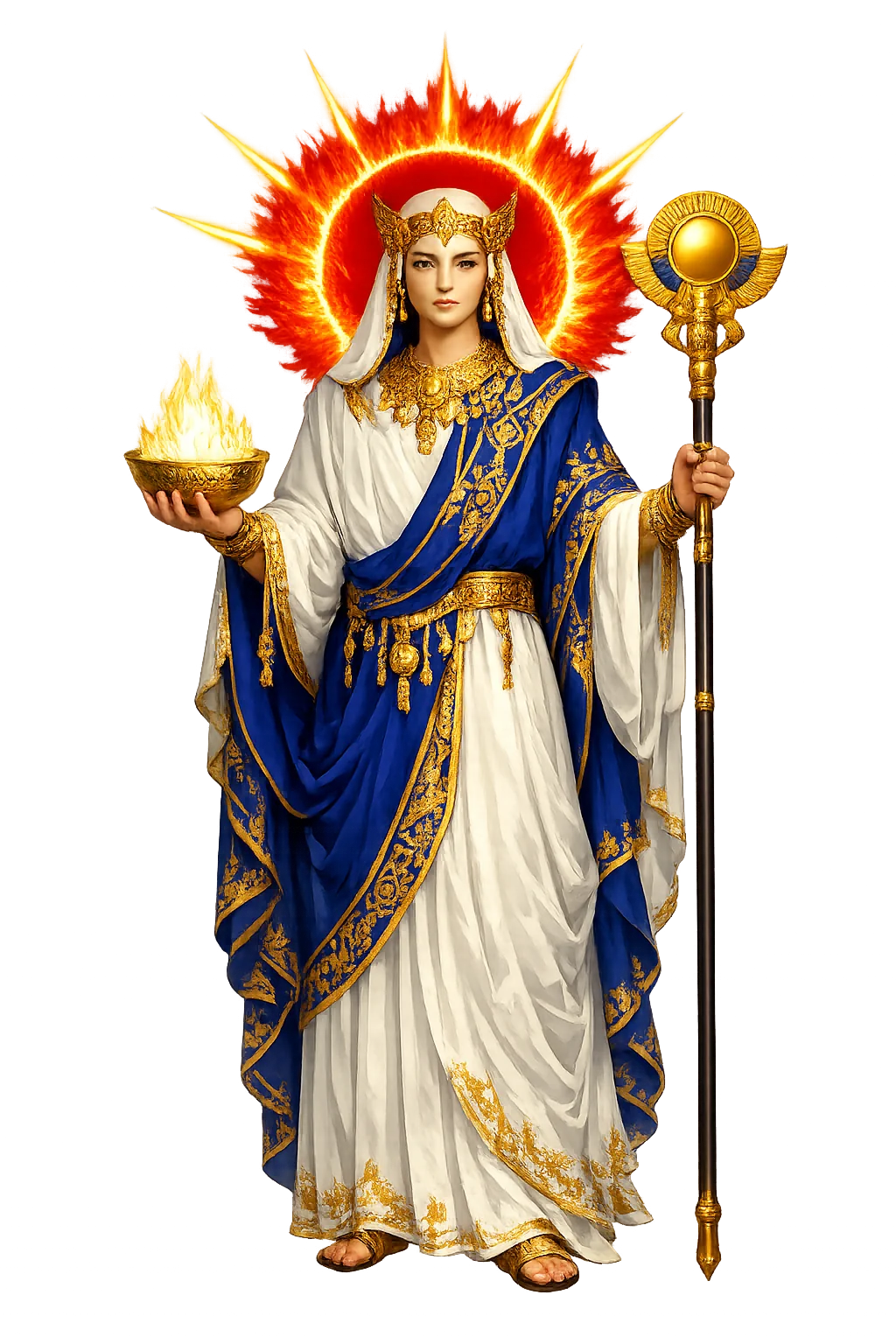
Zoroastrian orthodoxy forbids anthropomorphic images of the Amesha Spentas, so Aša Vahišta is represented aniconically by the fire-altar. Achaemenid royal inscriptions and Sasanian reliefs show the king or fravahr before a blazing altar, and Sasanian coins place the fire-temple on the reverse. The winged disk and the lotus-and-barsom motifs sometimes accompany the altar; modern Parsi art and community emblems use calligraphy, flame symbols, and the sacred ash on clothing, letterheads, temple textiles, ritual implements, and jewelry rather than a body.

06

Reception & Transformation

The name after its own age — transmission, translation, survival

Afterlives

The Gāthās preserved Aša Vahišta in the oldest stratum of the Avesta, and Sasanian priesthoods made him one of the seven great Amesha Spentas under royal patronage. After the Islamic conquest the cult retreated to Parsi communities in India and to isolated Iranian villages, keeping the fire-temples and the ašem vohū prayer alive through medieval rivayat correspondence. Nineteenth-century philology—Burnouf, Müller, and later Boyce—introduced him to Western scholarship and comparative religion, while contemporary Zoroastrian revival movements invoke his name as an ethical ideal. Modern Parsi communities in Mumbai and Karachi still recite his name in daily prayer, and diaspora publications in North America and Europe translate the concept of Aša into discussions of environmental and social justice. His afterlife is therefore textual, liturgical, and increasingly global, sustained by a small but tenacious diaspora.

Identifications Across Traditions

His cognate is the Vedic ṛta and its guardian: scholars pair Aša with the Vedic order-principle and note the shared Indo-Iranian root (*rtá/aša). In the Sasanian era his fire became state cult — the great fire-temples of Adur Gušnasp and Adur Farnbag bore his element as national shrines; and the Yasna's ašem-vohū verse ("aša is the best, it is happiness") remains the most-recited line of the living faith. He survives wherever the fire is kept: Yazd's perpetual flame is, by every account, still his.

Modern Legacy

He is the reason "truth" has a temple: the Zoroastrian moral tradition — good thought, good word, good deed — is his liturgy, and the fire-temples of Yazd and the diaspora are his addresses. The word "Asha" lives in modern Persian and as a common name across South Asia. Scholars read him as the hinge on which the Abrahamic heaven-and-judgment traditions later turned: the first theology of a universe audited for truth.

07

The Meditation

What Ašavahišta means — beyond the dictionary

Ašavahišta is the god of the honest ledger. Every institution, every code review, every signature, every exam proctor, every journalist and every judge works in his fire — the test of what is true. He asks the oldest question of any ordered life: is the fire you keep burning for warmth, for show, or for truth — and what, this week, have you fed it?

08

Frequently Asked Questions

Common questions about Ašavahišta, Truth, Righteousness, Fire, and Unicode restoration

01How do you pronounce Ašavahišta?

In reconstructed pronunciation, Ašavahišta is /a.ʃaː.va.hiʃ.taː/ — approximately ah-shah-vah-HISH-tah — two sharp š sibilants, even vowels.

02What does Ašavahišta mean?

Ašavahišta means "Best Truth" — the Amesha Spenta of cosmic order (Aša), guardian of the sacred fire and the moral law in the zoroastrian tradition.

03What are the symbols of Ašavahišta?

Ašavahišta is associated with The altar flame (The fire of the Avesta — his presence in every Zoroastrian temple), The ašem-vohū verse (The most-recited prayer of the faith: “Aša is the best, it is happiness” (Yasna 27.14)), The winged sun (The fravašis’ symbol he shares with the whole order), The molten metal (The river of ordeal-fire at the world’s end — warm milk to the truthful, burning to the deceitful).

04Why are there different spellings of Ašavahišta?

Each form is a historically attested restoration rather than a mistake: AšaVahišta is the alt form (Alternate Avestan orthography with explicit h before šta; canonical PuniCodex form is Ašavahišta). PUNICODEX registers the full set so the tradition is preserved under every defensible spelling.

05Why restore Ašavahišta in Unicode?

Plain ASCII ashavahista strips the stress, length, and script that make the name specific. Unicode restoration returns the name to its original written dignity.

06What is the most important myth about Ašavahišta?

“The Bounteous Immortals” — the The Council story that anchors the mythology of Ašavahišta, told in full on the lore page.

09

Scholarly Sources

The philological foundations of this restoration

Every claim on this page is grounded in established scholarship. The orthographic restorations follow disciplinary convention. The etymological chain follows the best available reference works. This is not invention — it is resurrection through scholarship.

◈

Lexicography & Philology

  • Cambridge
◎

Primary Texts

  • Gathas
  • Avesta
  • Rigveda
  • Yasna 30, 34, 43, and 47 (the Gāthās: the two spirits, the fire of Aša, the final ordeal)
  • Yasna 27.14 (the ašem-vohū prayer)
  • Insler, Stanley, The Gāthās of Zarathustra (Brill, 1975)
  • Rigveda 7.86 (Varuna and the Vedic cognate ṛta)
◉

Archaeology & Art History

  • Material evidence — iconography, inscriptions, and temple archaeology — for Ašavahišta and related cults.
✦

Religious Studies

  • Boyce, Mary, A History of Zoroastrianism, vol. 1 (Brill, 1975)
  • Skjærvø, Prods Oktor, The Spirit of Zoroastrianism (Yale University Press, 2011)
Return

The Surface Awaits

You have traced the name from its earliest attestation to its Unicode restoration. Now return to the myth. The story is where the name lives.

Back to Lore
Ašavahišta mascot