The Living Myth
Truth, Righteousness, Fire · The Best Truth · Keeper of the Sacred Fire
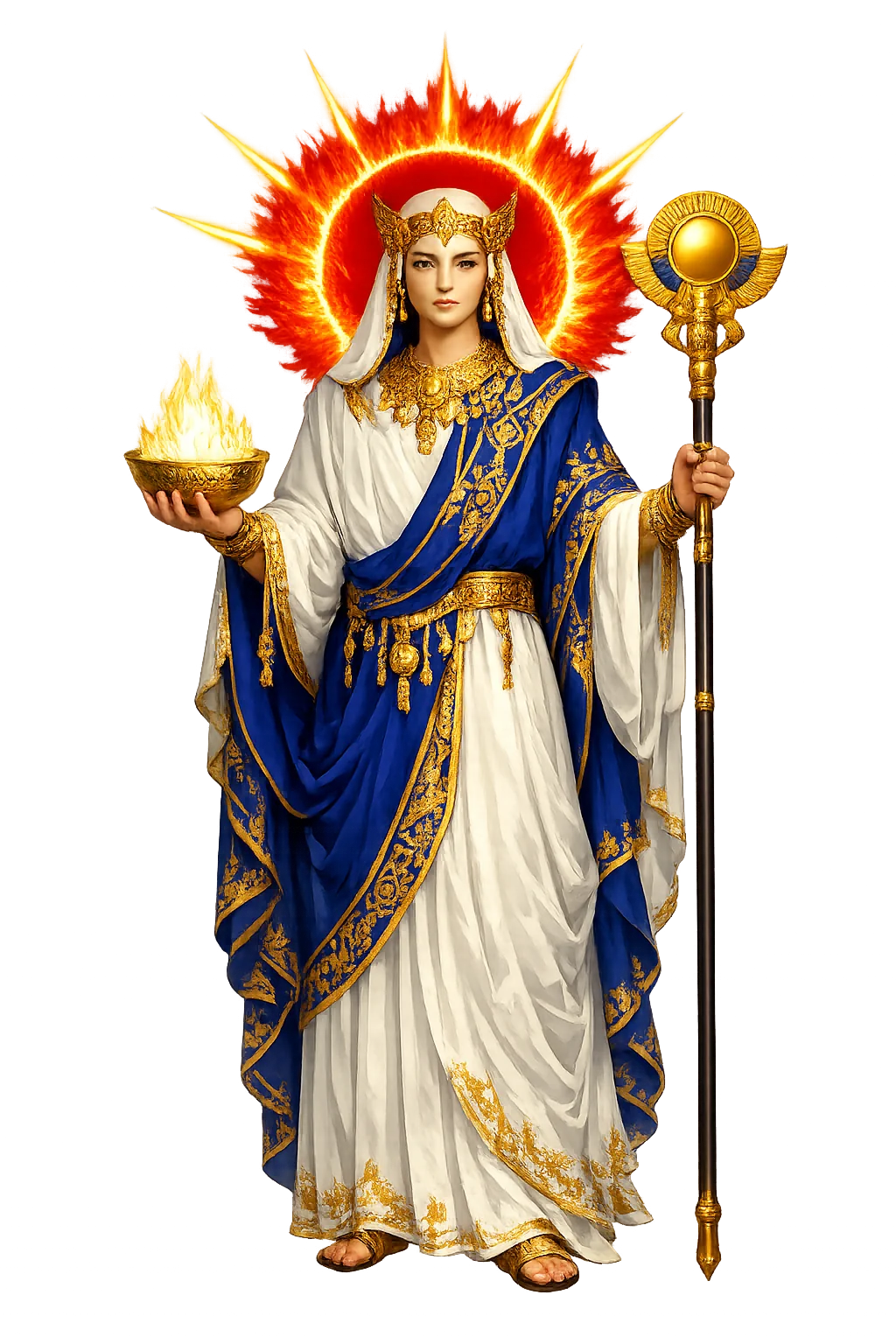
Stories of Ašavahišta
Ašavahišta’s mythology is the Gathas’ own theology made personal: truth not as an idea but as an immortal who must be fed, fought for, and kept alight. Every fire-temple flame is his dwelling, every honest word his territory, and the final fire of the world’s end his last and clearest sermon.
The Avesta’s great hymn-names them: Vohu Manah (Good Mind), Aša Vahišta (Best Truth), Xšaθra Vairya (Chosen Power), Spenta Ārmaiti (Holy Devotion), Haurvatāt (Wholeness), Amərətāt (Immortality) — the Amesha Spentas, the Bounteous Immortals who are at once Ahura Mazda’s powers and persons, his council and his limbs. Ašavahišta is the second, named beside Good Mind in the Gathas’ own theology: he is the Truth the Good Mind thinks, the order every right word and deed must match. In the earliest stratum he is not one power among others but the standard they all serve — the thing the two spirits contested at creation (Yasna 30.3–5), and the stake of the entire cosmic war between Aša and Druj, Truth and the Lie. Later tradition systematised the six into a household of creation, giving each an element, a metal, a month, a day; but the Gathas already meet him as a presence, not a principle — an immortal who must be fed with rightness and fought for, or lost.
His element is fire — not the destroyer but the tester. The Avesta gives fire to Aša Vahišta as his very domain: the altar-flame through which prayers rise — the Yasna calls it the most swift and powerful force of Ahura Mazda (Yasna 34.4) — and the ordeal-fire through which innocence is proven. In the Gathas, fire is the wisdom that discerns the true from the false in thought, word, and deed: swift to reward, swift to punish. Every Zoroastrian fire-temple keeps his presence: the flame tended in an urn for centuries without interruption is, in the faith, Ašavahišta made visible — the light that does not lie. Priests feed it five times a day with sandalwood and recite his verse over it; the laity honour it by refusing to defile it with breath, smoke, or the touch of the impure. A god of truth needs no statue: his icon is the one thing every honest eye can audit — a flame.
The Gathas’ whole drama is his: Aša against Druj — Truth against the Lie, order against deceit. “Now the two spirits, the twins known for their two thoughts, words and deeds… the better and the evil,” sing the Gathas (Yasna 30.3–4); at creation the good spirit chose aša and the evil one chose not-aša, and every human being inherits the same choosing, daily, in the only battlefield the cosmos finally has — speech. The righteous advance the world by good thought, good word, good deed; the deceitful tear at the fabric. Ašavahišta is therefore not a passive abstraction but the war’s front line: every true word spoken is his ground gained, every lie his ground lost. This is why Zaraθuštra’s own great crisis, in the Gathas, is not defeat by enemies but doubt among the deceitful (Yasna 46) — and why the creed’s most-recited prayer is his, the ašem-vohū: “Aša is the best, it is happiness — happy is the one who is pure in Aša for the sake of best Aša.”
At the end, the texts say, the world is tested by molten metal: a river of fire through which all humanity must pass — to the righteous, warm milk; to the deceitful, burning (Yasna 30.7–8; the Greater Bundahišn). Ašavahišta presides: his fire is the last instrument of the truth he has always been. The fravašis, the guardian spirits of the righteous, prepare the way; the Saoshyant, the coming Saviour, administers the test; and after it the world is made “wonderful” — deathless, without decay. The eschaton is not destruction but assay: the universe finally read for what it is. It is the weighing of the heart written in fire for all souls at once — the same scale, held at last over the whole world. That the final mercy should be molten is the faith’s deepest paradox: the judge of truth and the refiner of metal are one.
Righteousness, the Sacred Fire, and the Moral Order
Ašavahišta is the Amesha Spenta of Aša — "Best Righteousness": the Bounteous Immortal who is cosmic order itself, the truth the universe is built to run on, and the sacred fire that tests every soul and every word against it.
His element: the altar-flame of the Avesta, purifier and witness.
Cosmic order as a person — the truth against which all thought, word, and deed is measured.
One of the Amesha Spentas — the Bounteous Immortals who form Ahura Mazda's council.
Fire as the test: the Avestan ordeal that proves the truthful from the deceitful.
From the original script to the living URL
𐬀𐬴𐬀 𐬬𐬀𐬵𐬌𐬱𐬙𐬀
The name in its original Zoroastrian form. Ašavahišta (𐬀𐬴𐬀 𐬬𐬀𐬵𐬌𐬱𐬙𐬀) is attested in the source tradition — “"Best Truth" — the Amesha Spenta of cosmic order (Aša), guardian of the sacred fire and the moral law”. Its original diacritics and script distinctions carry the full phonetic and orthographic weight of the source tradition.
ashavahista
Reduced to plain ashavahista, the name loses everything that made it specific: original diacritics and script distinctions. What remains is an ASCII string that machines can parse but that no longer speaks with its original voice.
Ašavahišta
The Unicode restoration recovers what ASCII flattened. Ašavahišta restores original diacritics and script distinctions, returning the name to its original written dignity. The domain encodes to Punycode, but the browser displays the truth.
Ašavahišta.com → xn--aavahita-5wbf.com
The non-ASCII characters in Ašavahišta are encoded while the ASCII remains visible. To the DNS, it is Punycode. To humanity, it is Ašavahišta.
Owned, ideal, and ASCII forms of Ašavahišta
Ašavahišta
Restores 𐬀𐬴𐬀 𐬬𐬀𐬵𐬌𐬱𐬙𐬀. The live temple domain — ašavahišta.com.
ashavahista
Flattens 𐬀𐬴𐬀 𐬬𐬀𐬵𐬌𐬱𐬙𐬀. The plain ASCII fallback — what DNS and legacy systems see.
How Ašavahišta was spoken
How Ašavahišta travels from ancient script to the modern URL
The lore you have read is the living myth. Extended Lore opens the scholarly vault beneath it: the cult and its material remains, a history of the image, the name after antiquity, a meditation on what the name still means, and the full scholarly apparatus — etymology, orthography, sources.
Enter Extended Lore